Aaron’s sons Nadab and Abihu took their censers and, putting incense on the fire they had set in them, they offered before the Lord unauthorized fire, such as he had not commanded. Leviticus 10:1
Up to this point, all we know of Nadab and Abihu, other than the fact they were Aaron’s oldest sons, are their names. We are not even sure what exactly they did wrong to bring down upon themselves the fiery wrath of God. Were they even authorized to burn incense at this time? We know Moses was authorized “to take” Aaron and his sons (8:2), and Aaron “to take” a sacrifice (9:2), but there is no command here for Nadab and Abihu “to take” incense. Was it because they took their own private pans and did not use those specifically belonging to the sanctuary? Perhaps the ingredients of the incense were not of the specification for sanctuary use, emphatically forbidden in Exodus 30:9. The text does clearly say they used “unauthorized coals,” perhaps because they came from profane fires rather than from the altar.
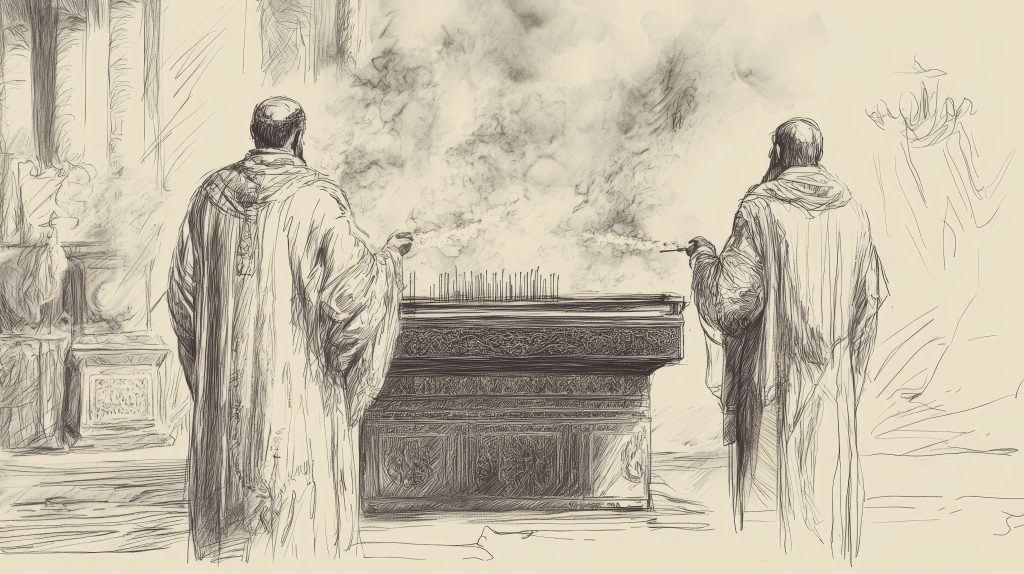
This sin, whatever it was, would seem to be covered by the reparation offering for sins concerning holy things, if it was done unintentionally. We are left to conclude they acted intentionally, or, as we shall see later, with a “high hand,” for which there is no cure. The result is frightening; fire issues out from “before YHWH” in the sanctuary, and they are consumed before the eyes of the whole community by the same fire that had just devoured the sacrifice for Aaron’s ordination (9:24). The effect of the first fire must have been stunning indeed, but the second fire, resulting in charred human corpses, must have been terrorizing. Moses, however, seems perfectly serene, without missing a beat addressing Aaron with these profound words:
This is what the Lord has said:
(Leviticus 10: 3, J. Milgrom’s translation)
Through those near to me I shall sanctify myself,
And before all of the people I will glorify myself.
“Those near to me” is a technical term describing those consecrated to YHWH having access to His sacred space, i.e. the priests. YHWH sanctifies Himself through those who have the privilege and responsibility of being near to Him. If they act improperly, they bring dishonor to YHWH before the people. If they act properly according to the forms of the rituals prescribed, they sanctify and glorify YHWH before the people.
These words put a complete stop to Aaron’s natural fatherly feelings of shock and grief. Stupefied, he held his peace. For Moses’ words carried another meaning; his son’s death brought glory to YHWH in establishing holy boundaries that must not be crossed. There is even the tradition which interprets the death of his sons, in spite of their infraction, as being translated into heaven because they died “before the Lord.” In fact, Jesus most likely draws from these words in His prayer, “hallowed be thy name,” and they may be behind the divine response to Jesus’ request “Father, glorify your name,” with “I will glorify it and will glorify it again [through Jesus’ death and resurrection] (John 12: 28, so J. Milgrom in Lev. 1-18). It is impossible to get into Aaron’s mind here, but he could have interpreted his tragedy as a very personal sacrifice he must bear given his role and example before the nation.
Moses’ cousins are directed to carry off the corpses in their own beautiful and ornate garments which now become their death shrouds outside the camp. Aaron and his two remaining sons Eleazar and Ithamar were to remain in the sanctuary and not show any signs of mourning on pain of death, although the rest of the community were allowed to mourn. The sheer immensity of God transcends earthly grief, even over a son, especially for those nearest to God through holy anointing. The gist of the matter came down to this crucial phrase which we elaborated on in our previous post What is Holiness Anyway, “You are to distinguish between the holy and the common, and between the unclean and the clean.” It is the priestly duty to teach these distinctions to Israel by word and deed.
At this point a puzzling infraction concerning the purification offering occurred. Out of respect for Aaron, who was ultimately responsible, Moses instead drills Eleazar and Ithamar for burning the whole of the offering rather than eating the priestly portions, and not bringing its blood to the interior of the sanctuary. Aaron’s response suggests that Eleazar and Ithamar died before it could be eaten, and because their bodies contaminated the sanctuary, the purification offering now stood for the sin offering, to be completely consumed. He bested Moses on a liturgical point! (So Milgrom).
Milgrom sees Nadab and Abihu’s act as heresy. Interestingly, it is the only narrative in Leviticus, and it follows the institution of the priesthood. It therefore parallels Israel’s act of heresy with the golden calf which follows the institution of the Covenant at Sinai (CC, p. 98). Being willful and careless with ritual and liturgical detail by those responsible in emulating holiness in sacred space is as dangerous as idolatry among the people. In fact, the two things may be connected. What was behind their action? Was it a rebellious heart? The prohibition against drinking immediately following the incident for Aaron and his surviving sons may suggest that Nadab and Abihu were drunk from the feasting when they offered the incense (so Jerome). Either way, this should be a warning to Catholic priests to humbly and reverently follow the prescribed rubrics for the liturgy and rituals, and not to carelessly do whatever they feel like doing. Unfortunately, this is not uncommon, and where this happens, the priests place themselves in mortal danger, and the people lose their sense of the holy.
Takeaway: Those consecrated to serve God in sacred things and sacred space must humbly and diligently follow the prescribed liturgy and ritual.
Questions:
- Given the fact that our culture, by and large, has jettisoned all formality and embrace improvising, how do you process in your mind and heart this terrifying incident?
- Can you give examples of priests who were lax in their liturgy and priests who were careful in their liturgy? How did you respond to their Masses?
Resources Used:
ACCS, vol. III, p. 175
Milgrom J. Leviticus 1-18, pp. 595-640
Milgrom, J. Leviticus, p. 98.