…Jesus [also] became the guarantee of an [even] better covenant. Those priests were many because they were prevented by death from remaining in office, but he, because he remains forever, has a priesthood that does not pass away. Therefore, he is always able to save those who approach God through him, since he lives forever to make intercession for them. It was fitting that we should have such a high priest: holy, innocent, undefiled, separated from sinners, higher than the heavens. He has no need, as did the high priests, to offer sacrifice day after day, first for his own sins and then for those of the people; he did that once for all when he offered himself. Hebrews 7:22-27
It is essential that we, as disciples of Christ, contemplate and turn over in our minds and hearts, all we have discussed in these first nine chapters of Leviticus in all of its meticulous detail. It all comes straight from heaven and is, therefore, timeless. To meditate on it is to meditate on the Eternal. Moreover, we must have a thorough understanding of these chapters to grasp the significance of Jesus Christ, our Great High Priest, and the Church with her sacraments, especially those of the Eucharist and sacred orders.
In our last post, we mentioned that Israel, upon the ordination of Aaron, was now prepared to live with YHWH and show the world His Glory on earth. Israel eventually failed her mission and was swept away, along with her temple and its high priest, by the Romans in 68 BC. It was not missed on the first generation of Christians that Jesus Christ, the Lord of time, planned this in tandem with His sacrificial death, thus antiquating the old order. Jesus Christ fulfilled these types and symbols of the high priesthood and the sacrificial system by becoming both High Priest and sacrificial victim. It is important to note that “fulfilling” is not the same as “abolish” when it comes to the law. Though antiquated, the law is still very much relevant. All the old transferred into the new.
The Church is the heir of all the riches of God, both old and new (Matthew 13:52). Thus we should not be surprised to see elements of the Mass and liturgies permeated by the old Hebrew and Jewish rituals. As for ordination, we must stress the foundational truth that the Church has only one high priest, Jesus Christ. Catholic priests stand in persona Christi Capitis where Jesus Christ presides as Head of the Church at every Mass through the priest. Jesus is physically present through the priest for the congregation. Like Aaron functioning in his office, the personality of the priest is not essential; it is all about the function, not the personality.
The ordained elders of the Church, called “presbuteroi” in Greek, from which we get the English word “priest,” are not priests in a mediatory way as we have in the Old Covenant (Hebrew kōhēn, Greek hieros). Christ is our one and only mediator. The presbuteroi are not mediators, but are sanctified to be Jesus Christ to the people in their priestly role, and channels of grace through the work of the Holy Spirit. Though the function is different from the old, they too must be transformed for this function through the liturgy of ordination.
We do not know what the ordination liturgy looked like in the first generation of the Church; we do see the laying of hands upon the ordinand. It is very interesting that under the old, the worshipper laid hands on the sacrificial beast, thus transferring guilt to the beast, and sending it to God. Hands are used by the priest, Jesus, both High Priest and victim, to consecrate the bread and wine into His Body and Blood.
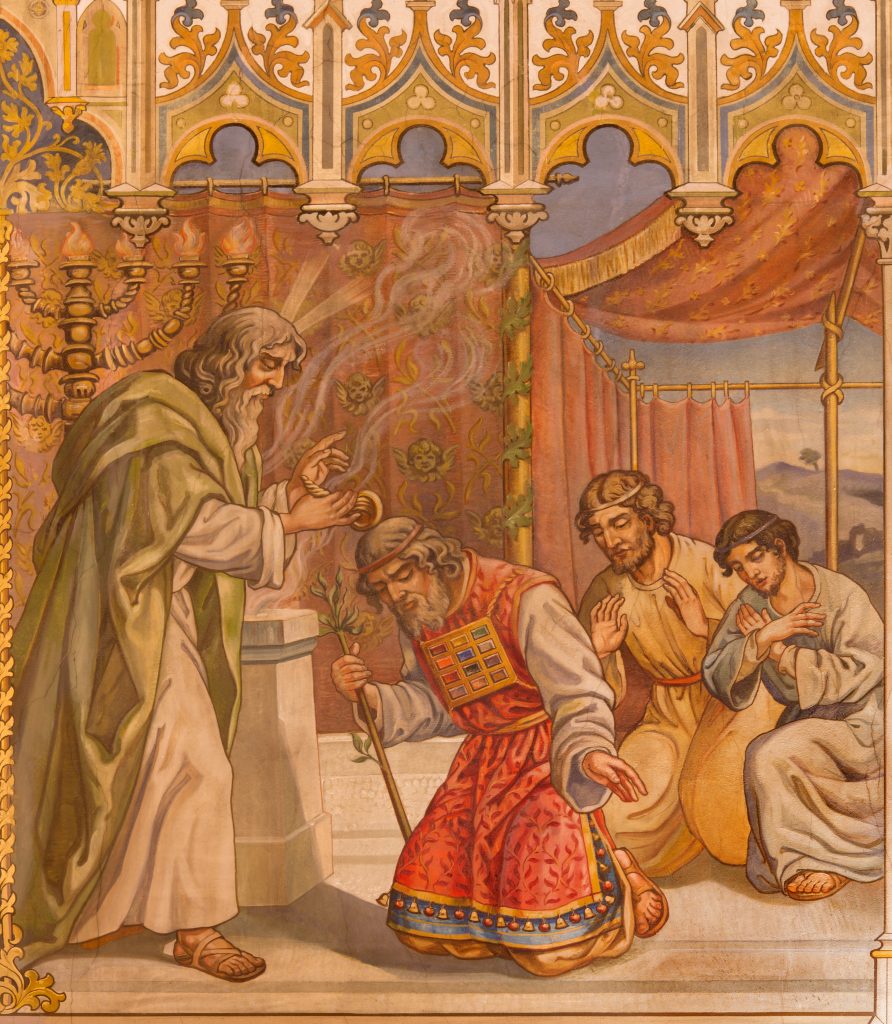
Our guilt is transferred to Christ who is our sacrifice. Just as the Aaronic sacrifices reach back in time and were accepted on the basis of Abraham’s willingness to sacrifice Isaac (the ‘aqedâ, see The Sublime Climax: Genesis 22), the Church’s Mass goes back in time to the Last Supper and the one and only sacrifice of Jesus on the cross. Just as there were sacrifices in the ordination of Aaron, so every ordination of a Catholic priest must be done in the context of a Mass. Chrism oil is rubbed into the hands of the priest, and although the term “filling of hands” is not used to describe Christian ordination, the idea seems appropriate. Ordination, no doubt, became more elaborate when the world converted to Christianity in the 4th century, especially in its ritual and vestments, but it was all done in the spirit of Moses’ vision of the heavenly temple and its high priest.
The first generation of Christians were predominately Jewish, and everything said above would make complete sense to them; it was their world. The modern attitude of egalitarianism, informality, individualism and congregationalism without hierarchy would be as foreign to them as automobiles. As for hierarchy and authority, all one needs to do is to go to the First Epistle of Clement, written by the Fourth Bishop of Rome, toward the end of the 1st century, and the one probably mentioned by St. Paul in Philippians 4:3 (57 AD). He naturally made the connection between high priest of the old with Jesus of the new, the priests of the old with the priests of the new, the Levites of the old and the deacons of the new (Chapter 40), and the laity of the old [with their role as a priesthood to the nations] and the laity of the new [common priesthood of the faithful].
The common priesthood of the faithful is indeed a priesthood in Jesus Christ with whom all believers are in union through the sacrament of baptism. The sacerdotal priesthood exists for the empowerment of the faithful. As we described the tabernacle with all of its functions as a universe in miniature, so too are we, the faithful in Christ, a universe in miniature, a microcosm of the whole. Origen brings this out with his famous allegory comparing worshippers bringing their offerings to YHWH under the old with Christians bringing their offerings to God through Jesus Christ in the new:
I do not desire that you seek all these offerings in visible animals nor that you think them to be found in mute cattle that ought to be offered to God. Seek these offerings within yourself and you will find them within your soul. Understand that you have within yourself herds of bulls, those that were blessed in Abraham. Understand that you have herds of sheep and herds of she-goats in which the patriarchs were blessed and multiplied. Marvel not that we say these are within you. Understand that you are another world in miniature and there is within you the sun, moon, and stars ... Since, therefore, you see that you have everything that the world has, you ought not doubt that you also have within you animals that are offered for sacrifices and from these you ought to offer sacrifices spiritually.
Homilies on Leviticus, 4.3.
Takeaway: The old covenant high priesthood was fulfilled in Jesus Christ; the sacerdotal priesthood (i.e. priests) of the Church makes Jesus physically present as presider of every Mass in persona Christi Capitis.
Questions:
- Can you explain your understanding of the High Priesthood of Christ Jesus, and how it emerges out of the Aaronic priesthood?
- How did we get our English word “priest” and how does this factor into the role and function of priests in the Church?
- How do you process the Origen quote above? Does it make sense to you?
Resources Used:
Clement of Rome, First Epistle, Chapter 20.
Origen, Homilies on Leviticus, 4.3.