You shall be holy; for I the Lord your God, am holy. Leviticus 19:2
“… you shall love your neighbor as yourself: I am YHWH.” Leviticus 19:18
You shall treat the alien who resides with you no differently than the natives born among you; you shall love the alien as yourself; for you too were once aliens in the land of Egypt. I, the Lord, am your God. Leviticus 19:33
We mentioned at the outset of our journey into Leviticus how it is strategically placed at the center of the Pentateuch. We go further and say that Chapter 19 is structurally placed at the center of Leviticus, making it central to the whole of Torah. It incorporates elements of the Ten Commandments, mixing ritual with ethical laws governing the warp and woof of Israel’s day to day life. Holiness is centered in sacred space, the Tabernacle of YHWH’s presence, but it emanates outward to the whole land through right moral conduct.
It all begins with the grand sweeping statement that says it all: “You shall be holy; for I the Lord your God, am holy.” In pagan culture, the gods act like humans and are created in humanity’s fallen image. In Israel, humanity must conform to YHWH who reveals Himself by means of revelation, His law. It begins with the Fourth Commandment of honoring parents, something the whole human race knows through natural law, but is codified in Israel. Then the Sabbath law, the Third Commandment, is briefly stated. The phrase “I am the lord your God,” which prefaces the Ten Commandments, is placed here before and after the First Commandment prohibiting idols, and occurs twelve more times throughout the chapter in an emphatic cadence. YHWH sees everything, and all life is lived before YHWH, the ultimate enforcer of His laws.
YHWH gives His people the privilege of caring for the poor and aliens by leaving gleanings from the field and fallen grapes from the vines for them to gather (vv. 9-10). This generosity spirit is next contrasted to stealing, the Seventh Commandment, followed by lying and swearing falsely in courts, the Eighth Commandment, thus profaning the name YHWH, the Second Commandment (v. 12). At this point this code of laws departs from the Ten Commandments, curiously not specifically addressing adultery, the Sixth Commandment, nor the Seventh (murder), nor the Ninth and Tenth (coveting things, neighbor’s wife/concupiscence). However, the Sabbath law is repeated in v. 30.
From here on out, the emphasis is on justice and how the Israelite should deal with one another, aliens, and the land upon which they lived. The word for justice in Hebrew is mišpaṭ, and it is used heavily by the 8th Century prophets, such as Isaiah, Malachi, Amos, and Hosea, in a time when Israel was prosperous, and became arrogant and self-centered. This is also the time when H, that is, this Holiness Code, according to scholars, was developed, sharing the same concerns as the prophets. Justice in the day to day looks like this: the powerful must not oppress the weaker, curse the deaf, or set up a stumbling block for the blind to trip over (vv. 13, 14). Justice in a court of law means to be impartial, whether to the poor or rich, and not to destroy your neighbor’s reputation or life by lies (vv. 15-17).
At this point, in the center of chapter, which is at the center of Leviticus, and in turn at the center of the Pentateuch, the fundamental issues of hate and love surface. Hate is destructive: we must not hate one’s kinsman in one’s heart, but go directly to that person with one’s complaint, and work it out, if possible. This shows respect to both the offender and offended, and snuffs out the opportunity of sin to take hold in either’s life. Moreover, one must not seek vengeance for wrongs done. In other words, justice and its implementation cannot be a private affair. Rather, one must “love your neighbor as oneself” (vv. 17-18). This in a nutshell encapsulates the whole ethical responsibility an Israelite has toward his neighbor, and it is placed structurally at the very heart of the Pentateuch.
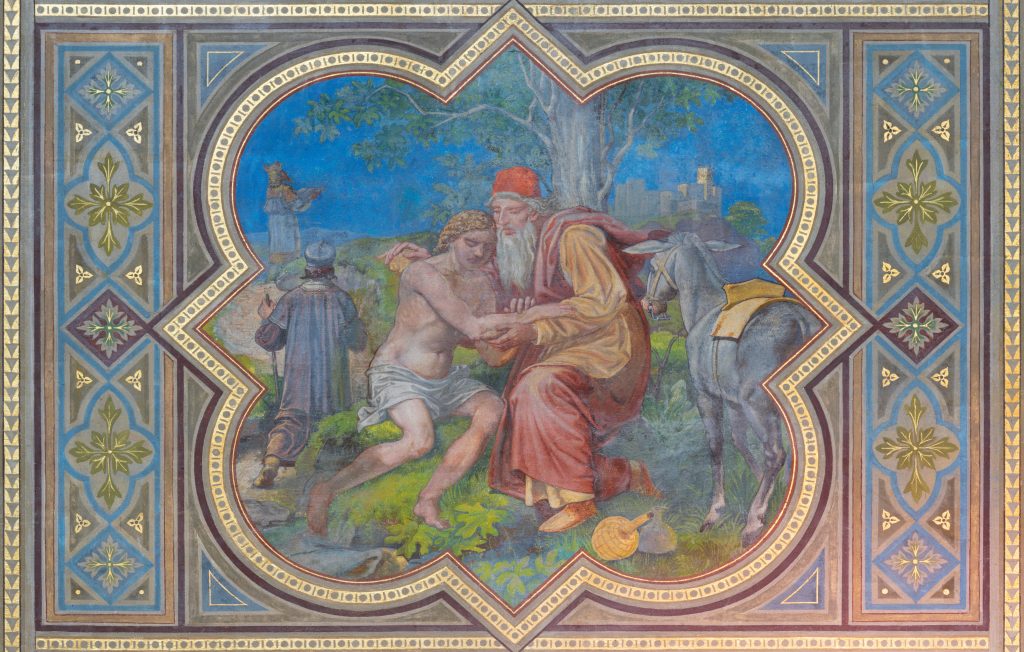
Love can be commanded because it is “not only an emotion or attitude, but also deeds” (Milgrom, p. 234). Just as worship is an act (Hebrew ‵ābȏdâ, “work,” Greek leitourgia from which we get our English word liturgy), so love is expressed in action, an act of the will. But the “as yourself” adds a deeper dimension to the command. Just as we instinctively look to ourselves for our own wellbeing, so this command must build within us an instinct to look to the welfare of others. This command is designed to counter the instinctual hardness of heart from the fall of man expressed in Cain’s cold response to God, “Am I my brother’s keeper?” Hidden in this command is a return to, and experience of, paradise lost, where love reigns, and selfishness melts away. When this happens, the emotions of love cannot help but follow.
The rest of the chapter gives us a smattering of laws intended to cause the Hebrews to reflect daily of their holy calling in life. Mixtures are not allowed in the common sphere (cattle, sowing seeds, or materials); it is only reserved for the holy sphere (e.g. winged cherubim in the Most Holy place, mixture of cloths of holy garments). Mixtures of animals in the common sphere are monstrous, contra creation. Then comes a law specifically addressing adultery between a Hebrew man and a slave girl betrothed to another man. Normally this would be a capital crime, but since the woman is a slave with no legal rights, atonement can be made through sacrifice (vv. 20-22). Fruit is to be nipped in the bud (lit. circumcised) from trees for their first three years of life, and the fourth year’s fruit is considered holy and to be joyfully given to YHWH (vv. 23-24).
Eating flesh with blood in it was prohibited in the Noachian Covenant. Here it is listed with the practice of witchcraft (nāḥaš), casting of spells meant to alter the course of the future, along with pagan practices associated with the cult of the dead. Fathers must not give their daughters up to prostitution, whether secular (for money), or cultic, thus defiling the land (vv.26-28). Necromancy is condemned because it was associated with the worship of the dead, as well as conjuring up ghosts for the purpose of viewing the future (I Sam. 28:15). This places these occultists in direct opposition to the legitimate prophets of Israel, as well as the High Priest with his Urim and Thummin (See Priestly Garments and the Urim and Thummin Post).
The chapter ends with the admonition to revere the aged, and the radical command to love the resident alien “as yourself,” just like one’s neighbor. Behind this is Israel’s own experience as slaves in Egypt. Again, love means treating the stranger as one would be treated themselves. All business must be conducted with absolute integrity.
Takeaway: The heart of this chapter is the command to love neighbor, as well as the stranger, as oneself. This lies at the heart of Leviticus, and therefore, the whole Pentateuch.
Questions:
- How does this commandment to love one’s neighbor as oneself connect with the overall idea of holiness as we have discussed in Leviticus so far?
- What does this commandment tell us about the nature of God?
Resources Used:
Milgrom, J. Leviticus, pp. 212-245.