We now enter into the last part of the Book of Leviticus which scholars call “The Holiness Code,” simply referred to as “H.” Rabbi J. Milgom, the greatest scholar of Leviticus in modern times, is convinced it was a compilation of laws dated after 750 BC, but before the exile of 586 B.C., probably associated with the Temple in Jerusalem. This H “school” added its materials to the older priestly “P” laws of Leviticus 1-16, whose origin was associated with the old sanctuary of Shiloh to the north, and redacting the Book of Leviticus to its final form. This, as we said above in the post The Literary Structure of Leviticus: Circle of Life and Holiness, does not mean these bodies of legislation are not Mosaic, but are built upon the Mosaic foundation given centuries before. On one hand, law must be founded on fundamental authority and unchanging principles, like the U.S. Constitution, but it is by nature dynamic in its application to changing times.
This new priestly school of H focuses on moral purity whereas P focuses on ritual purity. P is concerned with the holiness of the tabernacle, whereas H expands the domain of the holy from the tabernacle to the whole land, and from the priests to the whole of Israel. H tends to be egalitarian where everyone has access to the holy, and is mindful of resident aliens. These two sources are bound together in one book now called Leviticus, H respecting the older source P in spite of differences of perspectives and applications. Moreover, H intentionally ordered its material to parallel the laws of P in the circular structure we saw in the afore mentioned The Literary Structure of Leviticus: Circle of Life and Holiness, which we again display:
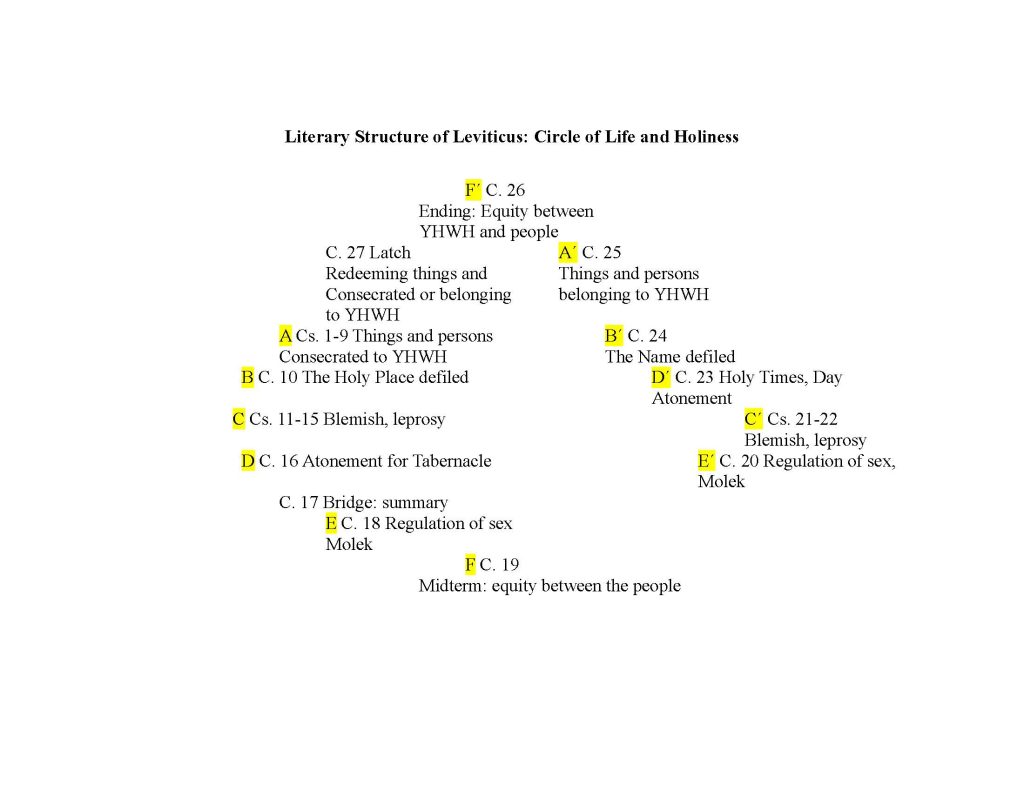
Chapter 19 is placed in the structural center of the whole book, and introduces H’s main theme of holy living, as we shall see. This chapter is “hugged” on either side by Chapters 18 (E) and 20 (E′), both concerned with sexual perversions associated with pagan practice, specifically Molek. Chapter 17, to which we now turn our attention, functions as a “bridge” (Milgrom), or a “hinge” (Wenham) linking the two halves of the book. It functions so by harkening back to the ritual sacrifices of P, but the focus is not on the priests and sanctuary so much as the Israelite, and even the resident alien, outside the camp, the main concern of H.
Here in Chapter 17 we have several laws regulating the secular slaughter of animals. We saw earlier in Chapter 11, and our post Meat on the Menu, what kinds of animals may be eaten, which were very few. The first law concerns animals approved for sacrifice slaughtered for secular purposes within the camp, or outside the camp, for the home table (17:3-7). They must be slaughtered at the entrance of the tent and offered as a peace offering officiated by a priest, the blood sprinkled on the altar and the fat burned on the altar as a soothing aroma to God. This was to prevent the pagan ritual of blood offered to satyrs. Should anyone fail to do this, they are to be “cut off” from the covenantal community, living a Cain-like existence, though not protected like he was from the wrath of God and man. It is a capital offence without direct execution. This was to be a permanent law (v.7), and H is assuming multiple sanctuaries to accommodate Israelites living far from the Tabernacle (Milgrom, p. 190).
The second law reiterates what is the assumption throughout; any sacrifices must be done in sacred space devoted to YHWH (17:8-9). This is to counter the ever present danger of sacrificing to demons and/or deities in pagan shrines ever present throughout the land. Again, the punishment was to be “cut off” from the people.
The third law focuses on blood; eating of it was strictly forbidden, for “the life (Hebrew nepeš) of the flesh (Hebrew habbaśar) is the blood (Hebrew baddam). The word for blood (dam) has a preposition “in” (ba) literally translated “in the blood,” but is used here expressing essence and therefore to be left out in translation, “is the blood.” Both humans and animals alike have a “life” (nepeš) within the body identified physically with the blood, even though animals do not have a “soul” in the human sense, a direct result of God breathing His image into Adam, Genesis 3:7). This life, this blood, must be given back to God properly through sacred ritual, at the altar, or if wild game in the open field, drained in the earth and covered up (17:13). On one hand, hunting is as old as historical man after the fall. On the other hand, a dread of killing and blood shedding is equally universal. But consider Milgrom’s bold statement; “However, Israel is the only people that codifies this sensitivity to animal life, converting this ethic into law” (p. 191).
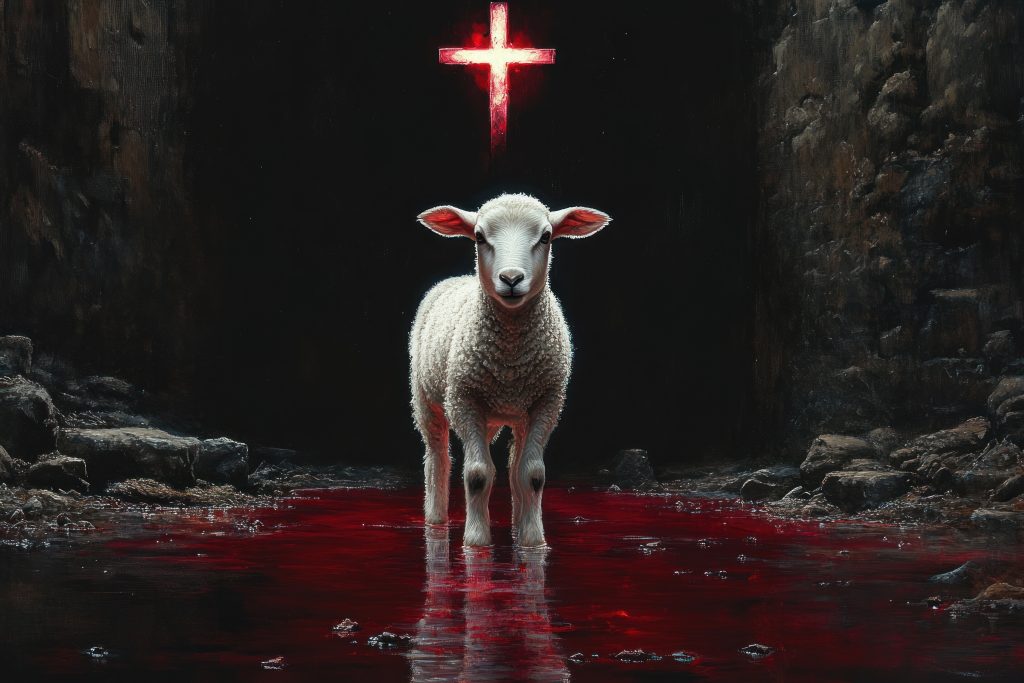
We conclude with three essential truths about life-blood of animals. First, the Hebrews were taught to deeply respect animals. Killing and eating was allowed only under the strictest of boundaries. Second, the eating of blood was absolutely prohibited. This separated them from the pagans who ingested blood for its magical properties and powers. Finally, the blood, because it is life, and life is most holy, makes atonement for sin if done properly at the altar.
As Catholics we can readily see how Jesus’ blood-letting on the cross, although not literally done at the altar, fulfills the sacrifices of old, making atonement for the sins of the world. Blood is life, and life is the most precious substance in the material world, especially the blood of the God-man Jesus. What is absolutely scandalous in view of Levitical law is that Jesus invites us to drink His blood transformed at the Eucharist. Whereas it was an unholy mixture to unite human life with animal life-blood, now human life is elevated to eternal life through the ingestion of Jesus’ blood. Both Jesus’ body, as the fulfillment of the animal sacrifices of old, and His precious blood, perpetually penetrate human existence from every altar as the world turns since the very first Eucharist instituted by Christ.
Takeaway: Life is identified as blood in Levitical law. It is contagiously holy if handled with utmost care, or contagiously impure if handled carelessly, and must never be consumed.
Questions:
- How do you respond to the idea of Leviticus being the compilation of two sources dubbed “P” and “H,” both presented to the reader as “Mosaic?”
- It is unsettling how much bloodshed there is in our society, and how blood it is portrayed on social media. Why the fascination?
- Humans tend to take blood by violence, some give blood to blood banks for others. How does Jesus’ blood fit into this scenario?
Resources Used:
Milgrom, J. Leviticus: A Book of ritual and Ethics, in A Continental Commentary, Fortress Press, 2004.
Wenham, G. The Book of Leviticus.