On the eighth day Moses summoned Aaron and his sons, together with the elders of Israel … Moses and Aaron went into the tent of meeting. On coming out they blessed the people. Then the glory of the Lord appeared to all the people. Fire came forth from the Lord’s presence and consumed the burnt offering and the fat on the altar. Seeing this, all the people shouted with joy and fell prostrate. Leviticus 9:1, 23-24
The sacrificial system established, the narrative picks up again from Exodus 40, where the glory of YHWH, descending from Mount Sinai, fills the Tabernacle, and rests upon the Ark of the Covenant in the Most Holy Place. YHWH speaks to Moses from the Tabernacle in the midst of the Congregation, no longer from the “Tent of Meeting” located “outside the camp” because of Israel’s sin (Exodus. 33). Aaron and his sons are summoned before the Tabernacle in their vestments described in the heavenly vision (Exodus 28), and then made (Exodus 39). The whole congregation, which previously cowered before God at Mount Sinai (Exodus 20), is commanded to assemble into the court of the Tabernacle. How this relatively massive congregation could fit into such a small space is not explained, but considered a miracle by the ancient commentators.
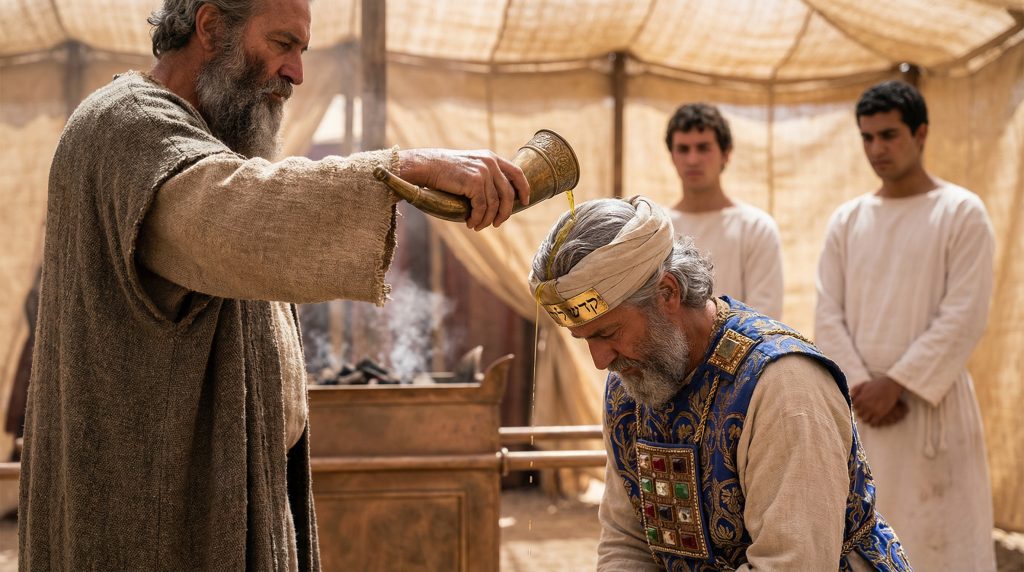
The ordination of Aaron is a cosmic event. His vestments were designed in heaven, containing all the colors and gems that unite heaven and earth (See Priestly Garments and the ′ûrîm & Tummîm under Exodus). People with official positions wear garbs associated with their office, and the higher the office, the more elaborate they tend to be. Aaron’s position is the most important one on earth, and his vestments reflect that. He must come with sacrificial animals for the purification offering, the burnt offering, the peace offering, and grain for the cereal offering. Neither YHWH nor Moses bring up Aaron’s part in the sin of the golden calf, and there is a passing reference in Exodus 40:29 to an offering of the holocaust upon the newly made altar, but we are to conclude that these offerings atoned for this sin, and did not jeopardize his position. As weak a human Aaron may have been, especially in comparison with his brother Moses, his new vestments emphasize the importance of his office over the man wearing them. Aaron as High Priest is about to become more important than Moses in terms of position in the cult.
Ordination is a divine act upon a person through a divinely prescribed ritual. It is not a mere ceremony celebrating someone’s promotion to a position in a community. This divine act brings about an existential change in the person; he was one thing before, and quite another thing after. It may or may not show itself outwardly in charismatic way as we see, for instance, in the prophets of Israel. The phrase used for ordination is “filling the hand” (Exodus 28:41, 29:9, Leviticus 8:33). Commentators do not seem to be quite sure what this phrase meant in the ancient Hebrew culture, but it does seem reasonably clear that God works grace to His people through the hands of the priest. We might say he is “configured” for a most sacred task, in this case, being the mediator between YHWH and humanity.
As for the ritual, Moses himself functioned as a High Priest transferring authority to Aaron. He washed Aaron and his sons, dressed them in their designated vestments, with special reference to Aaron’s breastplate and turban bearing the golden plate inscribed with the awesome words “Holiness to “YHWH.” Moses then anointed the whole sanctuary with oil, all of its equipment, sprinkling the altar seven times, and pouring the oil over Aaron’s head, engulfing the whole of his being. The first offering was a bull for the purification offering, sanctifying the altar with its blood applied to the horns of the altar, and by pouring the blood before it. Then a ram was sacrificed for the burnt offering, and a second ram for the peace offering, specifically referred to as the “ordination ram” (′ēl hammillu′îm, Lit. “ram of the filling”). Curiously, Moses dipped his finger in its blood and applied it to the right earlobes, right thumbs, and right big toes of Aaron and his sons. This suggests the consecration of their faculty of hearing, the works done with hands, and the places they go, but could simply be an instance of synecdoche (the part standing for the whole), the right side considered superior than the left. Its blood was sprinkled on Aaron’s robe and that of his sons, with oil.
After this ritual, Aaron and his sons had to remain in the sanctuary for seven days to complete the ordination process. It takes only a moment to sin and become defiled, but it takes time to recollect the mind and let the reality of what God has done by ritual to sink into the interior. Aaron is now, like Moses, a “cosmic man”; he will not be able to function in his new role until seven days, symbolizing the seven days of creation, are fulfilled. Failure to obey means certain death; it is dangerous being the High Priest dealing with sacred things.
After the seven days, on the eighth day, reminiscent of John Chapter 20 where the world woke up to a whole new week of existence, the world was also changed at this moment as well, for God once again lived on this earth in the midst of His chosen people Israel with provision for holiness through worship and sacrifice. Aaron served his first liturgy as High Priest, the Glory of the Lord appeared to all the people, and the fire of God consumed the sacrifice, before which all fell to their faces to the ground in fear and awe (Chapter 9). Aaron became mediator between God and Israel, and Israel was to present YHWH to the nations.
This profound moment in the history of the world is captured well by Radner who quotes the Rabbis:
In the sequence of praise that begins Rabbah 11, this centering [the tabernacle as the foundation of the whole world] is used to explain the continuity of the world’s history … from the creation to the temple to the giving of Torah to the final eschatological feast – all is undergirded by the consecrated reality that attends Aaron’s initiation into the priesthood, whereby the glory of God is joined to the earth in the form of Israel and extended in all directions temporally by the sacrifices themselves. Later explanations of an earthly and heavenly sanctuary mirroring each other and opening up the world of angels to the human world maintain this sense (Numbers Rabbah 12.12; see also Ginzburg 1911:3.185). The point here is simply, but massively, that Aaron’s time provides a vision of the whole creation’s time as given by God.
Takeaway: Aaron’s ordination as High Priest is a consecration that fundamentally changed his very nature, enabling him to carry out his cosmic role as mediator between YHWH and His people.
Questions:
- The ordination of Aaron configured him to preside over sacrifices as mediator, but it clearly is not personality based; it is all about his liturgical function. What do you think about this fact, especially living in our culture that is so personality based?
- How do you process in your mind this rather esoteric idea of the cosmic significance of Aaron’s ordination?
Resources Used:
Radner, E. Leviticus, pp. 87-90.
Wenham, The book of Leviticus, pp. 135ff.