The tabernacle itself you shall make out of ten sheets woven of fine linen twined and of violet, purple, and scarlet yarn, with cherubim embroidered on them. Exodus 26:1
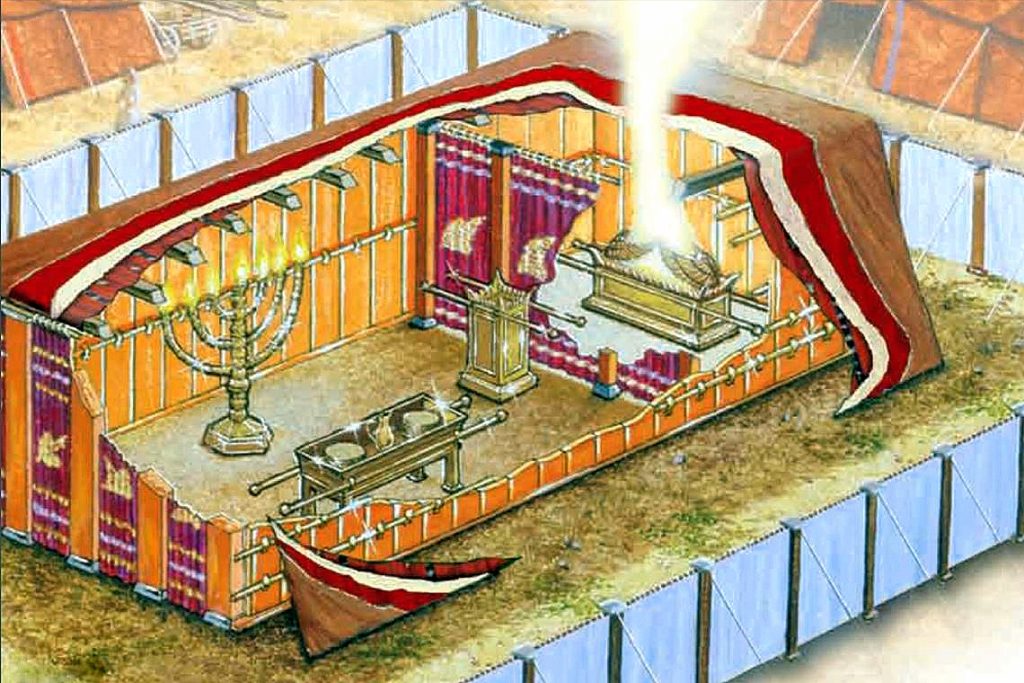
The foundational “furniture,” or articles, of the tabernacle described, Moses’ vision takes us to the walls, interior tapestries, and exterior coverings of this tent sanctuary. The description begins with the tapestry: 10 splendid curtains, each 28 cubits long and four cubits wide. They were made with fine linen woven with blue, purple and scarlet “stuff,” decorated with cherubim. Five were sewn together to make one set, and five sewn together to make a second set. These two sets were clasped together by 100 loops of blue fabric and 100 clasps of gold, making one tapestry of 40 cubits long and 28 cubits wide. The whole is made up of two parts for the practical reason of portability and packing away when the tabernacle moved with the people.
The framework over which this tapestry was laid was made of planks of acacia wood overlaid with gold. Each one was 10 cubits high and one and one half cubits wide; we do not know how thick they were. When fit together, embedded in bottom sockets of silver, the north and south walls measured 30 cubits.
The western wall, at the back, was made of six planks measuring 10 cubits, joined to the side walls with corner planks. When the 40-cubit veil was stretched over these framed 30-cubit walls of gold, an excess of five cubits hung over the back and five cubits over the entrance. Since the veil was 28 cubits wide, it never touched the ground along the flanks of the north or south side, but were attached to the outside walls by pegs a cubit from the ground (Cassuto, p. 351).
The interior veil, separating the Most Holy Place from the Holy Place, called the pârōket inHebrew, was made of fine linen, like the tapestry, of the same colors and cherubim design. We surmise the pârōket was of light weight, thin enough to let light through. It hung on four pillars of acacia wood plated with gold. This made the Most Holy place a perfect square of 10 cubits, each side approximately 15 feet. The Holy Place was a rectangle 20 cubits long and 10 cubits wide. The “doorway” was a screen similar to the pârōket in material and color, but without the cherubim, and supported by five pillars of acacia wood plated with gold.
Over all this beauty and splendor was a curtain of goat’s hair. It was made of 11 sections, one more than the interior curtains, each 30 cubits long and four cubits wide. Like the interior curtains, they were sewn together in two parts, one with five sections, the other with six sections. They were joined by 100 loops of unknown material, and 100 clasps of bronze. The total length was 44 cubits. When draped over the tabernacle, the side curtains were buttoned down at ground level, 12 cubits were draped at the back, and two cubits’ excess in front to fold over the entrance for protection. Over the top has laid goat and ram skins dyed red. “What did the tabernacle resemble?” according to the Talmud, “A woman walking down the street with her train trailing behind her” (Cassuto, p. 353).
The tabernacle was enclosed within a court. It was constructed with curtains made of linen, presumably white, which hung on wooden rods by silver hooks supported by pillars anchored in bronze sockets. The dimensions were:
- north and south sides: 100 cubits long with 20 pillars, five cubits apart
- west side: 50 cubits long
- east side: divided into three parts, 15 cubits apiece. On either side of the entrance was a curtain of the same construction of the north and south sides.
- entrance: 20 cubits long, made of the same beautiful colors as the screen of the doorway of the tabernacle. This entrance was affixed only at the top of the supporting poles so those who entered had to lift up the curtain to enter.
Ceremonial Law Fulfilled in Christ
This tabernacle is symbolic of the human person, made in the image of God, and more specifically, to Jesus Christ incarnate, the perfect image of God. The tri-partite structure indirectly refers to the Holy Trinity, and is reflected in the three-fold structure of the human being: spirit, soul and body. There is within us a Most Holy inner sanctum where the Divine Spirit touches the human spirit, which is too deep and profound for us to fathom. This room with the ark, housing the Law of God, its “mercy seat” with Cherubim above which divinity sits enthroned is a place of mystery. The Holy Place with its Table of the Bread of Presence, the Lampstand and the Altar of Incense, which we will discuss later, represents the soul of a person. Bread of sustenance, both spiritual and physical, light to illumine the spirit and soul, and the smoke ascending in prayer, are all representative of the powers of the soul such as the will, intellect, imagination, memory, conscience, and emotions.
The splendid inner veil is the immortal lining of the soul. The color blue is significant in that it symbolizes the sky, the heavens, and the spiritual realm. The red is the color of the earth and the blood of our humanity. These two colors, when joined, produce the deep and rich color purple, the integration of heaven and earth, the spiritual and physical, transcendence and immanence. The woven cherubim bond our humanity to that of angels and the angelic realm. The golden walls of pure gold reflect the glory of our immortal nature; certainly the priests going about their functions in the Holy Place would see the reflection of their faces in the gold. This corresponds to the interior recollection of our souls in meditation and contemplation.
The exterior veil of goat hair and the red-dyed ram skins on top certainly serve the practical function of protecting the inner sanctuary from the weather. However, it is symbolically clear that they represent our physical body made of skin and flesh, our sensual nature which we share with animals. All three levels, the interior spirit, the soul, and the body, are essentially one. We cannot rightly understand ourselves, and even God Himself as revealed in Christ Jesus, apart from this holistic vision given to Moses.
Finally, the outside curtains of plain linen making up the court represent the proper boundaries we have by nature of our human dignity and must keep and respect in ourselves and others. The 20-cubit veil woven with the same beautiful colors of its interior serves as an entrance for the tabernacle, but also symbolically the entrance into our “space.” We invite what is good, and we must reject evil that desires to enter our sacred “space.”
Takeaway: We cannot rightly understand ourselves, and even God Himself as revealed in Christ Jesus, apart from this holistic vision given to Moses.
Questions:
- Does it seem a stretch for you to see the connection between ourselves and this tabernacle?
- What speaks the deepest to you as you view and consider the tabernacle?
Resources Used:
Bede: On the Tabernacle, pp. 45-105
Cassuto: Exodus. 345ff.