You shall make an altar of acacia wood, on a square, five cubits long and five cubits wide; it shall be three cubits high. Exodus 27:1
For ablutions you shall make a bronze basin with a bronze stand. Place it between the tent of meeting and the altar, and put water in it. Exodus 30:17
In the old world everybody knew this fundamental truth about worship: the act of sacrifice was essential when presenting oneself to the gods, or in Israel’s case, to God. This ritual was performed on an altar. Specific types of animals were considered appropriate for such an occasion: the best of the flock. In some instances, human sacrifice was demanded. As we have seen in our previous post on Genesis 22, the idea of human sacrifice in and of itself was not wrong-headed, for God (or the gods) demands what is most precious, of ultimate value, not something common of comparative value. Israel’s sacrifices were animals, accepted by YHWH on the basis of Abraham’s willingness to sacrifice his son Isaac, in place of whom God provided a ram. More will be said later when we get to Leviticus about the specific sacrifices.
Here we will focus on the altar itself (Ex. 27:1-8). It was to be made with a frame of acacia wood plated with bronze five cubits’ square (7-8 feet) and three cubits high (4 to 5 feet), with bronze “horns” of one piece with it on each corner. The “horns” were necessary to tie down the sacrificial animal. As we saw in Exodus 20:21ff., this altar must be made of unhewn stone and earth. We must assume that the frame confined an area of earth and unhewn stone upon which the animal was sacrificed. The bronze “grating” associated with a “net” supposedly surrounding the altar is not real clear, but it could refer to air vents to heighten the intensity of the flame. If so, the interior would be more of loose stone than earth. Like the Ark and the Table of the Bread of Presence, it has four loops, but made of bronze; the poles used only when in transport. Along with all this were the pots, shovels, basins, forks and firepans for the ritual, all made of bronze (so Cassuto).
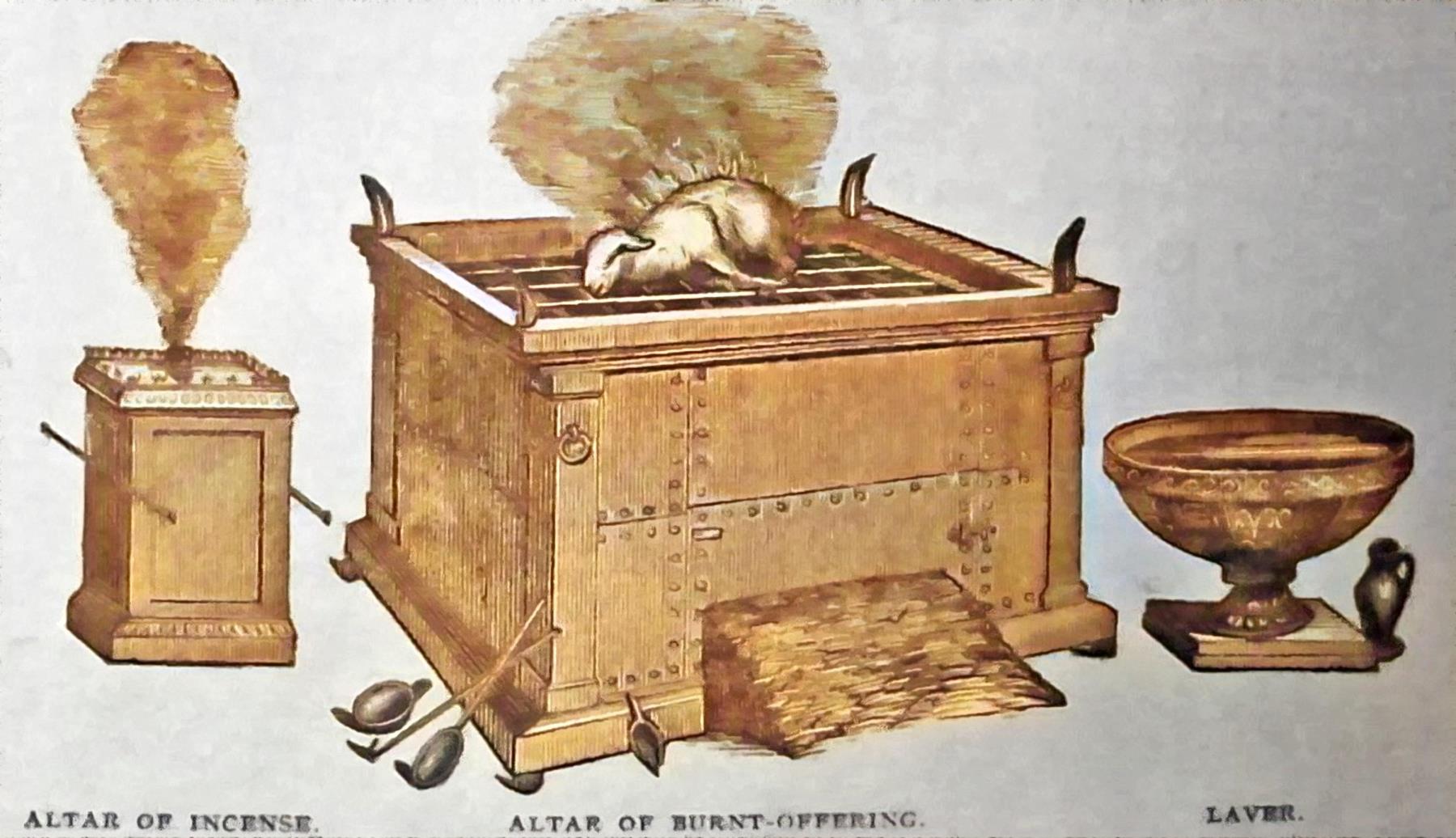
We do not know exactly where this altar was positioned, but it lies within the tabernacle courtyard in front of the Laver before the entrance of the tabernacle (Exodus 30:17-21). This Laver took the form of a large bronze bowl, we do not know how large, set upon a base. It probably had taps on it to facilitate the ritual washing of the hands and feet. We find a triple utterance in specifying this washing, two of which include the ominous warning, “lest they die.” This washing takes us back to the initial ritual in preparation for the encounter with God and the covenantal bonding (Exodus 19: 10), where the Children of Israel must wash their clothes. Dirtiness is associated with the fall; the priest must be clean to enter into the shrine, but also engaging in the sacrifices at the altar.
Again, we must always keep in mind that the altar and the laver are part of the overall vision Moses had of heavenly realities (Exodus 27:8). Indeed, we see this heavenly altar through the eyes of subsequent prophets such as Amos, Isaiah, and the Apostle John in the Apocalypse. One might ask, why should there be an altar for sacrifice in heaven where there is no sin? The answer is simply this: God is love, and love is always costly. We cannot think of love without sacrifice. This altar is symbolic of God’s fiery, eternal, inter-Trinitarian love which is sacrificial by its very nature, each person of the God-head deferring to the other. God extends this love to humanity through this earthly altar. To enter into the Holy Presence of the Tabernacle, one must first pass through the altar of sacrifice, cleansed with the Laver, which is a type of our baptism, bringing together those two most fundamental earthly elements essential to our salvation, water and blood (I John 5:6).
We can clearly draw from the above that we have an altar within our interior tabernacle. We may refer to it as the altar of our heart. It is directly linked to the Cross of Christ, the antitype, or fulfillment of the Old Testament altars of sacrifice. Love is never without sacrifice, and is exactly what our Lord teaches when He says, take up your cross and follow me. The purer the love, the hotter and fiercer the flames, the higher the soul is transported into Light Eternal. The soul itself can never burn, for it is made immortal, but all that is unholy which clings to it does burn away in the flames. This can terrify the soul; it fears the pain of earthly attachments burning away from it. But it is also beautiful. A soul obsessed with nuptial love for Her Bridegroom responds in kind to her Divine Lover who was crucified and resurrected for her. St. John of the Cross’ poem The Living Flame of Love comes immediately to mind.
1. Oh, living flame of love
That tenderly woundest my soul in its deepest centre,
Since thou art no longer oppressive, perfect me now if it be thy will,
Break the web of this sweet encounter.
2. Oh, sweet burn! Oh, delectable wound!
Oh, soft hand! Oh, delicate touch
That savours of eternal life and pays every debt!
In slaying, thou hast changed death into life.
3. O lamps of fire! in whose splendours
The deep caverns of feeling,
Once obscure and blind,
Now give forth, so rarely, so exquisitely,
Both warmth and light to their Beloved.
4. How gently and lovingly you wake in my heart,
Where in secret you dwell alone;
And in your sweet breathing,
Filled with good and glory,
How tenderly You swell my heart with love.”
But such intense love is rare in our mortal frames and would potentially bring death to the body. We can be content with our bodies being lamps that glow with the supernatural fire emanating from the burning coals of our altar within (Matthew 5:16).
Lastly, the church from the very beginning grasped the centrality of the altar in her liturgy, as we see by Jesus’ teaching to His disciples, “So, if you are offering your gift upon the altar, and remember…, leave there your gift at the altar…” We must clearly grasp that the Church immediately took upon herself what once was proper only to the Temple and lost in its destruction, but carried on in the sacrifice of the Mass. The first readers of Matthew, written after the destruct of the Temple and its altar, naturally interpreted this as the altar of their own liturgy. So too, we must understand these bold words expressing the superiority of the Church’s altar to the altar of the Tabernacle: “We have an altar from which those who serve the tent have no right to eat” (Hebrews 13:10).
Takeaway: The Altar and the Laver are fundamental to understanding our salvation and worship, and who we are meant to be and become.
Questions:
- How important to you is the altar in your church and your spiritual life?
- Has this historical and spiritual discussion on the altar and laver enhanced your appreciation for your church altar? Is so, how, If not, why?
Resources Used:
Bede: On the Tabernacle.
Cassuto, U. A Commentary on the Book of Exodus 362f. 395f.