And you shall make a lampstand of pure gold. Exodus 25:31
As one enters the Holy Place from the outside and looks to the left along the south wall, one sees the Lampstand (Hebrew menȏrâ), directly opposite of the Table of the Bread of Presence. It was made of one solid piece of gold, weighing 1 talent, approximately 66-70 pounds. It was not made from a mold, but pounded out in the shape of an almond tree with a base for a trunk, 3 branches sprouting on each side directly opposite of each other, and a branch emanating from the middle trunk at the top, making seven branches. These branches had floral designs and buds, like almond trees. On the top of these branches were cups, made like almonds, upon which the lamps, probably terra cotta, were placed, the wicks all facing the interior room. It is emphatic here that Moses was to make this Lampstand, its snuffers and trays, according to what he gazed upon in his vision of heaven on the mountain.
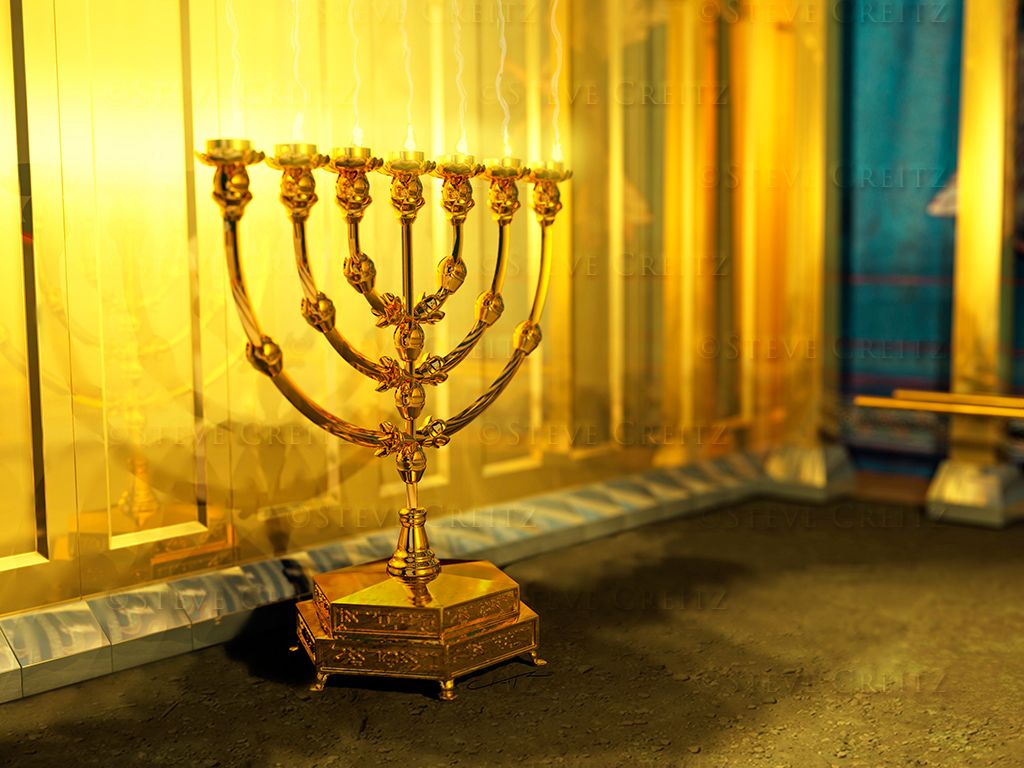
The text says nothing about what all this symbolizes, but the motifs speak for themselves. The floral designs and its produce (almonds) take us back to the Garden in Eden, and therefore to lost origins. God is here giving His covenantal people access to what was barred from humanity after the fall. We see there the cherub guarding the way back in with a sword. Here we see cherubim above on the ceiling tapestry, and on the veil separating the Holy Place, where this lampstand stands from the Most Holy Place where the ark is placed with the cherubim on top. We might say that the cherubim motif dominates the whole scene before us. This impresses upon us a sense of gravity and awe, opening a window into the spiritual realm, and with it an uncertainty and fear before the Holy. The cherubim are still terrifying sentinels guarding the Holy, but there is also an inviting benevolence.
The Lampstand serves to give light from evening to morning, tended to by Aaron and his sons with pure, beaten olive oil (Ex. 27:20). This is to be done “continually,” that is, perpetually. During the day the outside screen would be lifted so as to give light; thus, the sanctuary always had light, and never was left in the dark. This motif of light also takes us back to creation when God separated the light from the darkness, darkness being one of the three primal elements of chaos. The cosmic significance of the light is also reinforced by the fact there are seven lamps, the number of the planets then visible to the Hebrews. It is clear that this sanctuary, with its cherubim woven into the veils overhead with their glittering golden clasps sparkling like the starry heavens, and the lampstand with its 7 burning lamps created a cosmos in miniature. We have, therefore, a cosmic temple within the greater cosmic temple, our universe.
From an allegorical perspective, the venerable Bede associates the lampstand with the Church universal.
The shaft of the lampstand ought to be understood as the one who is the head of the Church, the Mediator between God and humankind, the man Christ Jesus. It is as though the Apostle were speaking of branches proceeding from the shaft when he says of [Christ’s] body (which we are) that from him the whole body, nourished and knit together by its joints and ligaments, grows in the increase of God… The branches are all the children of the Church to whom the prophet says, “Sing to the Lord a new song, his praise from the ends of the earth.
He also makes a profound observation of the Church made of beaten gold:
And because something is made of beaten work by being smitten, aptly was the same [lampstand] made of beaten gold. For our Redeemer, who from his conception and birth existed as perfect God and perfect man, endured the pains of suffering and thus came to glory of the resurrection. All who want to live godly in him suffer persecution; it is through the blows of suffering that they make progress toward the grace of immortality, just as metal is stretched out by being smitten.
St. Bede also makes a beautiful connection between the golden snuffers and trays with the human person:
And surely the trays in which the snuffings are extinguished are the immortal bodies and souls of all the righteous. Quite rightly are they made to be like gold, for they will undergo a most highly desired alteration, so that after the temporal benefits of God they may come to the ones that are eternal.
The imagery of God snuffing out our mortal lives with a golden snuffer, and likening our souls to the golden tray for the snuffer, is a most beautiful imagery of our passing of this mortal live into the immortal. How St. Bede employs the image of the tray is not all that clear. But taking it further, we can readily see that, in this life we give out light in the night, and when our eternal day comes, we are lovingly snuffed out of mortality, and transported into glory.
Takeaway: The lampstand takes us back to the creation of light on the first day of creation and the celestial bodies on the 4th day, as well as the Tree of Life motif; there must be no darkness in God’s sanctuary.
Questions:
- What goes on inside of your soul when you meditate on the image of this lampstand and its lamps in the context of its location in the Tabernacle?
- Does the allegorical interpretation by St. Bede move you in any way? Why or why not?
Resources Used:
Bede: On the Tabernacle, pp. 31-44
Durham, John, Exodus in WBC, p. 364f.