Today you have ordained yourselves for the service of the Lord, each one at the cost of his son, and his brother, that he may bestow upon you this day. Exodus 32:29
The great contrast in these chapters is between the mountain and the valley. Moses the prophet is on the bare heights of Sinai, fasting for 40 days and nights, bracing himself before the intensity of Holy YHWH, interceding for the very existence of a people who are plotting to do away with him. In the valley below we find Aaron, the priest, presiding over what has evolved into a pagan orgy before the golden calf. Somewhere down the mountain Moses meets up with Joshua, and as they descend, they hear a great uproar in camp below. Joshua, alarmed, thinks it to be war in the camp. Moses, in the know, knew it to be the uproar of debauchery.
It is not the sound (Heb. ‵ anȏt) of shouting for victory.
or the sound (Heb. ‵ anȏt) of the cry of defeat,
but the sound of singing (‵annȏt) that I hear. Exodus 32:18
The words for shouting/cry (Heb. ‵ anȏt) and singing (‵annȏt) most probably represent a pun on the Canaanite fertility goddess Anath, the consort of the Baal represented here by the gold calf. When Moses saw this betrayal, he threw the tables written by the finger of God to the ground, breaking them. This, of course, symbolized the breaking of the covenant. Moses’ hot anger and destruction of the calf by “burning, grinding and scattering” parallels Anath’s destruction of Mot the chaos god in Canaanite myth, and this act demonstrates the power of Moses above the Canaanite pantheon. Forcing the people to drink the calf’s dust demonstrates how ridiculous their act of idolatry was.
Aaron comes off ridiculous as well. He is afraid of the people; Moses defends them before God. Aaron excuses himself; Moses is willing to put his life on the line for them. Aaron was too weak to restrain the people; Moses restrains even God (Moberly). How lame to say that he threw the gold into the fire and the calf simply “out came!” But again, in our allegory, if Aaron represents our weak will, we see how lame our excuses are for our irrational and rebellious behavior.
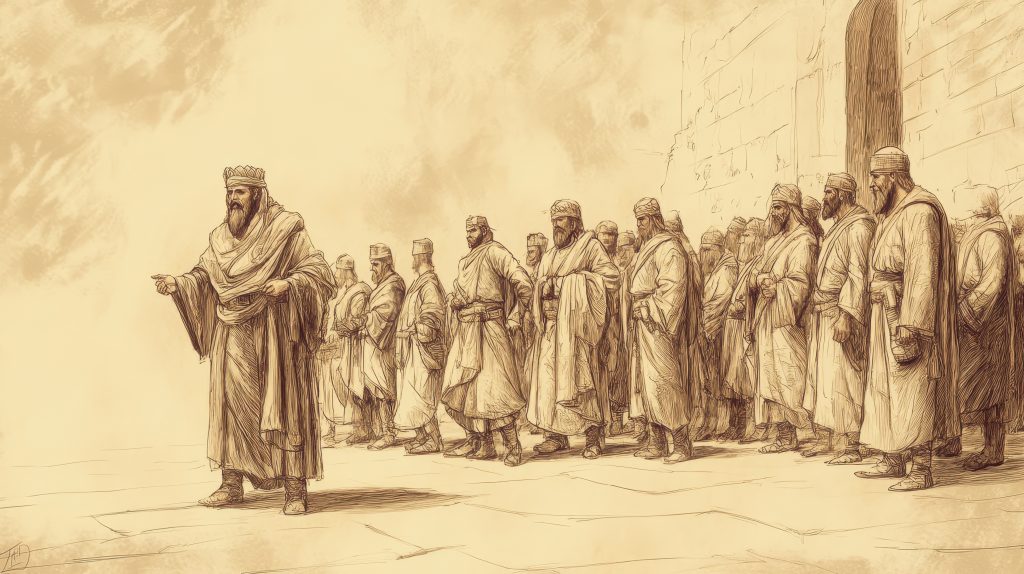
In contrast to Aaron’s weakness Moses calls out to those who were strong. The command is to take up the sword and slay. Again, we do not believe this to be an indiscriminate killing, but a purging of the perpetrators of the rebellion. The Levites answer the call, killing three thousand men. For this they are rewarded; by this act the Levites had “ordained themselves” for the service of the Lord. The effects of this are far reaching.
Up to this point the firstborns of the family units were priests according to the ancient right of primogenitor. However, they failed to restrain the people from their idolatry, and were in some cases, no doubt, part of the rebellion. They did not rise like the Levites to purge the people. With this new ordination of the Levites, the firstborns lost their priestly right of primogenitor. As such, it will be the Levites who will govern all the people in their place (so both Cassuto and Hahn).
Moreover, Israel’s own status as “firstborn” (cf. Exodus 4:22) and her subsequent right as a royal priesthood (Exodus 19:6) has been jeopardized. From this point on in the Pentateuch Israel is no longer referred to with these titles. Because they had become “corrupt” (Exodus 32:7, Hebrew šiḥēt) they no longer can fulfill these roles. We see in Leviticus 19:7 the same word used “to describe a defect which disqualifies a man from priestly service in the sanctuary” (Hahn, p. 144). Indeed, they only exist because of YHWH’s promises to Abraham, and Moses’ intercession.
What transpires is a renewed covenant made with Moses in the next chapter (Exodus 34) in the place of the old one made with Israel (Exodus 24). The former one was marked with simplicity, with only the Ten Commandments and the Covenant Code (Exodus 21-23). This renewed covenant is very complex, consisting of a “bicovenantal system” involving both the Aaronic priesthood initiated already in the first, and the new Levitical order assisting the Aaronic priesthood in the Tabernacle, but will eventually spread out among the tribes, governing the day to day life of the people. With this comes a new heavy layer of laws imposed upon the people as we shall see in the Book of Leviticus, geared to train Israel in holiness and keep them from falling into apostasy again.
Indeed, from this point on Israel never seems to have a clear purpose in their existence. The lofty call to be “firstborn” and a kingdom of priests has slipped out of their hands. Sure, YHWH will bring them to the Land promised to their fathers, and as we shall see, He agrees to dwell in their midst in the Tabernacle. But as we view the history of Israel as it rolls out, we get a sense that YHWH is preserving His people, in spite of themselves, for His own mysterious purposes only to be revealed in Christ Jesus, God’s legitimate Firstborn. One thing seems fairly certain, the Levitical system was not YHWH’s first choice for His people, but given to them because of their rebellion.
In the original historical context, we accept the fact that the Levitical purging of the perpetrators of this apostasy was necessary in accord to what YHWH was working to accomplish through Israel, although it seems so barbaric to modern tastes. On an allegorical level, St. Gregory the Great has this to say about the Levites’ violent behavior:
To put the sword on the thigh is to prefer the zeal for preaching to the pleasures of the flesh, so that when one is zealous for speaking of holy matters, he must be careful to overcome forbidden temptations. To go from gate to gate is to hasten with rebuke from vice to vice, whereby death enters the soul. To pass through the midst of the host is to live with such perfect impartiality within the church as to rebuke the faults of sinners and not to turn aside to favor anyone. Therefore it is properly added: “Let every man kill his brother and friend and neighbor”: that is, a man kills brother and friend and neighbor when, discovering what should be punished, he does not refrain from using the sword of reproof, even in the case of those whom he loves for his kinship with them. Pastoral Care 3.25
Takeaway: Israel’s sin with the golden calf necessitates a renewal of the covenant governed now by the Levites and Levitical Law.
Questions:
- YHWH will eventually accomplish His will in spite of human resistance and outright rebellion. Have you ever witnessed this phenomenon in your life? If so, give examples.
- Can you give examples on how St. Gregory’s allegory may be applicable to your life?
Resources Used:
ACCS, vol. III, Exodus, p. 143.
Cassuto, p. 422
Hahn, S. Kinship by Covenant, pp. 136-175.