Moses said to the LORD, “See, you are telling me: Lead this people. But you have not let me know whom you will send with me. Yet you have said: You are my intimate friend; You have found favor with me. Now, if I have found favor with you, please let me know your ways so that, in knowing you, I may continue to find favor with you. See, this nation is indeed your own people. The LORD answered: I myself* will go along, to give you rest. Moses replied, “If you are not going yourself, do not make us go up from here. For how can it be known that I and your people have found favor with you, except by your going with us? Then we, your people and I, will be singled out from every other people on the surface of the earth.” Exodus 33:12-16
Moses had just averted total disaster with his first and second intercessions, that is, the destruction of the people. This did not come without punishment: the Levitical purging and YHWH’s plague. Still, we do not find YHWH warming up to the people. He commands Moses to “depart, go up from here, you and the people whom you have brought up out of the land of Egypt.” We notice again the ping-pong game with regard to whom these people really belong, Moses or YHWH. YHWH is committed to driving out the Canaanites, and giving them the land “flowing with milk and honey,” purely on the basis of His covenantal promises to the Patriarchs. However, He will not go up with them, but send His “angel” before them instead, because they are unrepentant and stiff-necked, and as such, would not survive His holiness. This means the whole project of the Tabernacle will be abandoned; YHWH will not dwell in their midst.
As stiff-necked and spiritually dull the Israelites were, they sensed the impact of this, and grieved. Their immediate response was to take off their ornaments, which they do spontaneously, but also at the command of YHWH. In the context of what just happened with their jewelry in making the golden calf we interpret this as an act of humility. This, together with a rather obscure detail in Chapter 38:8 of the women “standing in array” (Heb. ṣābā′ battle array) before the tent offering their precious bronze mirrors for the building of the laver, would indicate a turn from self-focus to God-focus.
Since YHWH will not dwell in their midst, Moses erected a “Tent of Meeting” outside the camp. There he would go out to this tent when seeking revelation from God. When he went out, all the people would stand at the entrance of their tents and look at Moses as he passed by. When he entered, the pillar of cloud would stand at the door of this tent, and all the people would worship. Once in, Moses would converse with YHWH “face to face, as a man speaks to his friend.” There is no thought more beautiful than this, nor is there any higher experience then enjoying such intimacy with God. The sad fact is this is exactly what YHWH would have desired for the people had they not chose to stand afar off from the mountain, and rebelled in the valley. YHWH is now outside their camp, and they must worship from afar, and Moses “is” Israel as YHWH originally intended, the friend of God (Hahn).
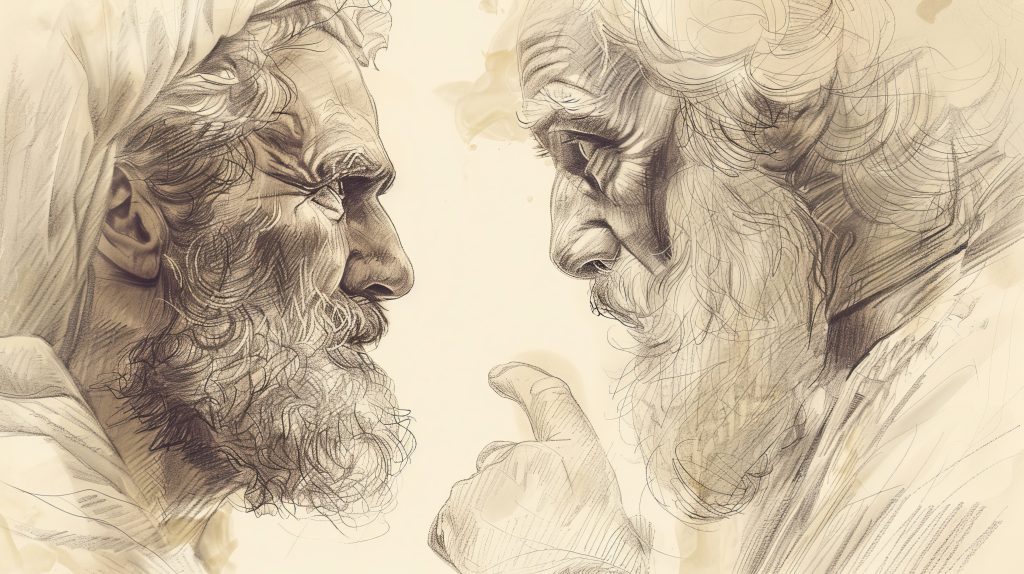
Anyone who is drawn to the idea of speaking with God face to face would be curious as to what went on in the tent. Indeed, what we find in the following verses is of supreme importance to those who wish to be a friend of God. We learn much about how to approach God through studying the ensuing dialogue. Moses begins by going back to his original encounter with YHWH at the burning bush, where he was given the mandate to bring these people here to this mountain and then to the Promised Land (Ex. 3:7ff.). What he is saying is that Israel really is YHWH’s problem, not his alone. He then argues on the basis that YHWH “knows” him by name and he has found favor in His sight. Indeed, YHWH did call out his name at the burning bush, and it is implicit by this encounter and call to greatness that he was favored by God. It is on this basis that Moses asks YHWH “to show me your ways that I may know you and find favor in your sight…” The Hebrew word to “know” (yādāh) means a knowing of deep intimacy, like that between a man and his wife, not mere intellectual knowledge. Moses wants to know YHWH like YHWH knows him, by knowing more deeply YHWH’s mysterious ways. Moses argues on the basis of the grace already given to him: YHWH has favored him, and builds on this by asking for more. We see this line of prayer in Psalm 139 which begins with the declaration of God’s knowledge of him, and ends with a request for God to search and know him even more.
The beauty of this request is that it is not made for himself, but for the people. Behind it all is this statement of YHWH declaring His intention of sending His “angel” before them, but He himself will not go up in their midst. Who is this “angel”? It could be a theophany that leads ahead but will not dwell within their community in the Tabernacle (Cassuto), or it could be, most likely, an angelic messenger distinct from YWWH’s direct Presence. Either way, it amounts to separation, and this is what saddens the people, and is Moses’ main concern.
YHWH graciously receives this petition with “My presence will go with you and I will give you rest.” Rest, of course, is a paradise motif, and describes the blissful state of blessedness and harmony between God and humanity. Moses plows on with his speech as if he did not quite hear what YHWH said. He tells YHWH that if His presence does not go up with them, then it would be better if they never went to the Promised Land at all. Moreover, Moses asks YHWH how it would be known that he indeed, along with the people, had found favor in His sight, and are distinct among the nations. To be “distinct” is to be unique and special, an aspect of holiness, as opposed to being like everyone else. Such mediocrity was abhorrent to Moses.
We see that Moses, after 3 intercessions, was able to persuade YHWH to come back to the people, dwell among them in the Tabernacle, and personally lead them to the Promised Land. These intercessions demonstrate how selflessness and desire for the holy moves the heart of YHWH, binding together the divine and human wills into one.
Takeaway: We gain grace and favor with God by building on previous graces.
Questions:
- Do you feel like God “knows” you and favors you? Do you “know” God? If so, how would you describe it?
- What do you learn about the ways of God through this dialogue in
Exodus 33?
Resources:
Cassuto, U. Exodus
Hahn, S. Kinship and Covenant. P. 148