Remembering our circular chart outlining the structure of Leviticus, we see that this chapter parallels Chapter 10. Both chapters provide short narratives in a sea of laws, and both serve as warnings, the former for the priests, and now here in this chapter for the people. The former centers on the defiling of sacred space, and here defiling the sacred name of YHWH. Again, if we remember, chapters 1-16 center on the Tabernacle and what goes on in sacred space (called “P” for “priestly” source), and chapters 17-27 center on a holy life as it is lived in the day to day (called “H” for the Holiness Code).
We might wonder why here, in Chapter 24, we find ourselves back in the sanctuary. The chapter begins with the command for the Israelites to bring pure olive oil to keep the Tabernacle Menorah burning from evening to morning. Then we have the command to provide the Bread of the Presence weekly for Aaron and the priests. What is behind this? A holy life is all about maintenance! The Hebrews were to sustain the worship of the sanctuary, and by doing so, maintain their own spiritual life throughout their life’s journey.
This is all the more true for us who are in Christ, Who is the full flower of the law incarnate. As we have discussed in our posts on the Tabernacle and its furnishings in Exodus, the Tabernacle is a type of the human person. The lampstand within of pure gold must be maintained with the pure oil and fire of the Holy Spirit, as we see in Jesus’ parable of the 10 virgins (so Origen). We also must regularly bring our offering of bread mixed with the pure incense of prayer for the consecration at Mass of the Body and Blood of Christ. This is what must be done to maintain and grow into the perfection Jesus demands of His disciples.
The chapter turns now to what must not be done. It begins with a man, the son of a Hebrew mother and an Egyptian man, who, in the heat of an argument, blasphemed (Heb. nqb, literally, to pierce) “the Name,” and cursed. It is not clear if the man actually cursed God (so Milgrom), or used “the name,” i.e. YHWH, in a curse (so Wenham), thus taking YHWH’s name in vain (the Second Commandment). Verse 15 “whoever curses his God shall bear his sin,” suggests the former. We see this desperate possibility with Job, who is encouraged by his wife “to curse God and die.” This is the darkest hole in which a person can plunge, separating oneself from God and redemption. He is to be stoned lest he infect the whole community with his contagion.
What follows seems a confusing mixture of legislation totally unrelated to blaspheme. However, the structure gives us a clue as to why these laws are grouped together. What we have is a chiastic structure:
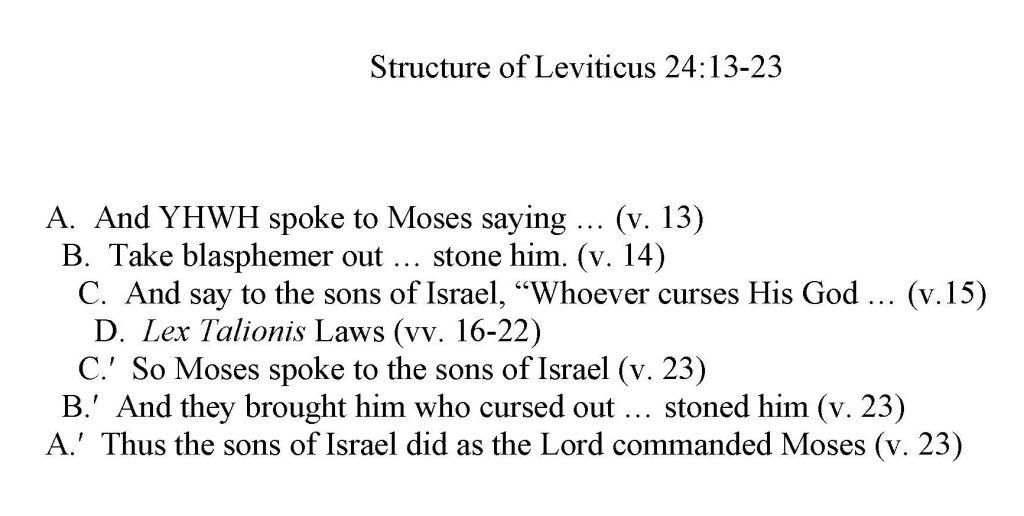
At the center (D) is a selection of Lex Talionis laws, or laws of retribution (see under Exodus 19-23, The Covenant Code: C. The Lex Talionis and the Idea of Justice)for a full discussion. We find the life for a life, disfigurement for disfigurement, fracture for fracture, eye for eye, and tooth for tooth. Interestingly, twice beasts are included: if one kills another’s beast, his beast shall be killed (vv. 18 and 21). But what is emphasized in the legislation is that the Lex Talionis applies to both the native Israelite and the foreigner in the land. This is not only stated as law (v. 22), but in the case study itself where the offender was part Egyptian.
When we look at this chiasm, we see that blaspheme (B and B′) surrounds the Lex Talionis on either side like bookends, thus welding the two moral realities together. The structure is telling us something; “In a word, structure is theology.” (Milgrom, p. 296). What it is teaching is violence done to others, killing or defacing, is on the level of blasphemy. This is so because humans are made in the image of God, and when we kill or deface persons, we are attacking and defacing this image by a violent act which is what blaspheme does with words (Milgrom).
As we mentioned above, the Hebrew word for blasphemy means “to pierce” the name, the name being an essential part of a person, in this case, God. As such, blasphemy was considered a violent act, even though it is verbal. A person who is associated with blasphemy in Jewish culture is called a mamzer (Radner). Jesus was considered a mamzer because of his questionable birth to an allegedly “loose” woman. Moreover, Jesus’ antagonists made the irrational claim that Jesus performed his miracles through Beelzebul. Finally, He was crucified for blasphemy by His claim to divinity as God’s son, and by His prophecy concerning the destruction of the Temple. The irony is heavy here, where Jesus, the Son of God, is condemned as a mamzer by the same people to whom He entrusted the law.
Jesus in turn warned his accusers about blasphemy against the Holy Spirit, which is attributing to the Devil the working of the Holy Spirit. It is by the Holy Spirit that a person can even identify Jesus as YHWH incarnate (I Corinthians 12:3). One who, by conscious and willful blasphemy against the manifold works of the Holy Spirit, commits the unpardonable sin, and is condemned by God, as this man in this chapter is condemned and stoned. It is very sobering that this can and does happen to people. If someone is worried that he or she has committed the unpardonable sin, then it is evident that person didn’t, or else they would not even care.
Takeaway: This chapter establishes the critical connection between maintaining our spiritual lives by the diligent provision of oil for God’s lamp and bread for His table, and the ever present possibility of blaspheme and violence if we neglect our spiritual and moral duties.
Questions:
- How devoted are you in maintaining your spiritual life through the provision of oil and bread as discussed above? How can you do better?
- How do you react to the fact that in the Bible, blasphemy is considered to be violence by words, and linked to violent actions?
- What does blasphemy look like in this present age of the Kingdom? What does an unpardonable sin look like?
Resources Used:
Milgrom, J. Leviticus. Pp. 288-298
Origen, Homilies on Leviticus, Homily 13.
Radner, E. Leviticus, Pp. 259ff.
Wenham, G. Pp. 307ff.