Scripture is resoundingly clear: it is no easy matter for God to live in the midst of finite, sinful mortals. All we have seen up to now with the sacrificial system (Chapters 1-8), the priesthood overseeing the sacrifices (Chapters 9-10), and the purification laws designed to safeguard YHWH’s sanctuary from the pollution of death brought about by sin (Chapters 11-15), emphasize this fundamental truth. But even with all these rituals, sin still can seep through and pollute the sanctuary. The Hebrews could not possibly observe them to perfection, and even the priests, as we saw with Aaron’s sons Nadab and Abihu, are liable to failure in one way or another. A day was therefore set, often called “The Day of Atonement,” or perhaps more correctly, “The Day of Purgation,” once a year, for an annual “house cleaning,” so to speak, to purge the sanctuary from the inevitable contagion of sinful mortals. It was a day of fasting and repentance. This solemnity preserved the people from destruction, or driving YHWH from His sanctuary, neither of which were God’s design for the people He loved.
The ritual for this unique day are rather complex. Aaron is told that he cannot enter the inner sanctum anytime he wanted, rather, at a specific time. When he does, he must bring a young bull for a purification offering and a ram for a burnt offering. Rather than wear his rich vestments worn when ministering for the people, he must wash and wear humble linen clothes to stand before YHWH. Aaron must first sacrifice the bull for his own purification and that of his household. He then enters the inner sanctum with a censor with coals from the altar, put two handfuls of incense billowing smoke to screen his eyes from the “mercy seat” (Heb. kappōet or, “footrest,” as Milgrom suggests, p. 1014), so He may not gaze on Deity. Seven times he must sprinkle with his finger the blood of the bull in front of the mercy seat. He then must go out and sacrifice the ram for the burnt offering, and re-enter to sprinkle with his finger the blood of the ram seven times before the mercy seat.
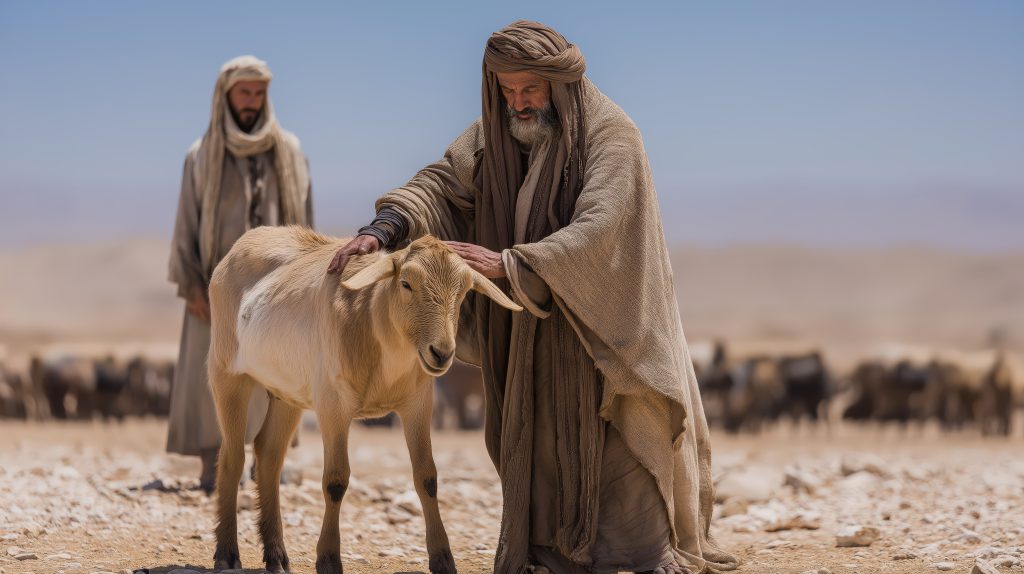
Along with the bull and the ram, Aaron was to bring two goats before the tent. One of these Aaron sacrificed as a purification offering for the people once he made purification for himself. He was to sprinkle with his finger the blood seven times before the mercy seat as he did with the bull and the ram. No other priest can enter the holy place while Aaron enters the most holy place; it is too volatile and dangerous. He must then go back out to the altar and take blood from the bull and the goat to apply it to the horns of the altar, thus purifying it, sprinkling it seven times with his finger the blood to cleanse it.
Of the two goats, lots were cast to see which one would be sacrificed for the purification of the people, and the other to be the “scape goat.” After all the purification rites and the sanctuary were cleansed, the High Priest goes to the living goat and lays his two hands upon its head, confesses all the sins of Israel. The three words for sin in Hebrew are used here to cover the whole spectrum of sin: ‵awōnōt translated “iniquities” with the nuance of “deliberate wrongdoings,” pešā‵îm translated “transgressions,” with the nuance of “rebellions,” and ḥaṭā′îm translated “sins” with the nuance of impurities. Then a man appointed for this job must drive this goat into the wilderness to Azazel, the demon of the desert associated with formless earth, one of the three elements of chaos. This goat therefore carries the sins of the people back to its origin, the howling wasteland where nothing grows.
The concluding ablution ceremony for the High Priest is significant. He must enter the tent of meeting (the Holy Place), take off the linen garments he put on at the beginning, leave them there, and go out in some unspecified holy place, bath his body, and put on his rich vestments so as to serve the people. Milgrom raises the question of why must he bathe his whole body since all impurities were just transferred away on the scapegoat. He introduces an interesting idea that Aaron was “supercharged” with holiness from entering into the Most Holy Place, and the bathe was to de-sacralize him so he could minister on the lower level of holiness in the shrine as usual (pp. 1048-1050). If so, we may possibly see a parallel with Moses’ veil in Exodus 34, and the risen Christ whose full resurrected glory was muted so as to minister to the disciples.
Jesus’ disciples and the first generation of Christians made immediate connection between the High Priest on the Day of Purification with its fulfillment in Christ, our High Priest. Hebrews 14:14- Chapter 10, the very heart of the Epistle, demonstrates this point, specifically 9:11-14:
But when Christ came as high priest of the good things that have come to be, passing through the greater and more perfect tabernacle not made by hands, that is, not belonging to this creation, he entered once for all into the sanctuary, not with the blood of goats and calves but with his own blood, thus obtaining eternal redemption. For if the blood of goats and bulls and the sprinkling of a heifer’s ashes can sanctify those who are defiled so that their flesh is cleansed, how much more will the blood of Christ, who through the eternal spirit offered himself unblemished to God, cleanse our consciences from dead works to worship the living God.
Moreover, much was said by the early Church Fathers about the two goats. For instance, Tertullian:
May I offer, moreover, an interpretation of the two goats which were presented on the “the great day of atonement”? Do they not also prefigure the two natures of Christ? They were of like size and very similar in appearance, owing to the Lord’s identity of aspect. He is not to come in any other form. He had to be recognized by those by whom he was also wounded and pierced. One of these goats was bound with scarlet and driven by the people out of the camp into the wilderness, amid cursing, and spitting, and pulling and piercing, being thus marked with all the signs of the Lord’s own passion. The other, by being offered up for sins and given to the priests of the temple for meat, afforded proofs of his second appearance, when (after all sins have been expiated) the priests of the spiritual temple, that is, the church, are to enjoy the flesh, as it were, of the Lord’s own grace. The rest will depart from salvation without tasting it.
Against Marcion 3.7.7
The multi-faceted connections are numerous, such as Origen’s comparing the two goats to the two thieves on either side of Christ at the crucifixion (Homily 9.2).
Takeaway: The Day of Purification purged the Tabernacle from all sins that slipped into their camp undetected during the year, thus “cleaning the house.” Christ fulfils every aspect of the ritual.
Question:
- Look at all the details of this ritual and list all the parallels with Christ and His Church. What do you see?
Resources Used:
ACCS vol. III, p. 185
Milgrom, J. Leviticus 1-16, pp. 1009-1084.
Origen, Homilies on Leviticus, Homilies 9 and 10.
Wenham, G. The Book of Leviticus, 225-238.