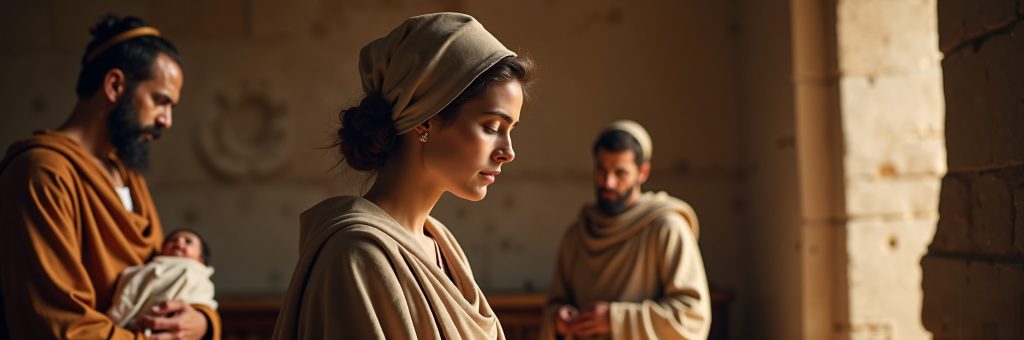
Birthing a child in ancient Israel was considered among the highest of blessings. In fact, it was fundamental to the vision God gave to humanity, to multiply and fill the earth. God is supremely pleased with the marriage act of sexual love and the resulting conception and birth. However, given the fallen nature of our bodies, the process is not according to original design. “To the woman he said, I will greatly multiply your pain in childbearing; in pain you shall bring forth children…” (Genesis 3:16). In our text the issue is not pain, but blood.
The directives concerning childbirth presented here are clear, but their meanings not so much. The woman is declared unclean for seven days for a boy; the same number of days she is unclean for her menstruation period, but double the time for a girl. On the eighth day the boy is to be circumcised. For a boy, she cannot come in contact with holy things or the sanctuary for thirty-three days, but for a girl this too is doubled, sixty-six days. After this time, the mother must bring a sacrifice at the door of the tabernacle, a lamb for a sin offering, or a pigeon or dove if a lamb is not affordable, (Hebrew ‵ōlâ, holocaust), and a pigeon or bird for a purification offering (Hebrew ḥaṭṭā′t). The priest will make “atonement” (Hebrew kipper) for her, and she will be clean.
It would be one thing if these laws were unique to Israel, but the amazing thing for us moderns is how common these laws were in the ancient world, reaching as far west as Greece, as far east as India, and as far south as Egypt, and probably further out yet. As for circumcision, the practice was fairly common among Israel’s neighbors; it was the timing that was different (eight days after birth rather than a pre-marital, or coming into manhood, ritual). Even the strange dictate demanding a longer period of uncleanness for the mother of a daughter than a son is common. After extensive comparisons between many cultures, Milgrom comes to this thought-provoking conclusion:
Certainly one corollary can be drawn from this comparative study: all attempts to explain these common impurity sources in terms of customs or values of any particular culture are bound to fail. Thus their origin cannot be traced to a creed or a ritual but must reside in some universal human condition that has evoked the same response all over the globe. In a word, we [are dealing with the deep sub-consciousness of] the human psyche.
Leviticus 1-18, p. 767
One thing is clear about these laws in the Hebrew context; the emphasis is on blood: “… in the blood of her purifying” (vv. 4, 5), and “… she shall be clean from the flow of her blood” (v. 7). Triple emphasis is always significant in Hebrew literature. As we shall shortly see, life itself and blood are essentially identified together, and their separation is desolation, death, and chaos. Blood released from the woman, whether by menstrual flow or childbirth, is frightening to the human psyche, so much so that pagan cultures perceived the demonic in it. Mosaic legislation takes us away from this association to issues of life, wholeness, and holiness. Here we draw upon Milgrom again.
The loss of vaginal blood and semen, both containing seed, meant the diminution of life and, if unchecked, destruction and death. And it was a process unalterably opposed by Israel’s God, the source of its life: you shall keep my laws and my norms, by the pursuit of which men shall live: I am the Lord (Leviticus 18:5).
Leviticus 1-18, p. 767
Sex and childbirth are considered good and a blessing, and the baby, though born in blood, is not considered unclean, but its processes are inseparable from the loss of the forces of life. Birthing seems to be the nexus of both death and life by the transference of vital force (Milgrom citing Adler, p. 768). So it is, blood ritually shed is considered holy and brings life and atonement, but blood loss outside of this sacred context is impure and defiles onto death.
But why the need for a burnt offering (‵ōlâ), associated with atonement for sin, when childbirth is not a sin or moral failure? Milgrom cites instances where the ‵ōlâ offering was sacrificed as a gift of thanksgiving to God when offered with a purification offering (p. 758). It is a purification not from sin, but to purge sacred space from the above mentioned pollution of blood loss which cannot be helped (p. 760).
But why the shorter purification time for a male child than for a female child? Milgrom believes the answer to this is unknown (p. 750). As we thrust around for an answer, it seems to me that an acceptable reason is suggested by the text itself. The feminine, because of association with much bleeding, takes twice as long for purification than the masculine, whereas the masculine, in the Hebrew culture anyway, lets out only a small portion from circumcision.
In the Venerable Bede’s Ecclesiastical History, he records answers from Pope Gregory the Great to St. Augustine of Canterbury over various topics, one of which was the impurity of women in their cycles and childbirth. He approaches the issue through the story of the woman with the issue of blood who unlawfully touched Jesus’ garment,
For we know, that the woman who had the issue of blood, humbly approaching behind our Lord’s back, touched the hem of his garment, and her infirmity immediately departed from her. If, therefore, she that had an issue of blood might commendably touch the garment of our Lord, why may not she, who has her courses, lawfully enter into the church of God? … If, therefore, it was a commendable boldness in her, who in her disease touched our Lord’s garment, why may not that which is allowed to one infirm person, be granted to all women, who, through the fault of their nature, are rendered infirm?
Ecclesiastical history of England, Chapter XXVII
Finally, Origin, through Psalm 51:7 “Behold, I was brought forth in iniquity, and in sin did my mother conceive me,” comes to the doctrine of original sin in these purification laws, “showing that every soul which is born in the flesh is polluted by filth of iniquity and sin,” hence the necessity of the sacrament of Baptism (Homily 8.5). For him, the pollution of birthing is symbolic of the pollution of original sin. This, I think, we can agree upon, as long as we are careful to note that the marital act bringing about conception is not sinful in and of itself (contra Augustine, St. Gregory), the birthing process was not considered sin, and the baby was never considered ritually unclean in the Hebrew mind.
Takeaway: It is universal in ancient cultures that women’s periods and childbirth rendered her unclean. In Hebrew law, this has solely to do with the nature and theology of blood.
Questions:
- This whole topic is very sensitive, and I suspect far more so for women. If you are a woman, how are you processing this post?
- Do these laws have any relevance to us in our modern culture? If so, what?
Resources Used:
Bede, Venerable. Ecclesiastical History of England. Chapter XXVII
Milgrom, J. Leviticus 1-18
Origin. Homilies on Leviticus, Sermon 8