As we see from the creation accounts, original humanity was vegetarian. Overall, Scripture is rather guarded about the idea of eating meat; it is allowed as a concession to fallen humanity after the Flood. This fact is crucial for us to understand the dietary laws in Leviticus 7 (cf. Deuteronomy 12:15-28). The taking of animal life was a very serious thing in Israel as well as everywhere in the ancient world.
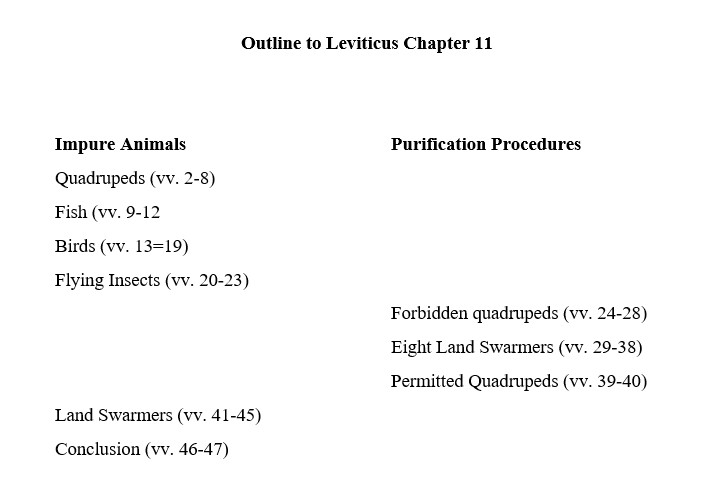
In a nutshell, we see here the division of animals according to their proper spheres: land, sea, and sky. Those animals clean for food are the ones who conform most perfectly to their sphere. Those quadrupeds who have parted hooves and chew the cud, namely cattle, sheep and goats, are clean for sacrifice, and therefore clean for eating. There are four specifically named animals declared unclean (Heb. tāmē′): the camel, rock badger, hare (not common rabbit), and pig. The camel chews but has no hooves, the rock badger and hare have no hooves, and the pig has cloven hooves but does not chew. The pig, as well as dogs, were considered chthonic animals, that is, animals associated with the gods of the underworld, and therefore detested as demonic, sacrificed in occult, magical rituals of the pagans.
Israel had little access to fish. The Hebrews had little love for the sea, and evidently the Mediterranean at the time had few fish along its coasts even if they did venture out into its depths (Milgrom). There was the Sea of Galilee, but transporting fish in the ancient world was challenging. Again, the clean conform most exactly to their sphere, having both scales and fins.
There are no stated criteria for birds. We are presented with a rather long list of unclean birds, which, in the main are predators, or carrion eaters, and therefore are in contact with death, rendering them unclean. We know that the turtle dove and pigeons were clean to eat because they were clean for sacrifice. It is not clear how clean birds, of which we do not have list, conform most to their sphere of the sky other than they have two wings by which they can fly, are not killers, and avoid dead things.
We are now coming to the bottom of the food chain with insects. Locusts, crickets and grasshoppers are allowed because they have wings, four legs with feet, and hop. All others are off the menu.
It seems evident the next section on purification (5:24-40) was added at a later date than the rest because it disrupts what would logically follow, that is, the last section on land swarmers (5:41-45). It prescribes what must be done if one should come into contact with dead or unclean things. The remedy is ritual cleansing by water and waiting till evening, the beginning of the new day. But why is this included here? If we consider Israel’s context of surrounding pagan cultures, things become clearer. Pagans in general believed touching a corpse brought on demonic possession, and must therefore be exorcised by a cultic specialist, i.e. a priest or witch doctor. What this law did was reject this pagan idea but at the same time acknowledge the seriousness of contamination of death. The ritual can be done by anyone (Milgrom, pp. 275, 693). The final editor evidently thought this was a good place to place this section.
Finally, the list concludes with a general statement on earth swarmers; anything that goes on its belly, anything that swarms, whether four footed or many footed, is an emphatic abomination. We cannot help but be reminded of the curse on the serpent in the garden, and the curse on the ground because of Adam, when we see this prohibition. The word for “earth” (′ereṣ) has the secondary meaning of “underworld” in Scripture for its proximity to the grave and associations with death.
The conclusion of the matter is summed up in v. 45 where we find the solemn divine pronouncement, “For I am YHWH who brought you out of the land of Egypt, to be your God; you shall therefore be holy, for I am holy.” What is behind this? They were delivered from something really bad, from being pagan like the rest of the world, killing and eating practically everything. When we look over the list, Israel was extremely limited to what they could eat. Not only this, but when they did kill, it must be done in the sanctuary, a sacramental act, and the blood must be poured out before the altar. Later in Deuteronomy (12:15ff.), we find the law pertaining to wild game; when killed, the blood must be poured out and buried. As we shall see in chapter 17, to kill a beast outside of these parameters, is to be guilty of murder, and “the improper disposal of the animal’s blood is a capital violation” (Milgrom, p. 711). Animals do not have a human soul made in the image of God, but they do have a “life” (Hebrew nepheš) in concert with humans, and this life is in their blood like humans, and they must be sent to God ritually to legitimize the killing.
The whole chapter could be reduced down to one simple paragraph stating the few things the Israelites could eat and leave it at that. The ponderous list of unclean animals serves to radically emphasize how distinct Israel was to be from the surrounding pagan world, which, by and large, freely killed and ate from this forbidden list. To be separated and distinct is a critical aspect of holiness. Meat was intentionally made rare because killing animals has to do with death, and death is the farthest thing from holiness, which can be described as “life.”
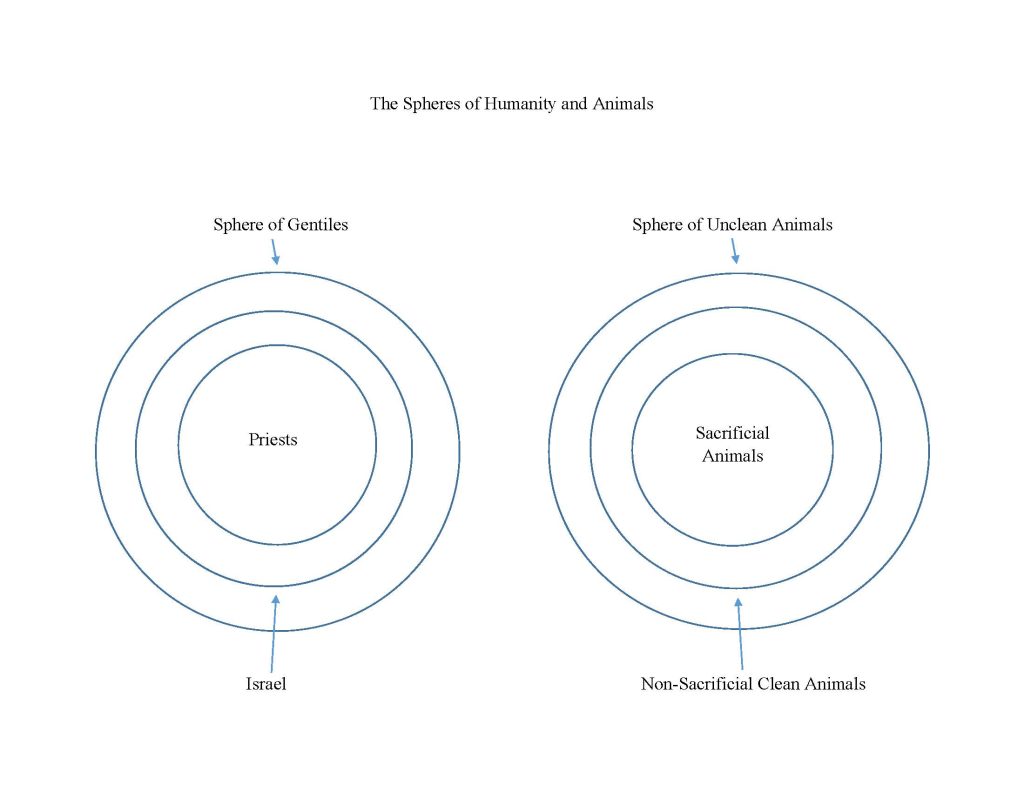
There is one other critical aspect of these dietary laws. From the chart we see the three spheres of animals paralleling the three spheres of humanity. In the center of the animal sphere are those beasts clean for sacrifice. In the center sphere we see the few wild animals clean to eat, but not for sacrifice. The outer sphere indicates all the rest of the animal world not clean to eat. Looking at the human chart, the inner sphere parallels the priests, the center sphere the Israelites, and the outer sphere Gentiles. The Gentiles were, by definition unclean, and outside the salvation of God. Jesus, having fulfilled the sacrificial system, declared all animals clean, and therefore all humanity clean for salvation. Gentiles do not have to become Jewish in their diet to be redeemable! However, this does not mean that “Meat is back on the menu, boys!” in an indiscriminate way. The respect for animal life is essential to a holy life.
Takeaway: The purpose of the dietary laws was to limit and sacralize (make sacred) killing and separate Israel from surrounding paganism in order to be holy to YHWH.
Questions:
- How and in what ways do you think the ancient Hebrew, observing these dietary laws, were formed spiritually by what they ate?
- Though we as Catholics do not observe these dietary laws, how and in what ways may they inform us spiritually?
Resources Used:
Milgrom, J. Leviticus 1-18