Because impurity and holiness are antonyms, the identification of impurity with death must mean that holiness stands for life. Rabbi Jacob Milgrom, Leviticus 1-16, p. 46
The Book of Leviticus developed within the covenantal community of Israel, like the whole of the Pentateuch, from core revelations given to the Patriarchs and Moses and built upon by a process of divine inspiration within that community to eventually come to its present state. A clear example of this is the Ten Commandments given to Moses on the Mount. It is immediately followed by the Covenant Code (Exodus 21-23), which is an expansion of this core Mosaic revelation, with laws that were no doubt included at later stages of Israel’s history as application to changing situations. Law by its very nature is dynamic, not static. We should not be disturbed that the whole is attributed to Moses because it all formed organically from his revelation (Milgrom, CC. Pp. 1ff.). Catholics should have no problem with this, for we see something like it in the Church with its development of doctrine, for instance, the doctrines of Christ and Mary (See John Cardinal Newman’s An Essay on the Development of Christian Doctrine).
Leviticus as we have it now, came to its present form by the eighth century, well before the prophet Ezekiel (years 593-571), whose world view was formed by it (so Milgrom, Anchor Bible, p. 5). As such it reflects the spirit of pre-exilic temple worship in Jerusalem as it had developed over time. The structure of the book is very sophisticated and unusual, employing a circular form unique in the Bible, discovered and developed by Mary Douglas, whose work significantly influenced J. Milgrom, a Jewish Scholar who wrote the definitive commentaries on Leviticus, and G. Wenham, whom we freely use here in Deep Dive. The structure is represented below, which we call here the Circle of Life and Holiness.
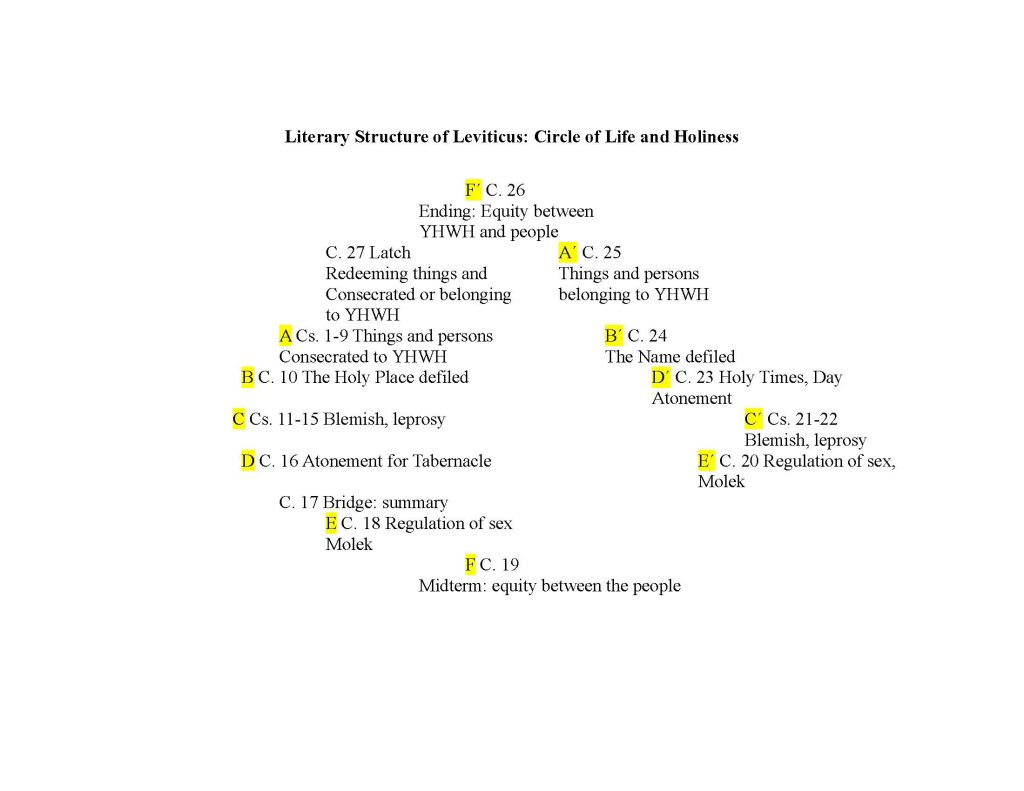
We see in this chart how the left side of the circle corresponds with the right side. Beginning at10 o’clock on the circle (A), we have the first 9 chapters where things and persons are consecrated to YHWH through the various offerings of the sacrificial system. This corresponds to Chapter 25 at 1 o’clock (A′) where things and persons belonging to YHWH must be restored on the Sabbatical year and the year of Jubilee. We then come to the desecration of Holy Space by Aaron’s sons (B) in Chapter 10 which parallels the desecration of YHWH’s name (B′) in Chapter 24. Chapters 11-15 (C) deal with clean and unclean animals, leprosy, and blemishes among the people, whereas Chapters 21-22 deal with leprosy and blemishes with regard to priests (C′). Chapter 16 introduces us to the Day of Atonement focusing on the holy space of the Tabernacle which parallels Chapter 23 which presents the liturgical calendar as a whole (D), including the Day of Atonement focusing on the interior penitence of the people (D′). Chapter 17 functions as a bridge between the two halves of the circle; it concludes the first half which begins with sacrificial animals (Chapters 1-9) by addressing the issue of beasts slain in and outside the camp. The chapter ends with the prohibition of eating blood, a pagan practice connecting with the concerns of the second half of the circle.
An interesting feature of this circle is how E (Chapter 18) and E′ (Chapter 20), both concerned with sexual taboos and pagan practices, flanks F (Chapter 19) which focuses on equity between people. This binds justice and equity within the framework of sexual morality. Moreover, this structure places Chapter 19 at the midpoint of the circle, or at 6 o’clock, directing our attention to F′ (Chapter 26) at 12 o’clock on the circle, which deals with equity between YHWH and His people. F′ is, in turn, flanked by Chapter 27 which serves as a “latch” that closes the circle and concludes the book, and Chapter 25 (A′), both of which are concerned with the consecration of things and persons devoted to, or belonging to, YHWH. Indeed, Chapter 27 concludes the whole with the same concern as A and A′, that is, things devoted to YHWH.
When we look at this circular structure, we see a whole theology of life embedded in ritual. Ritual is what preserves and perpetuates those things worthy to be remembered in a changing world. Ritual seems to be dead and irrelevant only to those who no longer care to discover the rich meaning of the truth about God and themselves in embedded within the ritual. As we view the circle as a whole, we are struck with how the whole cycle of life lays before us; life, birth, relationships between persons and with God, sacred space and times, and moral conduct. The key idea that binds it all together is the word “holy.” In fact, life equals holiness; anything less than holiness is death. Holiness and life are delivered to us through the ritual and bring victory over impurity and death (Milgrom, Leviticus 1-16).
We will talk more about the idea of the holy in our next post. Here we will emphasize that this cycle of life and holiness presented to the ancient Hebrews was something more than what met the eye. At the heart of it all is the sanctuary of the Divine Presence, modeled on heaven’s sanctuary. What they did in their worship transcended their moment of space and time. It was cosmic in scope. Their personal and corporate battle with sin, corruption, and death was not only their own battle, but a battle for the soul of the world. God made everything with a purpose wider than the thing itself, and this is certainly true for Israel.
One last word about ritual for us in today’s world. As I was emerging from what I experienced was the chaos of the Protestant world, I came upon what was to me an inescapable fact. Only those churches that were essentially connected to an ancient See, that is, Rome and the ancient Sees of the east, who preserved and perpetuated truth in ritual and tradition, can remain faithful to the Gospel over time. The Mass itself contains all the theology and vital spiritual experience there is to know.
Takeaway: The awareness and study of the literary structure of Leviticus can open for us the deep spiritual meaning that lays within.
Questions:
- Does the structure presented above help you in your understanding of Leviticus as a whole and of your own life and experience?
- Is ritual a positive or negative idea for you in your experience?
Resources Used:
Douglas, Mary. Poetic Structure in Leviticus. Pp. 239-56 in Pomegranates and Golden Bells [Fest. J. Milgrom]. Ed. D.P. Wright et. Al. Winona Lake, Ind.: Eisenbrauns.
Milgrom, J. Leviticus 1-16 in the Anchor Bible (AB) Commentary Series, vol. 3. New York: Doubleday, 1991. This commentary will be distinguished from Milgrom’s commentary below by AB.
Milgrom, J. Leviticus in the Continental Commentary (CC) Series. Minneapolis: Fortress, Press, 2004. This commentary will be distinguished from Milgrom’s AB commentary above by CC.