And you shall make a table of acacia wood … you shall overlay it with pure gold and make a molding of gold around it … and you shall make its plates and dishes for incense, and its flagons and bowls with which to pour libations; of pure gold you shall make them. And you shall set the bread of Presence on the table before me always. Exodus 25:23ff.
In the Holy Place, as one enters the Tabernacle and looks to the right, there is a golden table set up against the north wall. Although a little smaller than the Ark, they match having loops of gold on the four corners for the golden poles, and decorated with the same golden molding around its edges. Unlike the ark, the poles do not remain in place, but they are utilized only when transported. Upon this table one sees a plate with twelves loaves of bread, a plate containing incense, flagons and a bowls, all made of pure gold. These accoutrements must have been rather small, given the size of the table, but adequate for ceremonial and symbolic use.
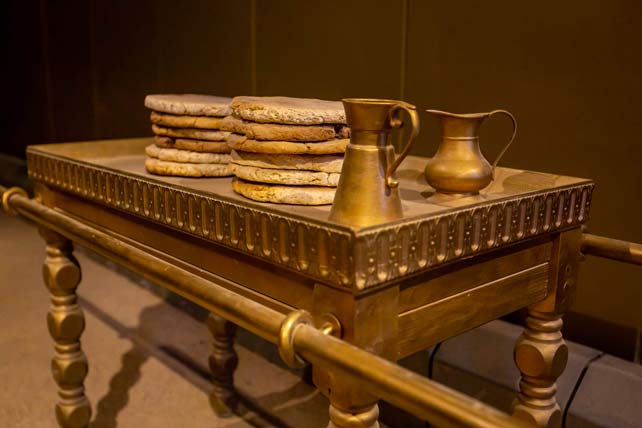
What we have here is a table spread for a feast. This is a common motif in the Ancient Near East, where food was prepared for the gods because, like humans, they get hungry. Humanity exists to serve the gods, and is expected to serve them at table. Here it is completely different. We know from Leviticus 24:5-9 that there were 12
Ceremonial Law Fulfilled in Christ
loaves, one for each tribe of Israel, and were replaced every Sabbath, the old ones consumed by the priests. It is not food for YHWH, but bread representing the love of God for His people. It is literally called the “bread of the face” (Hebrew leḥem panîm), best translated “bread of the Presence.” As we shall see, YHWH does partake of the sacrificial offerings, but upon the altar outside, completely vaporized in sacred fire, indicating that YHWH is not like the pagan gods who are hungry for human food. Rather, He receives the aroma of the sacrifice, as a “sweet savor,” a proprietary for sin, restoring broken relationships.
There are other things we learn about this table and its accoutrements from Leviticus 24. The twelve loaves are baked with fine flour, baked in a mold for uniformity as the Talmud tells us, each two-tenths of an ephah, weighing just over three pounds apiece. How twelve of these large loaves fit on the table, arranged on a platter in two rows, I find no explanation anywhere. They had to be large to have fed David and his men (I Sam. 21:1ff.). Pure frankincense was to be placed with each row, to be “with the bread as a memorial portion to be offered by fire to the Lord.” We know that these loaves were consumed by the priest on the Sabbath when changed out, so “by fire” suggests the frankincense was included in the process of baking. As such is it “most holy” (Heb. qodeṧ qodāṧîm), the same phrase used for the innermost room of the sanctuary. As we shall see, this phrase is also used to describe the meat of the sacrifice which the priests must consume with great care.
The Tabernacle therefore contained “bread” in two places, the manna in the ark of the covenant, which the Church has associated with the Holy Eucharist, and the bread of the Presence placed upon the table in the Holy Place with the twelve Apostles and their apostolic teaching to the world. This association was developed by the Venerable Bede.
The twelve loaves on the table of the tabernacle, then, are the twelve apostles and all those in the Church who follow their teaching; since, until the end of time they do not cease to renew the people of God with the nourishment of the word, they are the twelve loaves of proposition [Presence] which never depart from the table of the Lord. And those same loaves are properly ordered to be made not from just any flour, but from the finest wheat, doubtless because all those who minister the word of life to others must first devote themselves to the fruits of virtue, so that they may commend by their actions those things that they counsel in their preaching, being conformed to the example of him who says concerning himself: “Unless a grain of wheat falls into the ground and dies, it remains alone.”
St. Bede expands the meaning of the loaves to those who continue to teach apostolic doctrine in the Church with regard to the weekly changing out of the bread:
The Loaves are properly commanded to be changed before the Lord every Sabbath day; for surely the loaves that were set out on the table of the Lord through the six days of work are exchanged for new loaves on the Sabbath when all the teachers in the Holy Church, once the time of their holy labor is completed, are rewarded in heaven with eternal peace and leave others behind them in the same work, laboring in the world with the hope of the same reward. And in this way it is brought to pass that the table of the Lord is never left destitute of bread, but as soon as one loaf is taken away another is put in its place, as long as the churches never lack ministers of the word who follow one another in succession.
St. Bede further expands the loaves to all the faithful:
On the Sabbath, therefore, the loaves were set upon the table of the Lord, and those who placed them there intended that when the Sabbath was ended they might remain in the same place through the six days of working, and when the next Sabbath came they might be consumed for the refreshment of the High Priest and his sons. Doubtless this was because in the beginning those of us who lead lives devoted to God are promised that we shall receive the rest of eternal life, but only on condition that we attain to it through the labours and good works in this transitory life.
T
Takeaway: YHWH sets before Himself (His Face, His Presence) a table with bread representing His people; the twelve tribes of Israel, then the twelve Apostles and those who teach after them, and finally all those faithful in the Church.
Questions: 1) How and in what ways does this table in the Holy Place speak to your own spiritual life and experience? 2) Do you see yourself as God’s bread? Explain!
Resources:
St. Bede: On the Tabernacle, pp. 21-31
Cassuto, U. A Commentary on the Book of Exodus, pp. 336ff.