For I, the LORD, your God, am a jealous God, inflicting punishment for their ancestors’ wickedness on the children of those who hate me, down to the third and fourth generation; but showing love down to the thousandth generation of those who love me and keep my commandments. Exodus 20:4-6
Most people, on first thought, would love to live in a world without consequences for their actions. If they thought deeper on it, maybe not, because we can well imagine all chaos would break out. We know there is a God because there is such a thing as consequences in the first place; we really cannot get away with anything. Everything is “rigged” so our actions must reckon with consequences, whether good or bad. Judgement is not only something that happens at the end of time, but is meted out as time moves forward, moment by moment.
Behind this reality is a “jealous” God who desires the best for us. Certainly, YHWH’s zeal for His people renders Him, in human terms, “jealous” of pagan idols which seduce them away with their magical charm and sensuous aura. But the “idol” itself was not, scholars tell us, necessarily worshipped as their deity per se, but the vehicle by which the gods communicated to them. Rather, as Zimmerli tells us, “God has chosen to make himself known, not in a ‘static’ image, but in the ambiguity of dynamic history.” Again, YHWH has covenanted Himself with His people, encountering them in space and time in a relationship mediated by faith. Idolatry avoids relationship. YHWH’s jealousy is over the hearts of His people. Origen explains:
Now Christ is especially jealous for the house of God in each of us, not wishing it to be a house of merchandise or that the house of prayer become a den of thieves, since he is Son of a jealous God. This is the case if we understand such words from Scriptures in a reasonable manner, which we spoken metaphorically from the human viewpoint to set forth the fact that God wishes nothing alien to his will to be mingled with the soul of any, but especially with the soul of those who wish to receive [the teachings of the] most divine faith. (103)
Commentary on the Gospel of John, 10.221
Both idolatry and faithfulness have consequences, and the consequences are generational, falling upon children and on down the family line. Those who refuse to be exclusively loyal to YHWH are said to “hate Him,” choosing idols over Him. The terrible reality is that our attitudes and actions in this life directly impact our children. True, children cannot use their parents’ rebellion as an excuse for their own behavior as we see in Ezekiel 18. But, the impact of parents’ sins on their posterity is undeniable. We are, in many ways, directly responsible for the generations below us. Fortunately, consequences of the parents are limited here to the third and fourth generations; God always finds a way to restore the evil trajectory we set in motion to our posterity. Another aspect is this; if the evildoer lives long enough to see the second and third, and perhaps even into the fourth generation, he will suffer to see the effects of his sins on his posterity (Cassuto, p. 243)
In contrast, we see that exclusive faithfulness and loyalty to YHWH is rewarded without limit. This does not mean that every child born in their posterity will be faithful. We see that many godly parents, like Eli, Samuel and David, had wicked sons, and they experienced firsthand the pain of this (see article in Resources below). What it is saying is, for the godly, in contrast to those unfaithful to the covenant, God will find a way to pass on His ḥesed, that is, His covenant loyalty, mercy and lovingkindness, through their children and beyond to the end of time (Cassuto). The context for all of this is a culture where children were everything and were expected to carry on the family name and honor over every generation. Given the expansiveness and limitlessness nature of the promise, however, it is not improper to go beyond the literal into spiritual dimensions. Those who love YHWH will produce more than just physical children, but spiritual children, who in turn, will reproduce exponentially on and on till the end of time. This meditation would not have been beyond the mentality of the Hebrew culture at this time.
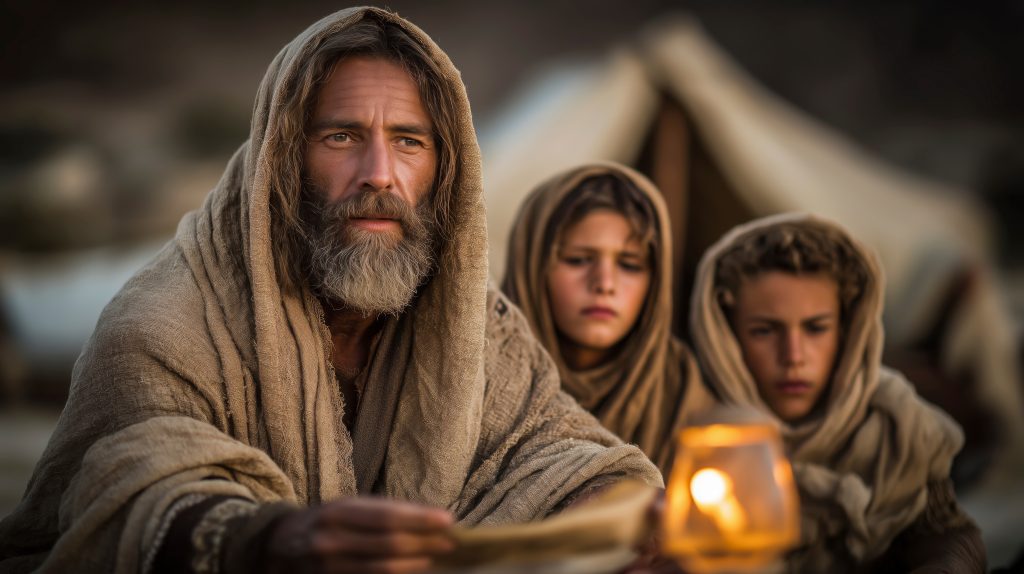
We see here the profound dynamic between the Divine and human wills. We humans possess real power to determine our futures, and to influence generations to come, for good or ill. Yet, it is God who directs it all to His own ends, straightening out what is crooked, and multiplying the good. Moreover, we are all handed, to some degree, a crooked baton, by parents who are flawed in some way or another. It is our duty to straighten it out the best we can as we pass it down to our children. What they do with it is on them.
Takeaway: We are given the power, as divine image bearers, to directly influence the generations under us.
Questions: 1) What do you know of your family history and how does this fit into this discussion? 2) How conscious are you of the fact that your attitudes and actions directly influence the generations underneath you?
Resources Used:
ACCS, vol. III, p. 103 for Origen quote.
Cassuto, U. A Commentary on the Book of Exodus, p. 243Childs, B. The book of Exodus, quoting Zimmerli, p. 408
Worgul, J. Eli and Samuel as Fathers, under Ancienthopes publications.