Yahweh is first and foremost, a God of the wilderness.
Christian prayer is a preference for the desert, for emptiness, for poverty.
Thomas Merton
We have seen that it was YHWH’s stated intention that Israel should go out “3 day’s journey in the wilderness” to worship (Exodus 3:18). This, of course, is a deception, at least not the whole truth, and Pharaoh knew it. On a practical level, they needed to separate themselves from the Egyptians who were offended with their worship and sacrifice (Exodus 9:26-28). We learn from the old Greek historian Herodotus that the Egyptians worshiped the animals the Hebrews sacrificed, and they were considered sacred. Depending where one was in Egypt, sheep in one district would be prohibited for sacrifice, but rams permitted, and vice versa. Bulls were sacred, and some were deemed to be the incarnation of Isis, and only a priest could determine this (Herod. 2. 24, 65-76, 3.5). The Hebrews did not have these scruples, and sacrificed bulls, sheep, and rams, and therefore, as Moses told Pharaoh, they would offend the Egyptians. Therefore a 3 day’s journey into the wilderness would be necessary to separate themselves enough to be away from the Egyptians. The question of what Hebrew worship looked like as slaves in Egypt is not answered.
But it is “the wilderness” that catches our attention. This desert east of Goshen separates Egypt from Palestine. In ancient times the journey directly from the borders of Egypt to the land of the Philistines at the southern edge of Palestine was considered a 3 day’s journey; it was very dry and inhospitable (Herod. 3.5). As we shall see, YHWH redirects the Israelites from this direct route because Israel was not yet ready to deal with the war-like Philistines. Instead, He leads them into the Sinai Peninsula, toward Mount Sinai, where He promised Moses that the Hebrews would worship God “on this mountain (Exodus 3: 12). The point is that YHWH delivered His people through the “watery deep” into the “formless earth,” two of the three primal chaotic elements. We must pause here to consider what the Hebrews thought of the “desert.”
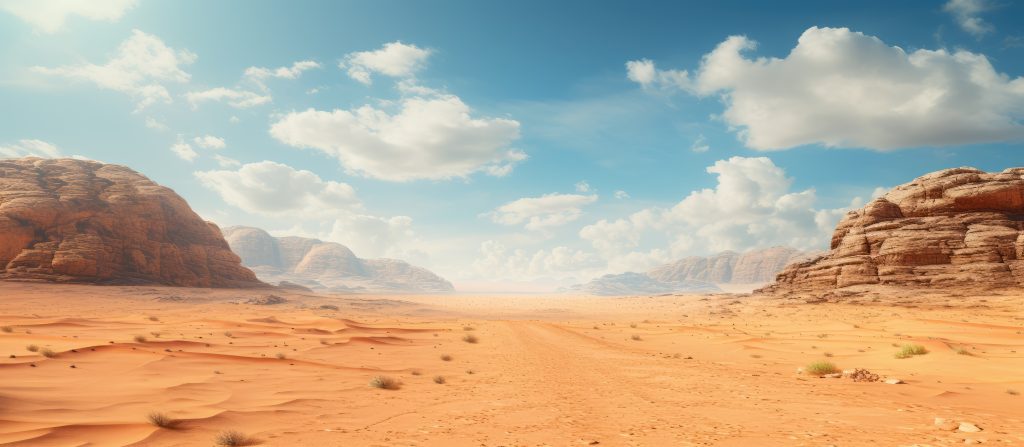
The desert was never far from the thin little strip of land which we call Palestine. Indeed, the vast Arabian Desert would certainly have swallowed her up long ago if she did not safely sit upon two mountain ranges running parallel to the Mediterranean coast. These mountains shut out the desert on the East and capture the rains and mists of the Great Sea on the West which feed the rivers and streams that tumble down into its valleys. Still, the Israelites never forgot the fact that the ever encroaching sands of the wastelands were at their back door, for every once in a while the desert would blow its hot, ominous breath that “neither fans nor cleanses” (Jer. 4:11, the Sirocco,” or east wind that comes off from the desert) to remind them of its presence. Those who ventured out into it could not help but experience the horror of formlessness and void (Gen. 1:2, tōhû wābōhû) and shudder in dread before the low wailing of the wind as it passed through the barren rocks (cf. Deut. 32:10, ûbtōhû yelēl yešimōn). Lilith the night hag was feared to haunt these lifeless places along with other unsavory creatures who let out lonely cries as they preyed upon one another for food (Isa. 34:13 14). Those banished to the desert, such as Ishmael (Gen. 21) and Esau (Gen. 27:39ff.), were not looked upon with envy. It was the land that felt the curse of the fall the greatest, and theologically represented the extreme opposite of the paradise for which humanity was made.
It is clear that YHWH directed Israel into the desert to test their faith, and prepare them for the Promised Land. As we shall see, they did not do well under the pressure of trusting God in a hostile environment, and the journey was expanded to 40 years, the average length of a lifetime. As such, we see that this desert journey comes to represent the life of a soul in this world. We are delivered from Egypt, the “world,” and baptized into a new life at the Red Sea, our faith tested and refined, and in the end, cross the Jordan, symbolizing death and rebirth in heaven, the “Promised Land.” And so this life is a journey through the desert; thank God for the few oases’ we come upon, but even more, for His miraculous provision along life’s way, where YHWH proves Himself to us.
Takeaway: YHWH intentionally leads His people into the desert so that He can prove Himself to us and refine our faith; this life can be likened to a journey through the desert.
Questions: We all by nature prefer prosperity and paradise. 1) How does this post align with your hopes and expectations for your life? 2) How have you experienced the truth of this post?
Resources Used:
Herodotus, Ancient History, many editions.
Rawlinson, G. Exodus, in A Bible Commentary for English Readers, (ed. by Ellicott, C.) pp. 200, 217.
Runcorn, David. A Center of Quiet (Downers Grove: IVP, 1990), pp. 51ff. for both the introductory quotes above.