Then Jacob called his sons, and said, “Gather yourselves together, that I may tell you what shall befall you in the days to come.” Genesis 49:1

Seventeen years had passed since that most famous family reunion (Gen. 48:28). Israel was old when he stood before Pharaoh, but now he passed beyond the realm of all terrestrial classification. His one hundred and forty-seven years hung about him in a most ghostly way. His eyes, once brown, had now grown white with blindness. We see him on the eve of his death, white bearded and white eyed, staring intently through the mist which blinds most of us to spiritual realities. He had summoned his sons one final time to “bless” them; or more accurately, to reveal their destiny (Gen. 49). Anticipation and anxiety filled the place as his sons, themselves of great age, assembled before him. Behind them stood nervously the vast assembly of Israel’s generations ─ children, grandchildren, and great grandchildren. No one was quite sure what their venerable patriarch would say.
All knew what happened to Joseph shortly before when he brought in his two sons to be blessed. The blind old man crossed his hands as Joseph positioned Manasseh his first born to his father’s right side, and Ephraim the second born to his left side, thus giving the right hand blessing to Ephraim the youngest. Joseph tried to “correct” the situation but soon found out that the way it happened was correct all along. In the Book of Beginnings, no firstborn receives firstborn honors. We cannot help but feel the gentle mirth of the blind man who now clearly saw the ways of God. No doubt his memory flew back to the days when he deceitfully stood before his blind old father, and tricked him into giving him first born status. Isaac was blind both physically and spiritually; Israel was blind physically but saw clearly with his soul. This made the assembly before him insecure, for they could not read him.
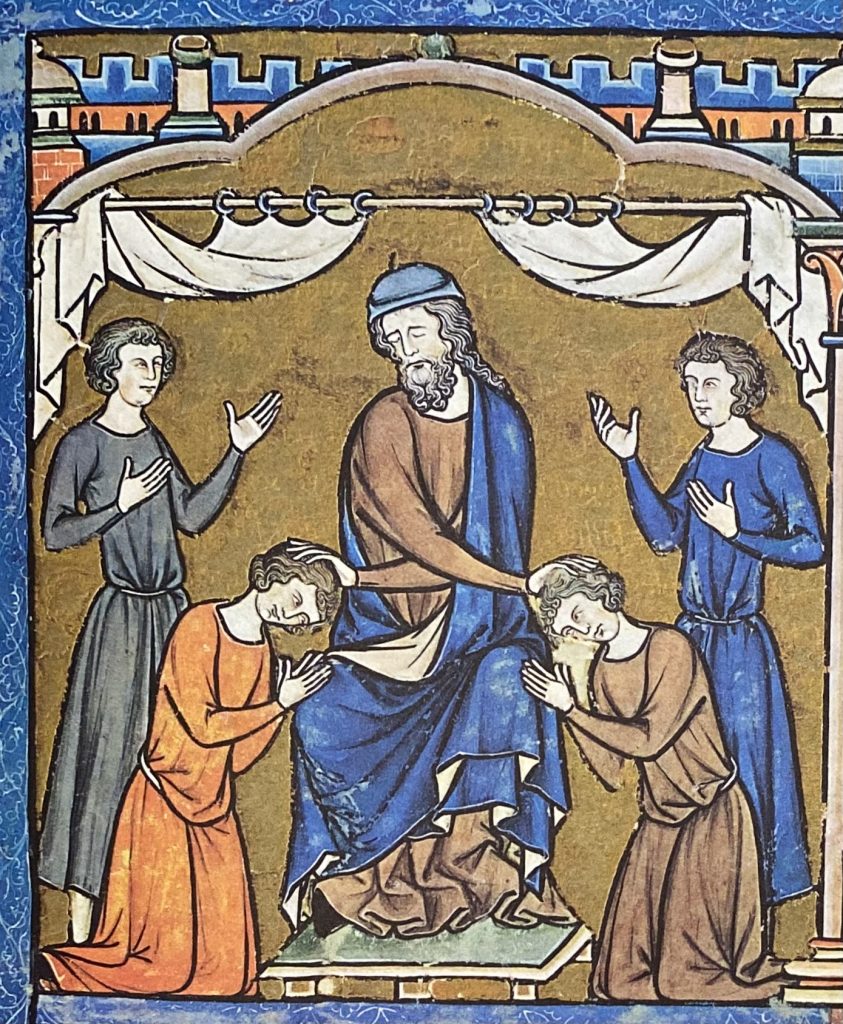
Israel began with his first born, Reuben, and worked on down to Benjamin, his youngest. On the whole, what we see before us is not a stellar group; in fact, they are us. Reuben never seemed to grow much, stymied by his inability to exert his rights as first born. His father directly addressed this, along with the embarrassing incident with his concubine Bilhah. Simeon and Levi were condemned for their violence, a character flaw that plagued them all their lives, although we expect they mellowed some with age.
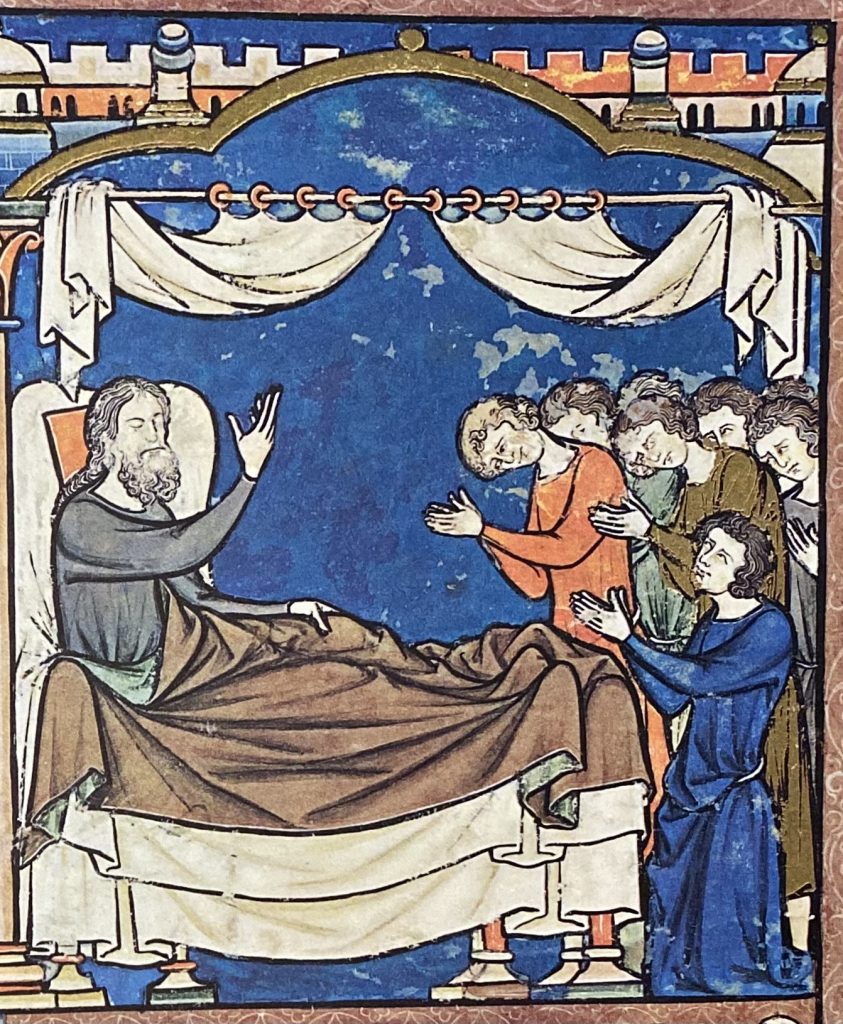
It is Judah that takes center stage in his father’s prophecies, and in the end inherited the first born honors in the family. In the narrative, apart from Joseph, he was the one who showed the most dramatic change in life. Playing off his name which his mother Leah gave him in her moment of illumination, “may YHWH be praised,” his father puns, “Judah, your brothers will praise you!” The lion imagery is prominent; lions always and everywhere and at all times were feared, revered, and admired for their strength and power, and as such symbolic of dominion. This is developed further in v. 10:
The scepter shall not depart from Judah,
Nor the ruler’s staff from between his feet,
Until he comes to whom it belongs;
And to him shall be the obedience of the peoples.
What this prophecy is saying is that Judah will predominate among the tribes “until he comes to whom it belongs,” that is, until a king will come and rule over the nations. As for this early semi-nomadic period in Hebrew history, kingship was associated with paganism, and not ideal. The word translated “scepter” (Heb. ṧebet) above simply means “stick,” or “club,” and is synonymous with the parallel “staff” (Heb. meḥōqēq, “staff;” the word “ruler” inserted by translator), are not, in and of themselves, royal, but used among herdsmen, and most likely means “commanders staff” of tribal leader. But the word “until” in the third line, along with the “to him whom it belongs,” i.e. “ruler” (enigmatic Heb. ṧîlōh) transports us into the future Kingdom, linking him to the promise to Abraham that kings will come forth from him (cf. Gen. 17:6 with 49:10, Westermann, pp. 228f.). This expectation is truly amazing in that it looks forward to a king in a culture that was tribal and had no use for kings.
As for Joseph, the “star” of the narrative, not he, but his two sons Ephraim and Manasseh, will have tribes named after them with patriarchal status. Joseph’s portion fell to his sons, for Israel claimed them as his own, raising the number of his sons to 12. In so doing, Israel made Joseph his equal; he stands as the fourth great patriarch after Abraham, Isaac, and Jacob his father. He is the one who receives the father’s warmest blessing. Indeed, only here on Joseph do we see the word “bless” and not on any other son, in spite of the narrator’s use of the word in concluding Jacob’s oracles in 49:28). As his name, so will he be, increasing and fruitful among the tribes. Success always attracts jealousy and enemies, but God will protect him from them, and he will be mighty in battle. Then comes a flurry of blessings upon the head of Joseph in the form of two merisms (two extremes including everything in between), blessings of heaven above and of the mysterious deep below, blessings of mother’s breasts and womb and of the father. This blessing of the father is more profound than the blessings first given at creation upon the ancient mountains and hills (Genesis 49:26).
Moving on to the sons of the concubines, Zebulun, Issachar, Dan, Gad, and Naphtali, we know very little of their lives. Jacob’s oracles on them are notoriously ambiguous, and few of which have obvious fulfillment. Benjamin, conspicuous for his silence throughout the story, is likened to a ravenous wolf. Obviously, his father knew something about him that we don’t, apart from the fact that his birth cost the life of his favorite wife Rachel.
These are the great grandsons of Abraham, the friend of God, the man of faith! These are the fountains of Jacob, the heads of the twelve tribes of Israel, the family of God, chosen above all on earth! Of these twelve, about only two do we know anything positive at all; of three we know the negatives. The rest are all enigmas to us. Surely if there were anything noteworthy about their spiritual journeys, the author of our story would have told us. The silence about them screams out at us ─ all the more so when we consider that the twelve gates of Heaven are named after them! (Cf. Ezk. 48:30-34 with Rev. 21:12). The first things the redeemed see when they pass into heaven are these names above the gates! It is hard to think of a more splendid honor for such a common, lackluster bunch.
Takeaway: The whole of redemptive history travels through the 12 tribes of Israel whose sons of which only two are obviously good, three are known to be bad, and the rest very obscure.
Questions: 1) What does the takeaway above teach us about God’s ways and the reality of the human condition? 2) what do you personally take away from Jacob’s oracles to his sons and your own aspirations for your life?
Resources used:
Westermann, Genesis 37-50