And Joseph provided his father, his brothers, and all his father’s household with food … Genesis 47:12

The Joseph Story is at the apex of world literature; it is not surpassed in sacred or secular lore. Moreover, the author shows skill as a historian as well, melding historical data together into a powerful and forceful account of how Israel ended up in Egypt. Hopefully we have seen something of the profundity of the story’s theology, and that sacred narrative opens up realms of spiritual insight for readers who desire to raise their souls to God. But in the end, the story as Scripture is something far more than sacred literature, history, or theology. It is eschatological in its core, pointing to “Something” to come who is far greater than itself through its characters, events and motifs. This “Something” is Jesus Christ, who is the Antitype to our story. The word “anti-type” is an old one that was used to describe an impression made by a “die” in the Greco- Roman world. The die itself was obscure and backward (the type), but the impression it made was clear (anti-type).
The grand assumption of typology is that history repeats itself in patterns. The deeper one goes into the past, the clearer picture one has of the future. Scripture itself can be styled purely typologically; its contents form a series of patterns. For instance, a cursory look at the description of Eden in Chapter 2 of Genesis reveals close ties with the last chapters of Revelation where the Eternal City is described. Eden is the type, and the eternal city is the antitype. Everything in the future has its roots in the past. In fact, if we could go back far enough into the past so as to see and comprehend creation itself, we would see all the future with the Spirit of God hovering over the face of the deep. Christ is the Great Beginning, and He is the Great End, the Alpha and the Omega. To find the One is to find the Other. Everything is therefore surrounded by God and penetrated with the mystery of Christ. There is nothing insignificant; everything is teeming with meaning. To be Christian is to understand the mysteries christologically. Consider these powerful words of St. Paul:
He (Jesus Christ) is the image of the invisible God, the firstborn of all creation; for in him all things in heaven and on earth were created, things visible and invisible, whether thrones or dominions or rulers or powers – all things have been created through and for him. He himself is before all things, and in him all things hold together. Col. 1:15-17
Christ is the Power behind every detail of creation and history. Therefore, to be a student of creation and the past is to be a student of Christ, if one wishes to be truly Christian. Everything is revelatory of Christ. This is why Paul further declares that the knowledge of God’s mystery is “Christ Himself, in whom are hidden all the treasures of wisdom and knowledge” (Colossians 2:2-3). Already in previous posts we have observed parallels between Joseph the type, and Jesus, the antitype. Let us look here more closely at the grand themes or motifs of our story. We have a Father and a beloved son in a land of promise and expectation. This father endows this son with firstborn honors giving him a garment that is most likely a priestly robe. The son has dreams of his destiny: he will rule over his brothers. The brothers, out of hatred and jealousy, throw him into a pit with the intention of killing him. Instead, one of the brothers, Judah, persuades them to sell him for twenty pieces of silver to merchants. The robe ultimately comes back to the father bloody, and he mourns. Meanwhile, the caravan takes the beloved son, Joseph, down to Egypt where he is tempted in Potiphar’s house. He is unjustly accused of a crime and thrown into prison where he is forgotten. Pharaoh, having heard that Joseph could interpret dreams, raises him out of the pit and puts him in charge of all Egypt. Joseph feeds Egypt and the surrounding countries. The brothers make three descents into Egypt, during which Joseph invites them to follow the same path he took to perfection. They repent and Joseph forgives. Joseph “appears” to his father when they are reunited and saves his family by providing for them, seventy persons in all. Finally, Joseph desires his bones to be buried in Canaan when God brings Israel out of Egypt.
The parallels to Christ are so obvious that we risk redundancy. Jacob is God the Father and Joseph is Jesus, his beloved son. God has made Jesus firstborn over his creation giving him ruling rights over His brothers made in His image and endowing Him with priestly powers. The brothers are Israel, and by extension all of humanity, who out of hatred and jealousy, decide to kill him. The pit symbolizes death; the blood of the priestly garment being the blood and sacrifice of Christ. Judah sells his brother for twenty pieces of silver; Judas sells his Brother for thirty. The Father turns His face in grief. Egypt is the world where Jesus suffered temptation as Joseph did. Jesus, like Joseph, was accused unjustly for crimes and punished. Joseph’s rise from the prison/pit parallels Jesus’ resurrection from the dead. Jesus rules the World like Joseph ruled Egypt and provides salvation for all humanity. Joseph provides humanity with bread; Jesus, the bread of life, provides the world with the Eucharist. Jesus is the spiritual father to his brothers as Joseph was to his. Jesus “appeared” before his Father as Joseph “appeared” to his father. Finally, Jacob’s household of seventy symbolizes the world wide family of the redeemed.
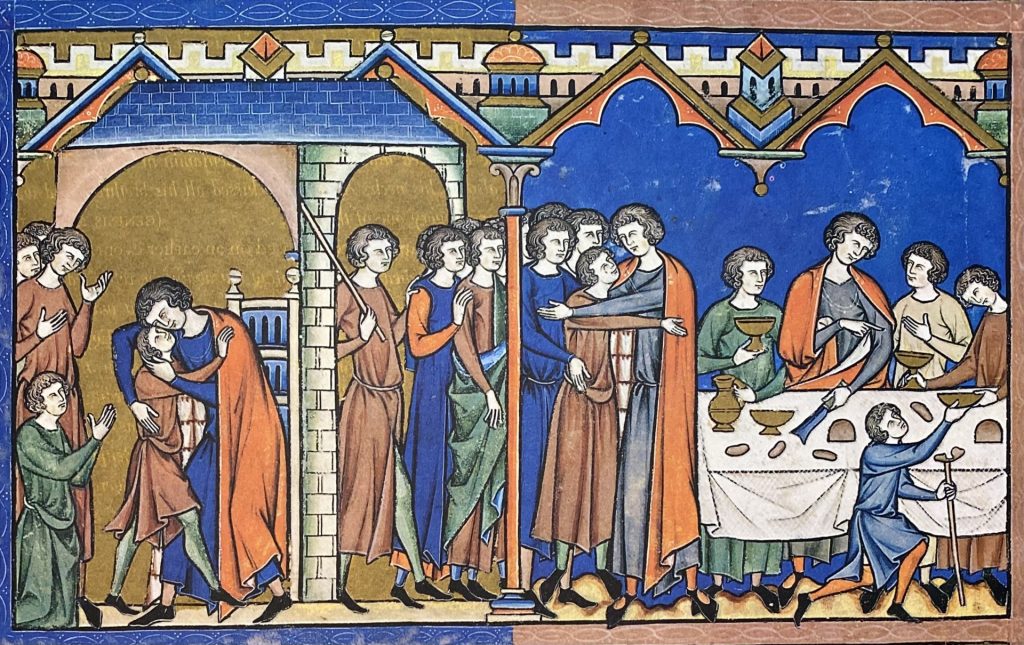
It would be superficial for us to look at these parallels and merely say, “Wow, see how the Bible is clearly inspired! How could anyone see these things and not believe?” What we have here is far more profound than an apologetic for scriptural inspiration. It is even more primary than the story’s prophetic power. In type and Anti-type we are invited into a whole new world view. It is a worldview, where Christ is at the very fabric of reality, where past, present and future is all a revelation of Jesus. Jesus is not just God/man who broke once into history and now rules the world at the right hand of the Father “out there” somewhere. It is true that Christ is transcendent, but there is more. Jesus is also the very Immanence of God, intimate in every detail of space and time, ruling from within as well as without.
What this means for the Joseph story is that the ancient Old Testament readers ─ as well as the people whose tales are told in it ─ saw the very Gospel of Christ unfold, albeit in shadowy form. How much they understood is open to debate; the brothers seem not to have grasped their own gospel story when their father died and feared reprisal from Joseph. Still, the basic themes of sin, death, atonement, and resurrection are obvious. Joseph was Jesus to ancient Israel. Jesus was right there with open arms when Joseph revealed himself to his brothers, weeping. Jesus played his story over and over again before He did so incarnate and continues to do it now through everything about us. We see Jesus now in full daylight, but He was there all along in the past. We just didn’t see him so clearly.
Takeaway: The pattern of Joseph’s life prophetically prepares the way for Jesus Christ.
Question: Spend some time reflecting on all the parallels you can think of between Joseph and Jesus. What does this reflection do for your soul?