Let every artisan among you come and make all that the LORD has commanded. Exodus 35:10
The motif of “building” is fundamental in understanding human nature made in the image of God. Genesis One depicts God as the original builder of the heavens and the earth, fashioning a cosmic temple. Humans likewise cannot help themselves but to build as well, as we see with Enoch, son of Cain, who built a city in antediluvian times (Genesis 4:17), paralleled with the post-diluvian Nimrod and the builders of the cities in the alluvial plain of Mesopotamia (Genesis 10:6ff.). Then there is the building of the Tower of Babel which brings to conclusion the narrative of the fall, as we have seen.
On the bright side of this motif we see God ordering the construction of the Ark with very specific details carried out by Noah. This ark was understood to be sacred space, a temple of sorts. As such, it is essentially linked to the Tabernacle. We cannot overemphasize the crucial fact that the layout of the Tabernacle was revealed to Moses through a heavenly vision in all its details, making it relevant for all time. This vision occupied all of Chapters 25 through 31.
After the breaking of the covenant and the covenant renewed (Chapters 32-34), we find God commanding Moses and Israel to build the Tabernacle (Chapters 35-40). As we survey these chapters we are immediately struck with curiosity. It is essentially a repetition of the vision in Chapters 25 through 31. Why repeat in such detail much of what was said before, “wasting” precious velum or whatever writing medium used, and making demands on the reader to re-read what they had already just read?
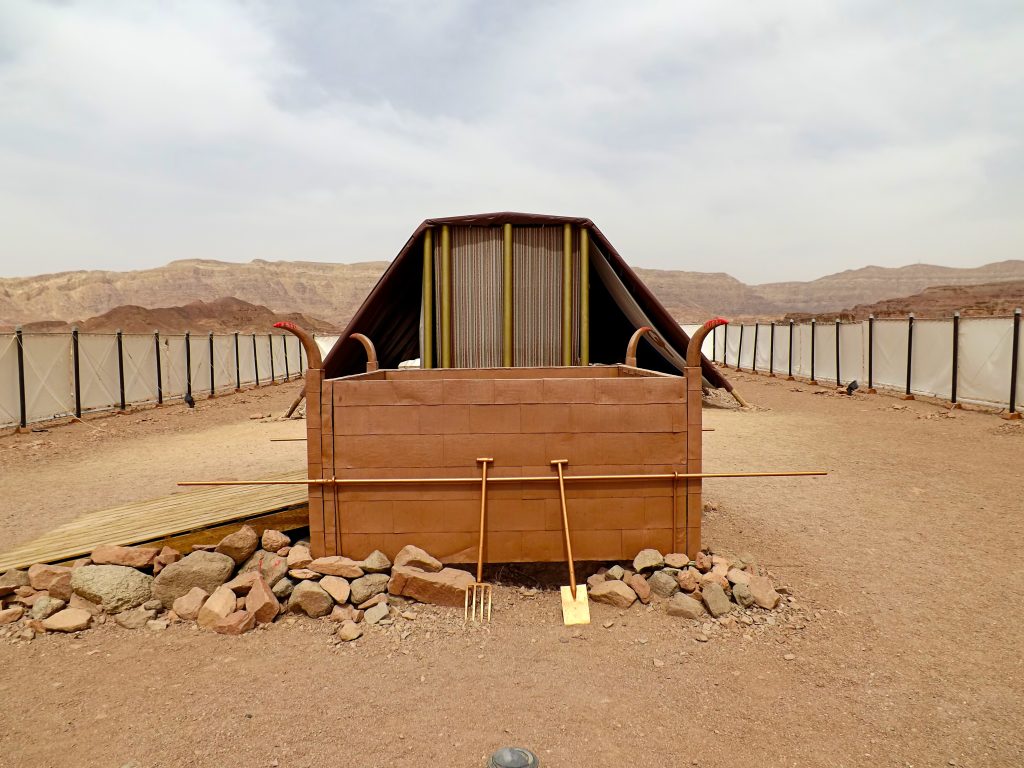
As we have said before, problems are our friends. They make us think. The biblical narratives, by and large, are written with great economy of style, which makes us moderns, who love efficiency and brevity, all the more curious. There must be a reason for this repetition, from which we, if we can fathom it, can gain insight into the Hebrew mind.
First of all, this repetition is deliberate and not a matter of sticking in a parallel source an editor happened to have at hand. Such duplication is, in fact, not uncommon in the ancient world (Cassuto). On further inspection, we see the two sections as complimenting one another. In the first section YHWH presents the vision of the Tabernacle to Moses; in the second, Moses presents it to the people to build. The first section begins with a call for the materials; the second begins with the offering of these materials. The first section ends with the instructions for the ordination of the priests; the second section ends with the glory of YHWH descending into the completed structure (Durham).
This complementary relationship between the vision and the implementation is crucial. The vision is spiritual, but is not complete until it is built in the physical. The vision is God’s doing, the implementation is a human production inspired by the Holy Spirit, made by contributions and materials provided by the people. The labor of reading through the second section seems redundant but it isn’t; it demonstrates the cost and effort we humans must make to bring the vision to an earthly reality.
On an allegorical level, we see that it is one thing to be “spiritual,” and to have a vision of the good, the true and the beautiful. This is revealed by God to the spirit within us, and it is exciting at first. But if the spirit, working through the will, does not arouse the whole being, body and soul, to the task of the actual construction of the vision, we fail to become what God wills for us. We were all made to be builders in a very tangible way. Jesus reinforces this truth in comparing the cost of discipleship with building a tower; one might very well begin with enthusiasm, and even lay the foundation, but is scorned because he was not able to finish it. He also concludes His Sermon on the Mount with the parable of building a house; the foolish build it upon sand, the wise builds on the rock, which is Jesus Christ Himself.
Again, we cannot, like the Babylonians with their tower, build with our own strength for our own glory, but must be empowered to do so. So Gregory of Nyssa on Bezalel:
For we are not wrong in saying just the same of Bezalel, that being entrusted by Moses with building the tabernacle, he became the constructor of those things there mentioned. He would not have taken the work in hand had he not previously acquired his knowledge by divine inspiration. He ventured upon the undertaking on Moses’ entrusting him with its execution. Accordingly the term entrusted suggests that his office and power in creation came to him as something adventitious, in the sense that before he was entrusted with that commission he had neither the will or power to act. But when he received authority to execute the works and power sufficient for the works, then he became the artificer of the things that are, the power allotted to him on high … sufficient for the purpose.
Against Eunomius 11.5.
Takeaway: It is not enough to have a vision of the Tabernacle; one must actually count the costs and build it. This holds true of the spiritual life as well.
Questions:
- Does the Tabernacle provide for you some visual way to understand what you are and what you are to become? Explain!
- What sort of things do you like to build? How does the building motif motivate you in your spiritual life?
Resources Used:
ACCS, Exodus, p. 157
Cassuto, U. pp. 452f.
Durham, pp. 474f.