The angel of God, who had been leading Israel’s army, now moved and went around behind them. And the column of cloud, moving from in front of them, took up its place behind them, so that it came between the Egyptian army and that of Israel. And when it became dark, the cloud illumined the night; and so the rival camps did not come any closer together all night long. Then Moses stretched out his hand over the sea; and the LORD drove back the sea with a strong east wind all night long and turned the sea into dry ground. The waters were split, so that the Israelites entered into the midst of the sea on dry land, with the water as a wall to their right and to their left. Exodus 14:19-22
YHWH dismantles his foe in three stages. Having toyed with Pharaoh in the first stage of the battle with the 3 sets of 3 plagues culminating with an unnatural darkness reminiscent of the pre- created state (See YHWH’s Strange and Terrible Weapons), and winning the battle of the firstborns in the second stage of the battle (12:29-32), YHWH now leads forth His people as a great captain of war with a plan to destroy Egypt’s army, the best in the world (13:17-14:31). He does this by trickery and by engaging the powers of chaos against Egypt, the great symbol of moral and spiritual chaos.
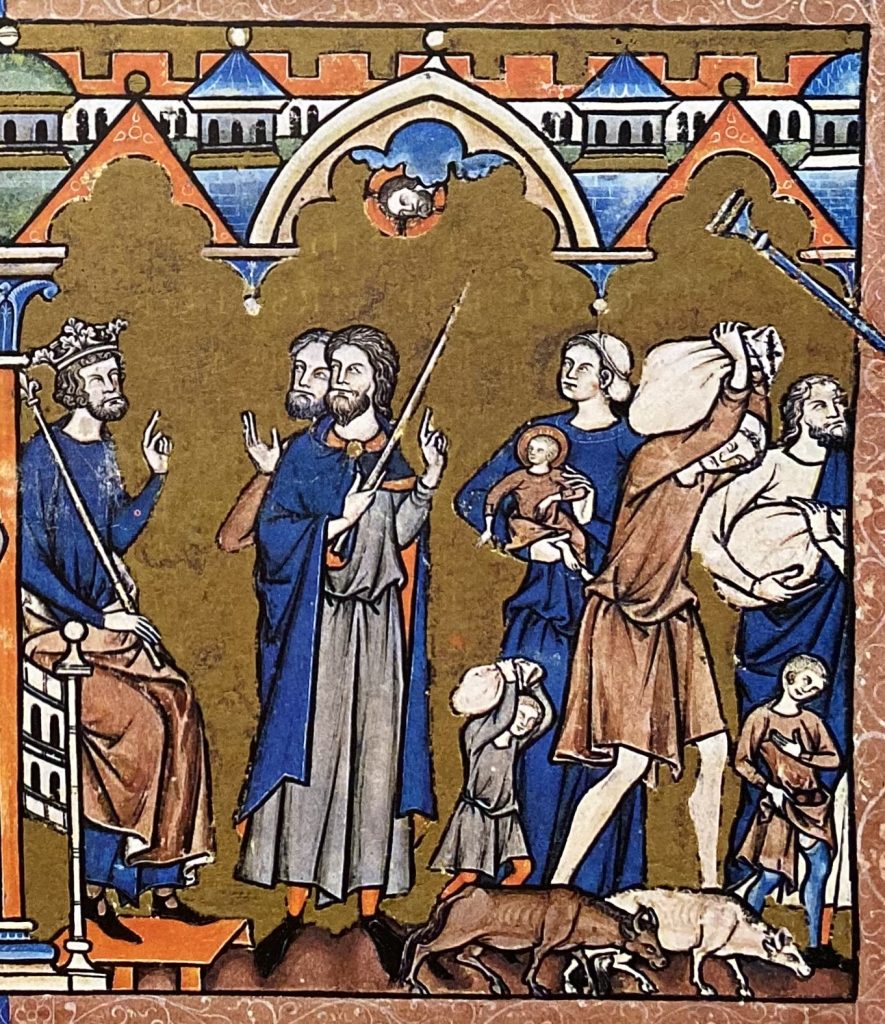
It is very interesting that YHWH refers to His people multiple times in the narrative as His “hosts” (ṣeb′ȏt, e.g Ex7:26). This word is a military word, and is in fact used often as a title for YHWH ṣeb′ȏt, translated, “Lord of Hosts.” This is curious because, on the one hand, they appeared to be a rabble of armed ex-slaves (v. 18), which, of course, verges on the humorous in comparison with Pharaoh’s elite troops. On the other, His hosts were not intended, at least at this point, for action. It is YHWH’s intention to prepare a grand spectacle where Israel stands back, as if before a stage, to see YHWH destroy the mighty Egyptian army all by Himself (14:13-14). War is a terrible thing; YHWH knew that if He led Israel by the most direct route to the Promised Land, they would have to face the warlike Philistines, lose heart, change their minds, and cower back to Egypt (Ex. 3:17).
Instead, YHWH sets this stage by leading them into the desert. The desert is not only the context of this battle (13:18, 14:3) but of the rest of the Pentateuch. As we have seen before, the desert motif is associated with the formless earth of the pre-created state, that which is inhospitable, the opposite of the Garden and its river of life. Immediately the question arises, “how shall this vast crowd survive even without an enemy at their heels?” The second primal element of chaos is the watery deep, here described as yam suf, the Red/Reed Sea. There are all sorts of speculation as to where or what body of water this refers to. For us, we assume with the narrative that this is a historical event that happened at a substantial body of water, wherever it may have been.
However, we simply cannot miss the cosmic dimensions with which our text frames this battle. YHWH intentionally leads the people “toward the Red/Reed Sea” (13:18). In this passage, the word “suf,” often translated “Reed,” which sounds much like the word “sof” to the Hebrew ear with the meaning “end.” Following this clue, it appears that YHWH is leading His people, as well as the Egyptians, to the very “end,” or “edge,” of the watery deep, which for Pharaoh’s army, means death. Finally, the third primal element of chaos, that of darkness, is instrumental in the fight as well, as we find in 14:20, right before the very end, where we see the angel of the Lord coming between Israel and Egypt with a “cloud and darkness.” YHWH therefore is engaging the three primal elements of chaos that we have seen at creation in His battle with Egypt, especially the watery deep (See Genesis 1:2, Primal Elements of Chaos and Primal Fears).
Pharaoh is tricked by the fact that Israel is now in a vulnerable situation, hemmed in by the desert and the sea (14:3). YHWH hardens his heart to go after them with his all of his chariots (14:6-9). The Israelites respond in fear (14:10ff.) in spite of the supernatural leading by the cloud by day, and the pillar of fire by night. These moved in between the Israelites and the Egyptians to separate them that night. Moses stretches his hands over the sea, and YHWH responds by driving the sea back with a strong east “wind,” “dividing” the waters for them to cross over on “dry ground” (cf. Ex. 14:22,29 with Gen. 1:2, 6, 9, 10). Egypt’s army perishes in the watery deep (14:28).
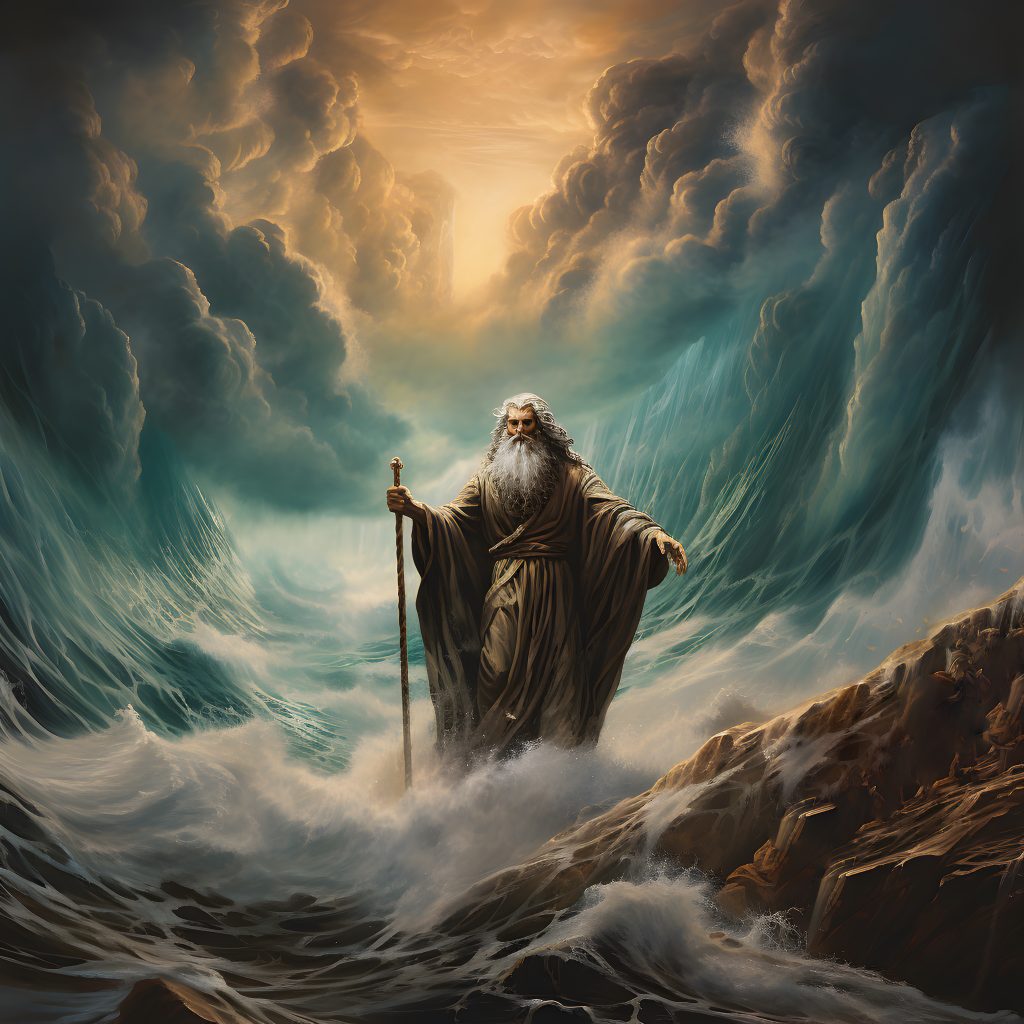
The language and imagery intentionally connects this event with creation. What happened at the sea was not merely a historical event, but a cosmic event parallel to creation itself. By delivering Israel out of Egypt, YHWH was effecting a new creation; the very inception of human salvation, for all humanity will trace its salvation to this event. It is noteworthy that the text explicitly states as an outcome that even the Egyptians shall “know that I am YHWH” (14:18). To “know YHWH” is to enter into truth and thus salvation itself. After all, YHWH was not fighting an ethnic war as if He hated Egyptians, but a war against what Egypt as a nation represented; the world in conflict with YHWH. YHWH unleashes chaos on chaos!
This event is the definitive act of salvation in the whole of the Old Testament. The Hebrews were created anew through this passage of the Red Sea into a nation, freed from slavery, their enemies defeated, and the Lord in their midst. It becomes the prototype of salvation, ultimately fulfillment in Christ’s deliverance of the human race through the waters of Baptism, creating it anew. The New Testament is clear on this as are the Church Fathers. For instance, St. Gregory of Nyssa:
Again, according to the view of the inspired Paul (I Cor. 10:1ff.), the people itself, by passing through the Red Sea, proclaimed the good tidings of salvation by water. The people passed over, and the Egyptian king with his host was engulfed, and by these actions this sacrament was foretold. For even now, whensoever the people is in the water of regeneration, fleeing from Egypt, from the burden of sin, it is set free and saved. But the devil with his servants (I mean, of course, the spirits of evil) is choked with grief and perishes, deeming the salvation of men to be his own misfortune.
On the Baptism of Christ
Takeaway: YHWH defeats chaos by turning the elements of chaos against itself, out of which comes salvation to His people, a new creation.
Question: How and in what ways do you see yourself as part of the “army” of YHWH?
Resource Used:
ACCS, p. 76