Then God spoke all these words: I am the LORD your God, who brought you out of the land of Egypt, out of the house of slavery. Exodus 20:1f.
The stage is set: The people are about to encounter the Living God before His Holy Mountain. Moses ascends into the dark clouds to receive God’s word for His people, the so-called “Ten commandments.” God has a right to make demands on us because He created us in His image, and we must think and act accordingly. The big question is: how will Israel respond to God’s great expectations?
It is never in the nature of things for humanity, in our present state, to feel comfortable with God. Rather, it is in our nature to either ignore God the best we can or recreate God in a way to our own liking. We especially do not like it when God makes demands on us, or sets moral boundaries as He does here at this point in our narrative. Two things, however, are necessary to grasp at this juncture. First, all the images and motifs that we find in the Ten Commandments are anchored in creation. To experience the law in obedience is to experience the world as it was originally intended to be experienced on God’s first Sabbath, the seventh day. Second, the preface to the commandments, where God sets before Israel the fact that He delivered them from Egypt for this very moment, demonstrates that grace comes before command and is the very context for obedience. Salvation is not something earned. Law is creation goodness and was a gift of grace to Israel at this juncture in their history.
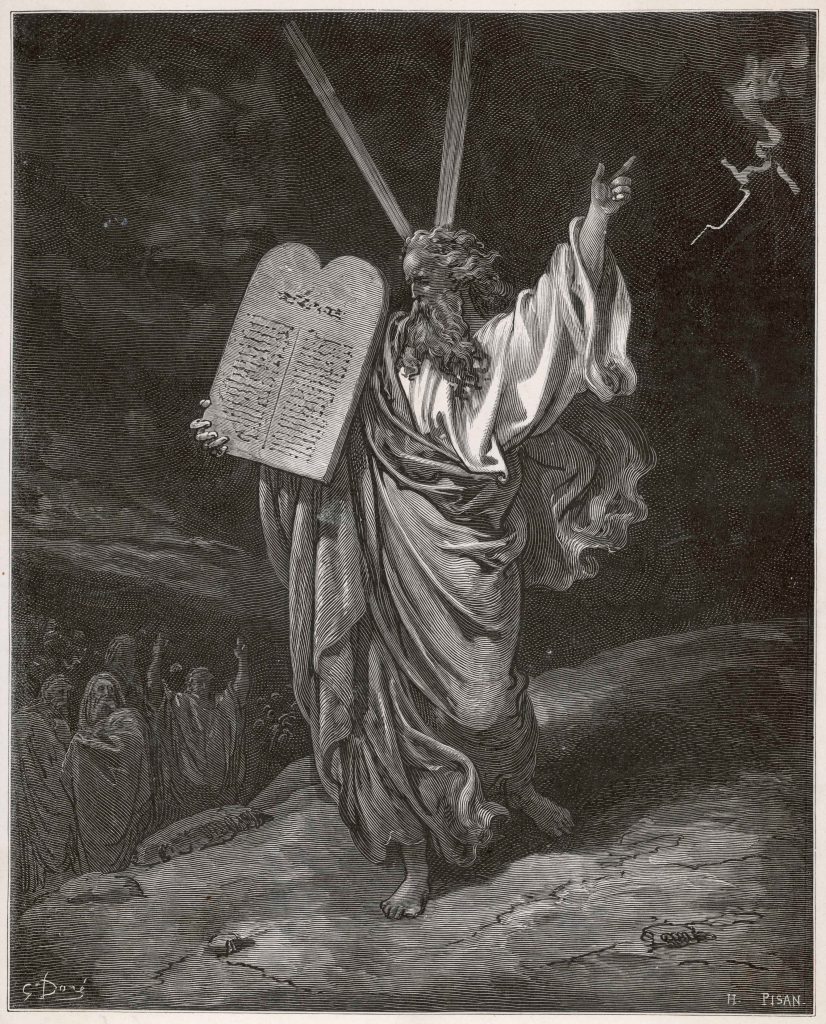
Yet we will find Israel running away from YHWH’s dreadful sound just as Adam and Eve ran and hid themselves when they heard the sound of God approaching them in the Garden (Exodus 20:18). Clearly YHWH invited them out of desire for friendship, to re-establish what was lost at the fall. On a negative note, YHWH wanted them near because distance causes suspicion and relational breakdown. We see this in 19:9 where YHWH tells Moses that He will come in a thick cloud so the people will hear when He speaks to him, so that they might believe Moses forever. Then, in 20:20, when the people stood afar off trembling at the pyrotechnic display of divine terror, Moses pleads with the people not to fear, for this was a test. Moses gives 2 reasons for this. The first seems very paradoxical. It is so that the people will “fear” YHWH. There are two types of fear; one that drives us away from God, and one that drives us to God. The former is a fear of distrust; that God is out to destroy us. The latter is a fear before the immensity and reality of God, a fear that inspires faith and obedience. Strangely, this fear can mature into the love of God. Second, Moses wanted them to brave it out so that they would not sin, which, in fact happened in Chapter 32. The Venerable Bede provides us with these reflections:
When about to give the Law, the Lord Descended in fire and smoke. Through the brilliance of his manifestation he enlightened the humble, and through the murky smoke of error he dimmed the eyes of the proud.
Commentary on the Acts of the Apostles 2
Moses alone ascended to its very top, where the divine majesty shone forth in fire and a dark cloud. Only the more perfect know how to grasp and observe the deeper and most sacred mysteries of the law; the carnal minded people, content with the external aspects of the letter, and gathered apart, as it were, below, stood to hear the words from heaven.
Homilies on the Gospels 11.17
The law of God is bracketed by YHWH’s warning in 19:24 for Israel not to break boundaries lest “He break out” against them, and this moment, when Israel actually hears YHWH thundering His commands and stood afar off in fright (20:18). The first has to do with presumption, the second with spiritual feebleness. YHWH and His law are terrifying while at the same time good. We cannot approach with presumption on one hand, and we cannot allow ourselves to be frightened off on the other. St. Paul must have been meditating on this very passage when he exhorts us to “work out your own salvation with fear and trembling, for God is at work in you, both to will and to do his good pleasure” (Phil. 2:12b, 13). Israel did not have the advantage of the last part “for God is at work in you …” for we have Christ, who is the very divine Word, the law, indwelling and at work within us. Yet, something strangely remains the same, and that is the “fear and trembling.” Are we presumptuous? Do we really know anything about holy fear? Do we choose to stand afar off and therefore fall into sin? Or, do we turn our face toward the terrifying mount with its dark cloud where we must face God and ourselves? It is not easy living with a Holy God!
They love Thee little, if at all
The Fear of God
Who do not fear Thee much.
If love is thine attraction, Lord!
Fear is thy very touch.
Our blessing will be to bear
The sight of thee so near,
And thus eternal love will be
But the ecstasy of fear.
Frederick Faber
Takeaway: God had great expectations for Israel and has great expectations for you personally; we must “work out our salvation with fear and trembling.”
Questions: How do you respond to the takeaway above? How do you feel about the importance of God’s law in your life?
Resources Used:
Faber, F. The Fear of God.
Bede in ACCS, vol. III, Exodus, Leviticus, Numbers, Deuteronomy.