They [Canaanites] must not live in your land. For if you serve their gods, this will become a snare to you. Exodus 23:33
Having introduced in the last post the idea of YHWH as “Divine Warrior” and holy war, it seems that here we need to discuss this topic that has drawn so much attention in modern times. To understand the biblical notion, we must reach back into its original context.
First of all, we must grasp why our modern culture condemns those places in the Old Testament where YHWH commands the annihilation of people groups as immoral. Where, we must ask, did this moral sensitivity come from? It can only be from Christianity itself, which, in its historical and orthodox expression, embraces these Old Testament narratives as divinely inspired. It did not come from the Greeks, the Romans, or any other religion or philosophy. This demands that any discussion on this difficult topic must engage in sincere dialogue with the Church.
Second, the whole topic turns on our doctrine of God. In the Scriptures, God as Creator has supreme and sovereign ownership of all things seen and unseen; the lives of every human and beast lie in His complete power. Indeed, all things come to life through Him, and all things die under His sovereign will, in spite of the fact that humans have been given power and a real will that can abuse and bring to an end the life of another human. It is understood in Scripture that God brings to an end, or allows the end, of every life individually, or if He so determines, great masses of people at once. This is true for natural disasters like tsunamis, or genocides committed by mankind. If we come at this purely from a secular or humanistic point of view, which denies the existence of God, or is deistic, then there can be no understanding of holy war in the Bible; all argumentation will be condescending and missing the mark.
Third, God determined that death is a direct punishment for sin. If we operate on a non-theistic evolutionary model, then sin and death can only be “flaws” in the system which science must rectify in time. The old liberal notion that humanity is getting better has lost its steam over the course of wars of the last century, and is all but extinguished in our present century. When we reject the doctrine of sin as the direct cause of death, we can never understand the Bible, and we drown in the hopeless despair of ever finding genuine meaning in life. We will be lost in the famous secular riddle; God either does not exist, or if He does, He is either cruel or impotent in the face of evil.
Fourth, mass destruction and annihilation of people groups, towns and cities, were a fact of life in the ancient context. The usual impulse behind this was survival and expansion in limited space. True, such wars were justified by the gods and therefore “religious;” the gods were invoked, directing by omens, and were acknowledged when successful, demanding a share of the booty. This may seem primitive to modern minds, but the truth is this sort of thing has been carried out over the last 100 years on a scale unthinkable by the ancients. Contemporary man is more brutal; killing wholesale and indiscriminately with their technology not to survive like the ancients, but for secular, political, or ideological reasons. Humanity is not getting better but worse.
Fifth, holy war in Israel was unique in that the nation did not wage war for YHWH or with the help of YHWH per se. Rather, the “wars of Israel were the wars of YHWH” (de Vaux). It is the very reverse of Islamic holy war where Muslims are expected to fight and kill for Allah. Israel’s enemies were first and foremost YHWH’s enemies. He was the one who determines the enemy and the right time to strike. His motive is justice; evil has to get to a certain point to vindicate war and annihilation. He is the one who goes before the hosts of Israel, fighting with supernatural powers, bringing the victory.
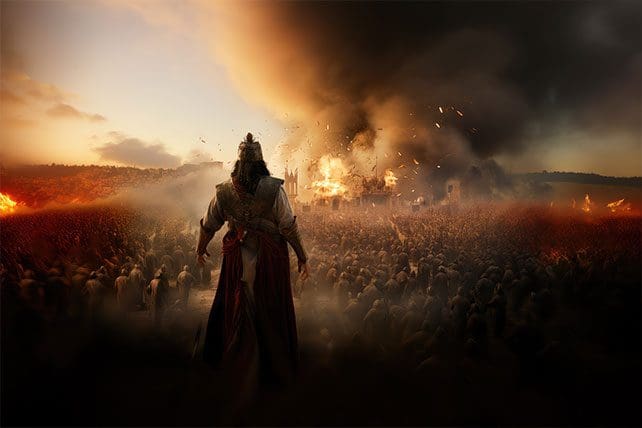
Six, annihilation was commanded in the land of Israel not only to cleanse the land from pagan practices of crimes, but to protect Israel from cavorting with the Canaanites, eventually making covenants with them (thus becoming kin to the pagans), intermarrying, breaking covenant with YHWH, and thus endangering YHWH’s plan to save the whole world. YHWH, who has complete power of life and death (point 2 above), has every right to bring whole populations to death whenever and however He deems fit.
Finally, although YHWH is the principle warrior, directing and fighting for His people supernaturally to bring about His own purposes, He often demands that His people engage in the slaughter. This, to me, is the hardest thing to comprehend. It is too horrible and painful even to imagine ourselves, sword in hand, hacking away at defenseless women, children, and babies. What did such bloody work do to the psyche of these warriors for YHWH? It is one thing to do it from the distance with bombs and drones, quite another with one’s own hands. How could they go home to their wives and families at the end of the day? I have no answer.
All this is hard indeed. We know that God demanded holy war for this particular period of redemptive history, and we are glad that we were not a part of it. The Church, however, has made holy war relevant through allegory. Our interiors are the land of Canaan, and they are filled with “Canaanites” in the form of vices and evil habits. We must invite Jesus, our YHWH, to lead us into battle against them. We must be merciless even though they scream “save me,” “have pity on me;” which if we do, they put us into miserable slavery. So we must be warriors determined to put to death everything that gets in the way of our reclaiming the spiritual space within. I remember my mother with shining eyes reciting those famous lines in Psalm 149:
Let the faithful exult in glory;
Let them sing for joy on their couches.
Let the high praises of God be in their throats
And a two-edged sword in their hands,
to wreak vengeance on the nations
And chastisement on the peoples,
to bind their kings with chains
and their nobles with fetters of iron,
to execute on them the judgement written!
This is the glory for all his faithful ones.
Praise the Lord!
Takeaway: YHWH is not some benign old bearded sleepy deity who pats humanity on the head overlooking their sins, but is a mighty holy warrior who brings judgment upon evil and injustice, who, in the old covenant, engaged His people to wage war with Him.
Questions: 1) How adequate is this excursus in your mind in response to the common liberal condemnation of YHWH as warrior in the Old Testament? Explain! 2) How does such knowledge of YHWH, who is revealed as Jesus Christ in the New Testament, affect the way you view God? 3) How is all this relevant to your Christian life?
Resources:
De Vaux, R. Ancient Israel, vol. 1 Social Institutions, Part III, Chapter 5.