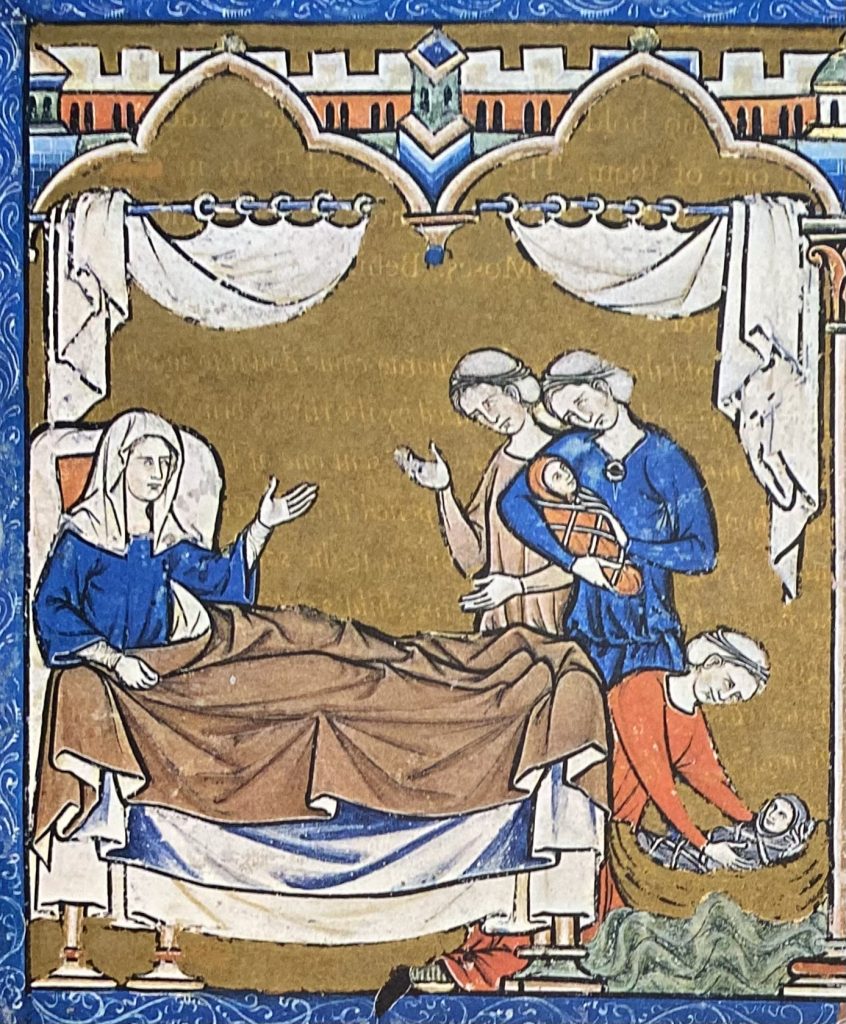
Now a man from the house of Levi went and took to wife a daughter of Levi. The woman conceived and bore a son; and when she saw that he was a goodly child, she hid him three months. And when she could hide him no longer she took for him a basket made of bulrushes, and daubed it with bitumen and pitch, and she put the child in it, and placed it among the reeds at the rivers brink. Exodus 2:1-3.
The persona of Moses dominates the whole of the Old Testament. True, Abraham is the father of the Hebrews, but God through Moses forged the Hebrew people into a nation in the most unlikely of situations. He is the soul of the nation; we might even say that he is the part that represents the whole. As God created by separating light from darkness, so Moses was the divine instrument to form Israel from chaos, to order, to rest. The man ascended the Mountain of God, disappeared into the cloud of unknowing, beheld what no other mortal has ever seen, gazing into the secrets of the heavenly temple (Ex. 24:15-18, 25:9). From this, Moses directed the building of the Tabernacle, upon which the glory of God settled so as to dwell once again amongst humanity. Moses is a man of cosmic dimensions.
Whence the law was rightly said to have been given by Moses, being a rule of right and wrong; and we may call it with accuracy the divine ordinance (Gk. thesmus), inasmuch as it was given by God through Moses. It accordingly conducts to the divine … Now Moses, to speak comprehensively, was a living law, governed by the benign Word.
Clement of Alexandria
There are two subtle indicators in the text of Moses’ destiny and greatness to come. His mother saw that “he was good” (2:2). The Hebrew kî-ṭôb is the very same phrase used at creation when God looked upon his work and pronounced it good, thus linking creation itself with Moses. God raised up Moses to perform acts that were parallel to the creative energies of God at creation. He was to separate a whole new people out of the chaos of Egypt, and thus transforming the world forever. As God set boundaries at creation that govern the cosmos, so God through Moses set moral boundaries, law to govern the human race. All creation was made to be a cosmic temple, and Moses is the one tasked to make the tabernacle, a microcosm of the whole. All of this is packed into kî-ṭôb.
The second indicator is in the little boat that his mother made, translated in the old English as “ark” 2:3. (trans. “basket made of bulrushes” above). The Hebrew here is the exact same as we have in Genesis 6:14 (Heb. tēbat) linking Moses with Noah’s ark, a word used only in these two places. Previously we have seen that Noah’s ark was in fact a Garden of Eden, a microcosm of creation and a temple bobbing on the face of chaos, the watery deep. As Noah was a “first man” like Adam in the ark, Moses is also a “first man” in that it is through him that God established salvation for humanity. All this was set in motion by a slave woman making a reed basket, placing her baby in it, and sending it adrift into the wild Nile to see what God would do with it. All of this is packed into this tiny basket. (See Cassuto, pp. 18ff).
Moses functions on a deep psychological level in the Book of Exodus. We might say that he represents what the Orthodox theologians call “the intellect” in the human psyche (also “spirit”). By intellect they mean that deepest part of our interiors that orders our more exterior parts like our reason, imagination, emotions, memory, will, and conscience (i.e. the soul), and outward to our bodies. The ‘intellect” is the most spiritual and mysterious place in the core of our being where God communes (See The Philokalia). All the other characters in the book are arranged around Moses like these other aspects of the person are arranged around the “intellect.” Egypt is the world which surrounds us. Pharaoh symbolizes the Devil who is intent on never letting us leave his domains. So Augustine:
We have been led out of Egypt where we were serving the devil as Pharaoh, where we were doing works of clay amid earthly desires, and were laboring much in them. For Christ cried out to us, as if we were making bricks, “come to me, all you who labor and are burdened.”
Pharaoh can also be linked to that mysterious part of us what St. Paul refers to as the “old man” within, always nasty, and never repents, crucified with Christ at our baptism (Romans 6:6), but still haunts us when we yield ourselves to sin and concupiscence. Aaron his brother, the High Priest, is the will that is so hard to keep in line. The Hebrew nation symbolizes the emotions and perhaps even the body and senses that craves to be satisfied by the things of this world. In the end Moses achieves for Israel what each one of us is to achieve in our own beings; to subdue our pharaohs and cravings of our flesh and create a sanctuary in our hearts where God can dwell. Indeed, Moses is a man of cosmic dimensions.
Takeaway: We must understand Moses not only historically, but also as cosmic man; he and the characters in Exodus must be allegorized so as to understand who we are in the journey of this life.
Questions: How comfortable are you with applying this narrative to your own life through symbol and allegory? Explain.
Resources Used:
ACCS, Augustine, Tractate on the Gospel of John, p. 3
Cassuto, U. A Commentary on the Book of Exodus, Jerusalem: The Magnus Press, The Hebrew University, 1987 English ed. Cassuto is a respected Jewish scholar.
Clement of Alexandria, Stromata, Chapter xxvi, vol. 2 of Ante-Nicene Fathers, p. 338
The Philokalia, compiled by St. Nikodimos of the Holy Mount and St. Makarios of Corinth. Vol. Two, London: Clays Ltd. 1990 paperback edition. This volume dedicated to St. Maximus the confessor. See glossary for “intellect” (Gk. vous), defined as “the highest faculty in man, through which, – provided it is purified – he knows God or the inner essences or principles of created things…” different from “reason” (Gk. dianoia).