… but the chief butler did not remember Joseph, but forgot him. Genesis 40:22

This episode in Joseph’s life is structured by the storyteller in an interesting way. There are three segments leading up to the central issue of this episode and three segments leading back down to the result of the story, forming what is called a “chiasm.” This structure may be outlined like this:
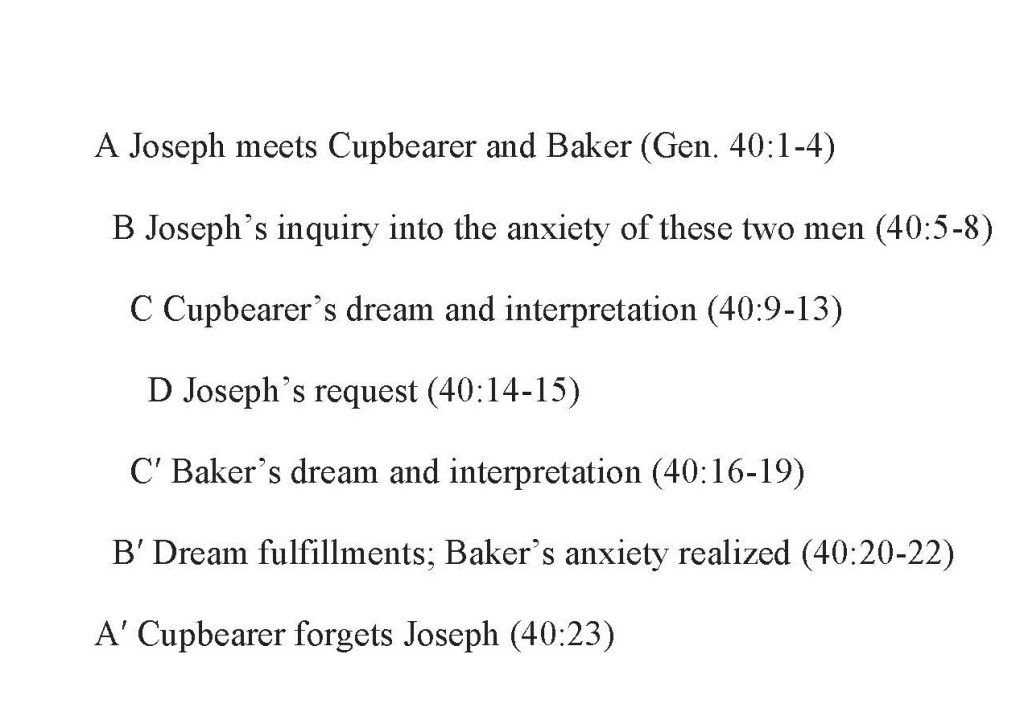
The first segment records the meeting between Joseph and the Cupbearer and the Baker (segment A), the gist of which has been described in the last post as we imagined the Warden giving these men into Joseph’s care. The second segment informs us that these two officials had dreams which made them uncomfortable and perplexed (segment B). Joseph out of sensitivity and compassion inquires about their state of mind. They tell him that they had dreams but did not know the interpretations. Joseph responds that interpretations belong to God and encourages them to tell their dreams, confident that God would show him insight into the matter. Evidently, the Cupbearer was the more hopeful of the two and divulges his dream first (segment C). This dream, of course, is known to us all; he dreamed of a vine with three branches budding, blossoming, and ripening with grapes all at once. He pressed the grapes into Pharaoh’s cup and placed the cup in Pharaoh’s hand. Joseph immediately interprets the dream favorably; in three days he will be restored to his former post.
What is most significant is not that Joseph could interpret the dream, but what happens next. Here we come to the midpoint of this episode where something truly unusual takes place (segment D). For the very first time in the life of Joseph, as we have it handed down to us, we catch a glimpse into his heart. He opens up, and the reader is allowed to see his deepest fears and how he really feels about things.
But remember me when it is well with you; please do me the kindness to make mention of me to Pharaoh, and so get me out of this place. For in fact I was stolen out of the land of the Hebrews; and here also I have done nothing that they should have put me into the dungeon.
Gen. 40:14- 15
The word translated “dungeon” above is in fact the Hebrew term for “pit,” the same word used for the hole that his brothers threw him in years before. (The Hebrew word is bȏr; cf. verse 15 here with Gen. 37:22.) The “pit” becomes for Joseph a metaphor for the dark trials he has endured for so many years. There is a sense of urgency, even desperation in this plea. We see him suffering “within the story rather than above the story where we see God working all things out for Joseph.” He is in the dark about his future, and he is afraid. His deepest fear is that he will remain forgotten in this pit for the rest of his life, and then what will come of his dreams and the destiny he felt God was guiding him toward?
The story moves on, however, and our brief window into Joseph’s soul is quickly shut. The Baker, emboldened by the Cupbearer’s sunny interpretation, blurts out his dream (designated segment C’ because it parallels the Cupbearer’s dream in segment C). This segment begins to move the episode back down to its conclusion. As we know, things do not work out so well for the Baker, who dreamed of three baskets on his head, the uppermost filled with baked food which the birds were devouring. Whereas in three days the Cupbearer would lift up his head before Pharaoh, in three days Pharaoh will lift the Baker’s head from off his shoulders.
Moreover, his body would be thrown out into the open for the birds to pick away, a fate worse than death itself for an Egyptian. The narration moves on in describing the fulfillment of these dreams just as Joseph predicted (segment B’). Finally, the episode ends with the disappointing fact that the Cupbearer forgot Joseph when he was restored to office (segment A’).
This structure highlights two critical things about Joseph and his experience. First, the D segment, which is intentionally positioned in the middle of the structure, contains Joseph’s request and is central to the whole episode. As described above, this segment reveals his deepest fears. Second, segment A’ is emphasized by its concluding position where Joseph’s deepest fears are realized. He becomes the forgotten one. We are mistaken, however, if we merely conclude that the forgetting here is on the part of the Cupbearer alone. The Cupbearer is incidental to the story. What is primary is something implicit and has to do with God Himself. When we compare this episode in Joseph’s life to his rise and fall in Potiphar’s house (Chapter 39), we are struck with the fact that there it is said that God was “with” Joseph. Indeed, the structure of that episode “hugs” Joseph; God was “with” him in Potiphar’s house and was “with” him in the prison; in between is the disastrous account with Potiphar’s wife. God surrounds Joseph with His presence in spite of the circumstances. In contrast, nowhere does it say that God was “with” Joseph in our present episode. This, of course, doesn’t mean that God actually abandoned Joseph. Rather, the reader is invited for the first time into Joseph’s perspective. He feels utterly forgotten by God. For two years (41:1) he languishes in the prison with a torment far worse than family betrayal, slavery, and unjust accusations that brought him to the pits of life. The One that really mattered to Joseph, whose presence he always felt and never doubted even in the toughest of times, now becomes utterly remote. Joseph now finds himself experiencing the dark night of the soul.
Takeaway: Joseph experienced his worst fear, that of being forgotten in the prison, and there is no mention of God being “with him.”
Questions: 1) What do you think God is trying to do with Joseph in this “dark night?” 2) Have you ever experienced anything like this in your life? 3) Do you have difficulty accepting that God sometimes treats his people so poorly for a greater end?