And Pharaoh said to Joseph, “I have had a dream, and there is no one who can interpret it; and I have heard it said of you that when you hear a dream you can interpret it.” Joseph answered Pharaoh, “It is not in me; God will give Pharaoh a favorable answer.” Genesis 41:15

We imagine Joseph going about his duties in the dungeon with his usual diligence, yet having to deal with the disappointment of being forgotten by the world outside ─ and seemingly, by God Himself. This went on for weeks, months…to be exact, two whole years. One morning Joseph woke up with his usual agenda in mind when the royal messengers came to the door. The day before he was organizing activities for criminals. That day he would stand before Pharaoh. In spite of the initial shock, we believe that in some strange way Joseph was really not all that surprised. As the Egyptians rushed about him in excitement, doing their best to make this grimy Hebrew presentable before their god the king, Joseph instantly knew what was happening. This was his hour! God had prepared him for this moment! With calmness and dignity, he went before Pharaoh to meet his destiny. Pharaoh was about to be introduced to the most unusual person that he would ever meet. So Chrysostom, “Notice immediately how much esteem Joseph enjoys from the outset. After being completely purified by endurance and emerging from prison like some piece of glittering gold, he was brought into Pharaoh’s presence.”
To appreciate more fully how unusual Joseph had become by this time in his life, we must compare him with the Egyptian magicians. These were no ordinary folk themselves. They were the elite group of wizards in a land famous for magic and the dark arts, rivaled only by ancient Mesopotamian cultures like Babylon. By Joseph’s time their guild boasted an aged past, collecting metaphysical lore and practicing rites for at least a millennium, perhaps two. Out of their labors came magical texts, such as the famous Book of the Dead, the primary source for witchcraft to this day. That they understood spiritual realities and possessed “paranormal” powers is not disputed by the Scriptures; they could turn common rods into snakes, water into blood, and even produce frogs from what seemed to be nowhere (Ex. 7:11, 8:7). We assume that they understood that dreams were mediums of spiritual revelations and insight, and were very adept in interpretations. On this occasion they did not have the ability to satisfy Pharaoh’s heart concerning his dreams.
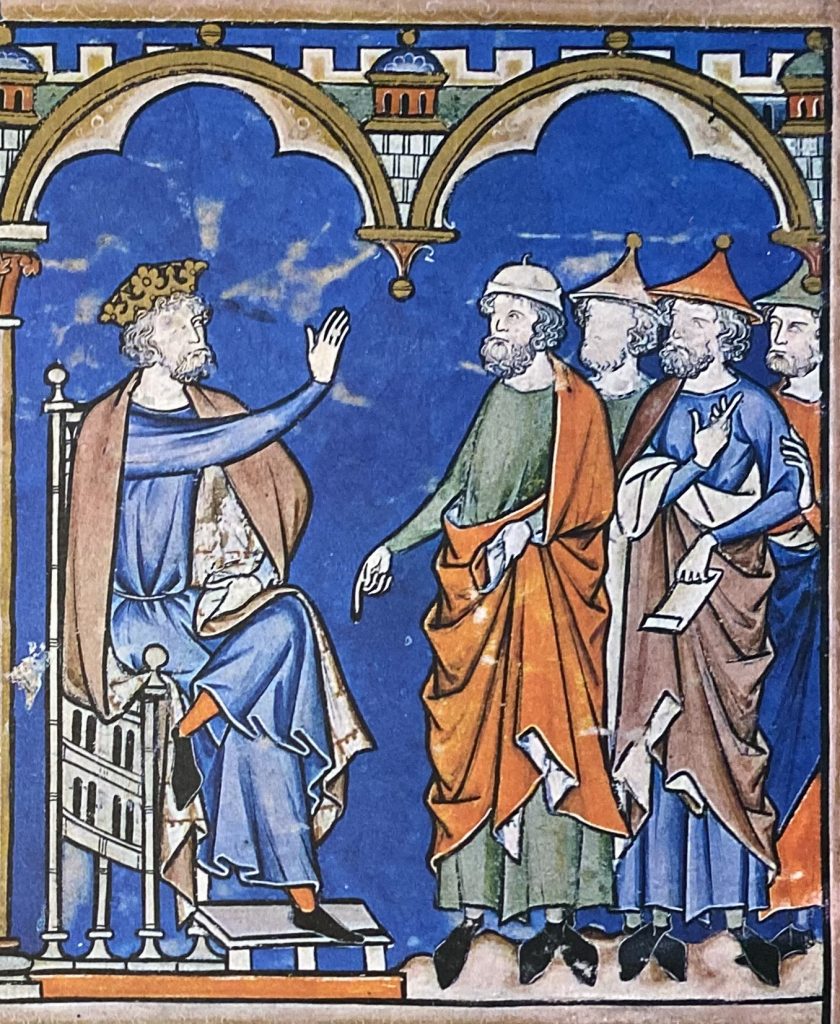
Here we cannot resist the parallel with Joseph’s counterpart in Babylon, Daniel. He achieved the auspicious title “Dean of Magicians over all the Wise in Babylon” (Dan. 2:48) and in another place filled the rather alarming position of “Chief sorcerer.” The word for sorcerer is the very same word used here in our Joseph story, usually translated “magician” (Cf. Gen. 41:8 with Dan. 2:48 and 4:9). It is difficult for us, with our rather austere conception of this very Jewish and orthodox prophet, to imagine him presiding over such an infernal collection, comprising of wizards, warlocks, soothsayers, mediums, and God knows what else. Tradition doesn’t elaborate for us what this might have looked like. It merely emphasizes Daniel’s complete power and authority over what was then the most elite group of spiritual power brokers. The same could be said of Joseph in this instance. He was a man who, in Pharaoh’s eyes, was more connected to the mysterious realm of the supernatural than anyone available to him.
It is here that we must distinguish true biblical mysticism from magic. Because both share the metaphysical sphere as its field of consciousness, there are bound to be similarities in vocabulary, concepts and perhaps even method in some cases. However, they belong to opposite poles. On one end is true mysticism, which springs from a vital relationship with the one, true, Transcendent God in order to give and serve God and others, not for power or the aggrandizement of self. On the other end is magic, which seeks to manipulate supernatural powers, the natural gods, so as to exalt the self. Both passionately seek to free themselves from the ordinary limitations of humanity and to live supernaturally. But the motives and the goals are as far apart as Heaven is from Hell. Moreover, the purest form of mysticism is biblical at its core, for the Holy Scriptures provides a map for those who venture into the supernatural, interpreted and guided by God’s very Own Spirit within. We simply do not know what this meant for Joseph, who did not have access to the Holy Script as we now possess them. To him belonged the rare circumstance of living out the drama of the holy story itself, a part which he was most probably aware of on some level, being a son of the promises. He was, no doubt, inspired by the God of his fathers, who raised him above the lowly realm of magic and the nature gods. The stage is set for the inevitable confrontation between true spirituality and magic.
Takeaway: Biblical mysticism and paganism may seem to share external similarities, but are worlds apart as to their essential world view.
Questions: 1) How comfortable are you with Joseph’s new station in life among Egypt’s occult community? 2) How do you reconcile this with what you know of Joseph’s ancestral religion of Abraham his great-grand father?
Sources Used:
Montgomery, James. Daniel, ICC, Edinburg, T & T Clark, 1979 ed. pp. 182f. on etymologies on Joseph’s (and Daniel’s) pagan titles.
Underhill, Evelyn. Mysticism, p. 71. For further discussion on the similarities and differences between false and true mysticism.