And Joseph said to his brothers, “I am Joseph; is my father still alive?” But his brothers did not answer, for they were dismayed by his presence. So Joseph said to his brothers, “Come near to me, I beg you.” And they came near. And he said, “I am your brother Joseph, whom you sold into Egypt. And now, do not be distressed, or angry with yourselves, because you sold me here, for God has sent me here to save lives…” Genesis 45: 3-5
In speechless terror the sons of Jacob stood before their brother Joseph (Gen. 45:3). It was if they saw a ghost, a demonic incarnation of their little brother now grown great, looming over them in absolute power. Surely they tasted at that instant something of the dread all souls shall one day experience before the Almighty “God of the spirits of all flesh” (Num. 16:22). We may be certain that their initial reaction, leaping out of their bodies in unified fright, was that this was the day of vengeance. However, they experienced something far stranger than vengeance. They simply were not prepared to see this Egyptian apparition, this incarnate Joseph, weeping before them, reassuring them that they were forgiven. Love is more shocking than justice.
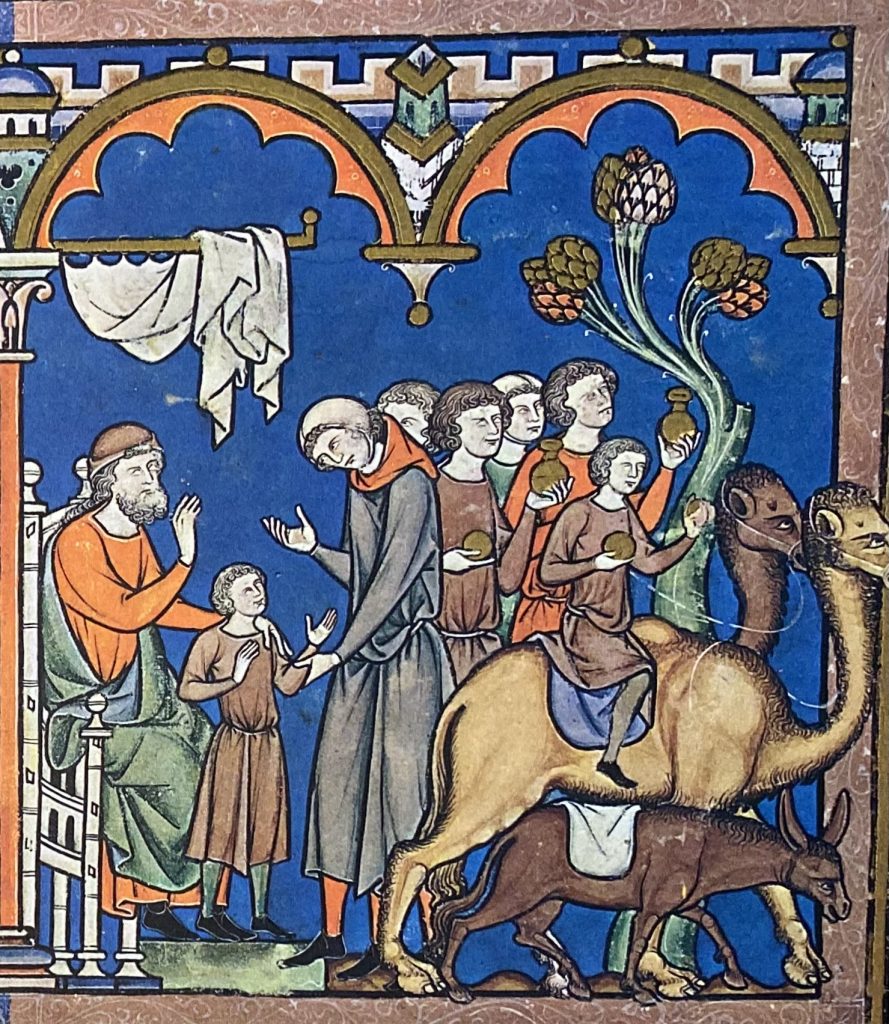
We are struck with the great man’s gush of emotion. Here was the embodiment of dignity itself howling so loudly that the Egyptians could hear him clear outside the walls of his palace (Gen. 45:2). At first blush we might think that Joseph was acting out of character. When we consider the story to this point, however, we see that this sobbing man was in complete control. In fact, Joseph’s control over Egypt and himself is absolute. We have seen that Joseph gained mastery of his soul early on; he could control his passions. In his dealings with all whom he encountered since his descent into Egypt, he shows himself master of his tongue, keeping knowledge to himself with the power of the apt word (so W. Lee Humphries, see below). Moreover, here we see clearly demonstrated that he was master over anger, possessing the power to forgive.
It is also a fact that Joseph was master of his emotions. Twice before Joseph was overcome with emotion and had to leave his brothers: when he saw that his brothers were convicted of their crimes and when he first saw Benjamin (42:24, 43:30). He showed incredible control in leaving his brother’s presence, lest he would give himself away, and all would be lost. Now, the third time, the number of completion, when the time was perfect, he lets himself go. We see a tremendous power of will here. The mark of spiritual persons is that their wills govern their emotions, rather than their emotions govern their wills. When the emotions rule the will, the result is ineffectual action. Joseph is anything but ineffectual. “It is Joseph’s control of emotion, not its denial, that the wise value” (Humphries).
Biblical wisdom, which is to say biblical spirituality, or mysticism, doesn’t deny emotion like other philosophies or forms of mysticism. We are not to be stoics or emotionally detached Buddhists. Rather, the emotions must be arranged under the will. By nature, our emotions, such as fear, sorrow, joy, and hope, control the will so that we fear the wrong things, sorrow over the wrong things, rejoice over the wrong things, and hope in the wrong things (So St. John of the Cross, Ascent). Self-mastery means that we, by the inner working of God’s Spirit, reverse this pattern. God wishes us to have strong wills; wills that will what He wills. He wishes that we fear Him, and Him alone. He wishes that we sorrow over the things that He sorrows over. He wishes that we rejoice and hope in Him, rather than take joy and hope in things temporal. Those who have their emotions rightly arranged under their wills, feel not less, but more keenly, than those who don’t. They feel the way God feels, and God feels intensely. He is pure passion!
Joseph’s display of emotion, therefore, enhanced his stature with his brothers, as well as with the excluded Egyptians who heard from the outside. We see the great man gaining his composure and at once addressing the core issue that divides them. He is anxious that they not be angry or distressed with themselves for their evil deeds, for God was behind their actions all along. Now it is true that Joseph wished to relieve his brothers from their dismay with these words. However, he spoke to them not in an expedient, or off-handed way, but as one who had pondered deeply the meaning of causality. Joseph’s God was one who governed the world through secondary causes. That is, humans are absolutely free to do what they want however evil their intentions may be. They are endowed with the power and dignity of causality. Joseph’s God is so great, however, that He works all these actions to His own purpose.
We do not know how philosophical the brothers were, particularly in the emotion of the moment. Once left alone with their thoughts, however, they must have marveled at how God brought good, even their own salvation, out of their own destructive behavior. Completely unknown to them, God fully permeated the whole of their lives and with a skill that did not violate their freedom, brought them all before Joseph in this great moment. And so it is, this ancient story endorses with enthusiasm human freedom and responsibility at one extreme, and God’s absolute freedom, power and foreknowledge over his creation at the other extreme. The story does not achieve a balance between these two but pushes them both to their extremes. Truth lies in the outer extremes when both ends of the paradox are pushed at the same time to their utmost (so Merton, see below). Error lies when one extreme is pushed at the expense of the other. Balance is for those in theological slumber. The theologically alive live on the edges and, therefore, possess all that is between.
Takeaways: 1. Emotions are good and necessary to who we are as humans, but must be rightly arranged under our wills, as Joseph demonstrates for us. 2. God is absolutely sovereign over everything; even over your own narrative, but we have free will and are responsible for who we are and become.
Questions: 1) What role do your emotions play in your life? 2) Would you say that you are emotionally mature or immature? 3) How do you personally respond to the paradox of God’s sovereignty and your own freedom when it comes to living out your own life day to day?
Resources used:
Humphries W. Lee, Joseph and His Family W. Lee Humphries. (Columbia: University of South Carolina Press, 1988)
Merton, Thomas. Introduction to his No Man is an Island, (NY: Harcourt, Brace and Company, 1955).
St. John of the Cross, Ascent of Mount Carmel, Chapters 16-45.