
I will put enmity between you [serpent] and the woman, and between your seed and her seed. (Gen.3: 15). When Adam had lived a hundred and thirty years, he became the father of a son in his own likeness, after his image, and named him Seth. (Gen. 5:3).
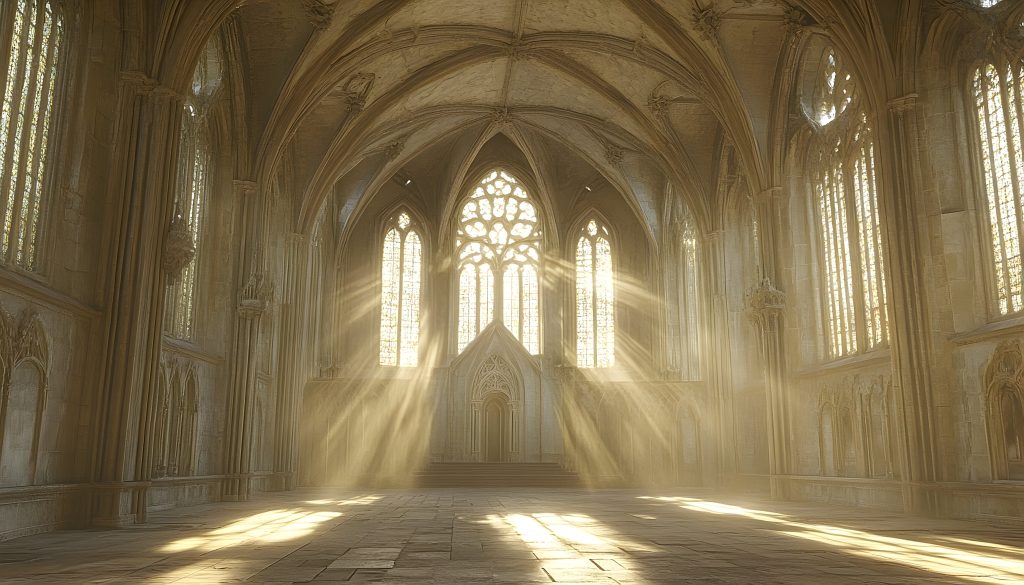
The picture painted in the last post is dark and grim, but it is not the only reality. True, the cosmic Temple is but a shadow of its former glory, but the glory is still present, just under the crust of the cursed earth, pushing its way to the surface, an undeniable reality in the world. Gothic Cathedrals were made with an upper level full of windows called a clerestory through which light streamed down upon the floor. In a like manner, the light of God shines down through the wreck and ruin of the temple upon the earthen floor, giving us hope. Chaos cannot win; God must and will.
The ray of light is given to us in 4:25 where we see that Adam and Eve bore Seth, and it is in his line that “men began to call upon the name of the Lord.” What is more, Seth is specifically said to be made in the image of Adam who was made in the image of God (5:3). This specifically tells us that the imago dei, in spite of the fall, is the fundamental reality of Seth’s line, the distinguishing trait. Now it is true that Cain was also made in the imago dei, being Adam’s offspring. However, we see in Chapter 4 that Cain’s line is in process of falling away from this fundamental human feature, and become more violent and wicked. The fact that the fall has not obliterated the imago dei in every human is critical. The divine image within us leaves us with many interior powers, such as a conscience and the knowledge of what is right, and real choice. God’s warning to Cain in 4:7 proves to us that Cain was not absolutely powerless against the temptation before him. He had fight, and with God’s help, he could have mastered the beast of sin.
Moreover, the divine in humanity will conquer evil. Here we have the famous passage in Gen. 3:15 traditionally called the “protoevangelium” (first forecast of the Gospel). Modern critical scholarship has abandoned the messianic understanding of this prophecy, interpreting it as a simple etiology of why women and snakes do not get along, a life-death struggle of species (Gunkle, von Rad, Westermann). However true the etiological interpretation may be, in the context of the whole of Scripture, as we shall see, this “seed motif” demands a much deeper meaning, the allegorical meaning. The serpent has spiritual, metaphorical, and symbolic meaning that cannot be denied to be true to the text. In spite of the fact that evil will snap at, strike, or bruise “his” heal, he shall crush its head. The pronoun “his” is masculine singular, and can be understood as a collective of the seed of Eve, or as an individual who will prophetically conquer evil. In fact, as a first reference to Christ, we see that the collective Church will in fact defeat evil by and through the power of the One.
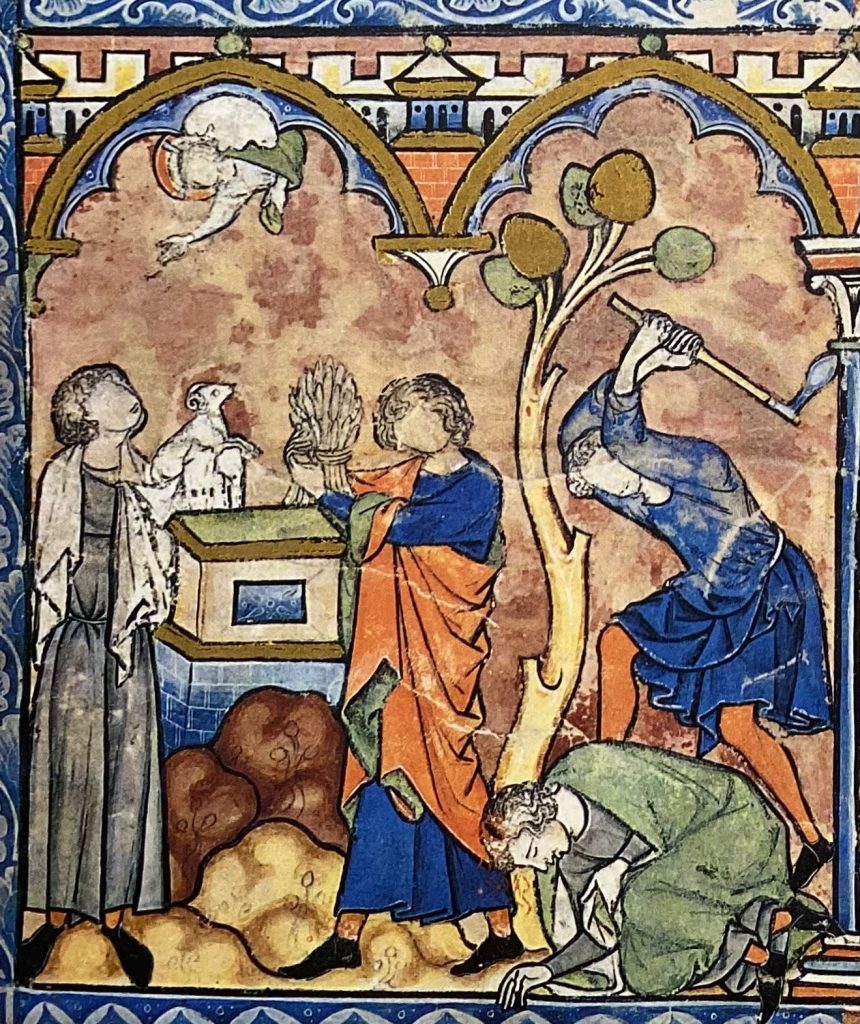
Finally, God clothes Adam and Eve. As we have said in previous posts, nakedness is the visible symbol, or motif, that describes sin and its effects on humanity. Adam and Eve tried to save themselves with their feeble attempt to cover themselves. That God provided animal pelts to deal with sin and its consequences is symbolic of salvation as a divine act. Implicit is that God slew these animals, which is startling, for it makes God the first killer. This speaks of a price that must be paid for sin. Redemption is not cheap. It costs the most precious thing that we humans have ─ life! Sacrifice is fundamental to restoration and worship itself, and it would be natural to the ancient mind that the story of Abel and his sacrifice in contrast to Cain’s halfhearted vegetable offering follows hard upon the fall described in Chapter 3.
We see these beams of light shining through the clerestory down into the gloom. It gives us hope. Humanity will either seek this light or hide in the gloom, groveling in the shadows. The ruined temple can be experienced as heaven or hell. It all depends on how we see the light. Do we love it and work our way towards it, or do we shrink from it because it exposes our evil?
With these beams of light, we see that God is recreating his holy temple. There are two forces within. Like the original creation pattern, God is taking humanity from chaos to order to rest. This movement is in contrast to the fall where we see humanity receding from rest to disorder, finally to tumble into chaos? The re-creation of the individual is the same motion as the recreation of the cosmos, for both are temples.
Takeaway: In spite of creation’s haunting and an environment crawling with snakes, both literally and spiritually, God is reversing the effects of the fall, working from chaos to order to rest.
Questions:
- How equipped do you feel to live in the drama described above? Do you feel resilient? If so, why?
- What do you personally tend to see in this cosmic temple of ours, its hauntedness or the light from the clerestory? Explain.
Resources Used:
Gunkel, Hermann Genesis in Mercer Library of Biblical Studies, Mercer University Press, 1997, Macon Georgia, p. 21
Westermann Genesis 1-11 p. 260.
von Rad, G. Genesis, in the Old Testament Library, Philadelphia, The Westminster Press, 1972, p. 92.