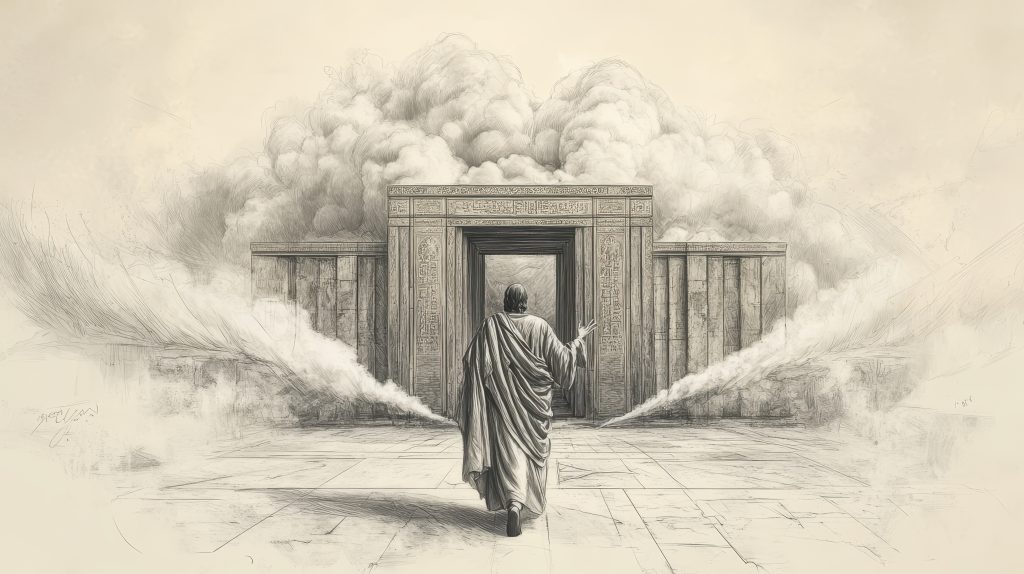
Then the cloud covered the tent of meeting, and the glory of the LORD filled the tabernacle. Moses could not enter the tent of meeting, because the cloud settled down upon it and the glory of the LORD filled the tabernacle. Whenever the cloud rose from the tabernacle, the Israelites would set out on their journey. But if the cloud did not lift, they would not go forward; only when it lifted did they go forward. The cloud of the LORD was over the tabernacle by day, and fire in the cloud at night, in the sight of the whole house of Israel in all the stages of their journey. Exodus 40:34-38
We find ourselves at the grand finale of this great Book of Exodus. The conclusion is dramatic. The glory cloud of Sinai now shifts off the spectacular heights of Sinai and descends upon the Tabernacle. Here we clearly see the merging of the temple/mountain motifs, taking us back to the beginning of creation where we saw Eden, the original sanctuary, on God’s primal mountain. Now God’s cosmic mountain is portable in the form of this Tabernacle, YHWH dwelling in the midst of His people. The glory is so intense, even Moses, who saw things beyond the pale of the rest of humanity, could not stand within.
The portable nature of this Temple/Mountain edifice dovetails with the journey motif. As we said earlier in our post, in statu viae, this mortal life is one of journeying toward a perfection beyond this transient world. The desert is symbolic of this world, but the beauty of being guided by the glory cloud gives Israel meaning and direction. YHWH is taking them, as He is us, through the desert of this life to the Promised Land. The impact of this stage in Israel’s life left an indelible memory of theophanic light; “seeing” is fundamental to salvation.
Throughout our work we have seen how fundamental both typology and allegory are to our interpretation. Without it all this wonderful drama, however interesting, remains an antique of the past. Typology directly links persons and things to Christ and His Church. For instance, Moses is a type of Christ in delivering Israel, Passover to the sacrifice of Christ, and the passage through the Red Sea to Baptism.
There is one very important typological connection we must not miss about the tabernacle. As we have seen, it was built on a vision God gave to Moses; it was an earthly representation of a heavenly reality. It was therefore absolutely critical for the Tabernacle to be perfectly pure, beautiful, and proportioned. In short, it must be immaculate to house Deity. It is crystal clear in biblical thought, and specifically to St. Luke in his infancy narratives, that the Blessed Virgin was the fulfillment of the Tabernacle. When the Angel Gabriel greeted the Blessed Virgin, he referred to her as “full of grace” (charitoō). This is a verb in the Greek perfect tense which poignantly indicates she was such before this encounter, not because of the encounter. Behind this Greek verb “grace” is the Hebrew word ḥesed as we find in John 1:14 referring to Jesus as “filled with grace (Gk. charitos) and truth.” Jesus possesses this grace essentially as YHWH of the Old Testament; Mary possesses this grace by divine gift, a perfection from original sin or even taint of sin from birth, immaculate, like the Tabernacle.
Further proof that this was precisely in St. Luke’s mind is the Greek word used in the phrase, “the Most High will overshadow you.” The verb translated “overshadow” (episkiasei) is the very same word used in the Septuagint for the glory cloud over the Tabernacle “because the cloud abode (episkiaṣen) upon it.” The root of this word is “over cover, shadow,” binding the YHWH’s theophanic glory in the Tabernacle with that of the Son of God within the Blessed Virgin.
Of course, our Incarnate Lord is the ultimate fulfillment of this Tabernacle/Temple motif as we have seen earlier in our posts (See Post Conclusion to the Tabernacle above). The Tabernacle is not only a type for the Blessed Mother of God, but of her divine son who took on human flesh from her through the mystical work of the Holy Spirit. Her womb was the “Most Holy Place” where transcendence and the material came together in Jesus Christ. He is the divine sanctuary among us birthed out of the sanctuary of His mother. This close association between Jesus Christ, Lord of All, YHWH of the old Covenant, and His mother, is essential to recognize. Christians who do not recognize it tend to de-emphasize the humanity of Jesus Christ and emphasize His divinity. In turn they tend to de-emphasize the material and emphasize the spiritual, the internal and subjective, thereby tending toward Gnosticism.
On the allegorical level, we see this whole story is the story of a person’s progress towards perfection. Moses, representing our spirit/intellect, finally, after much prayer and intercession, begins the building of our “Tabernacle.” The will, representing Aaron the High Priest, no longer sacrifices to the golden calf, but is set up to sacrifice to YHWH. The body follows the spirit through the will. Satan, that is, Pharaoh, is defeated and the person leaves Egypt, representing the world, behind. It all ends with YHWH’s glory cloud descending upon the person, and dwelling within. Surely this is what St. John means when he records our Savior’s words, “If a man loves me, he will keep my word, and my Father will love him, and we will come to him and make our home in him (John 14:23).”
We see there is a fluidity between type and antitype and allegory which simply does not compute in the brains of rationalists and those committed solely to the historical/grammatical approach to Scripture. This is because their minds have been formed by modern western thought without their knowing it, and are much farther from a truly biblical and Apostolic world view than they suspect.
Takeaway: This climax of the finished Tabernacle and God’s Glory descending and inhabiting it is critical to the Incarnation of Jesus and our own spiritual perfection.
Questions:
- Many Christians believe that focusing on Mary in any way takes away from Jesus, who must be our sole focus. In what ways does this post help you understand that this mindset is just not true?
- As you think over the Book of Exodus as we have presented it to you, how and in what ways has your understanding of your salvation changed?