Unclean animals were associated with death (Chapter 11). Blood loss at childbirth, outside of the sacred context of ritual, is impure and defiles unto death (Chapter 12). Skin diseases look like death (Chapters 13-14). Here in Chapter 15 we see that genital discharges of various kinds are associated with death as well. We prefer the more imaginative French Phrase La Petite Mort over the rather pedestrian English word “orgasm” because, as we shall see, it fits the theology in our discussion better. Only ritual can take a person from death/chaos, to order, to rest, that is, life, wholeness, and holiness.
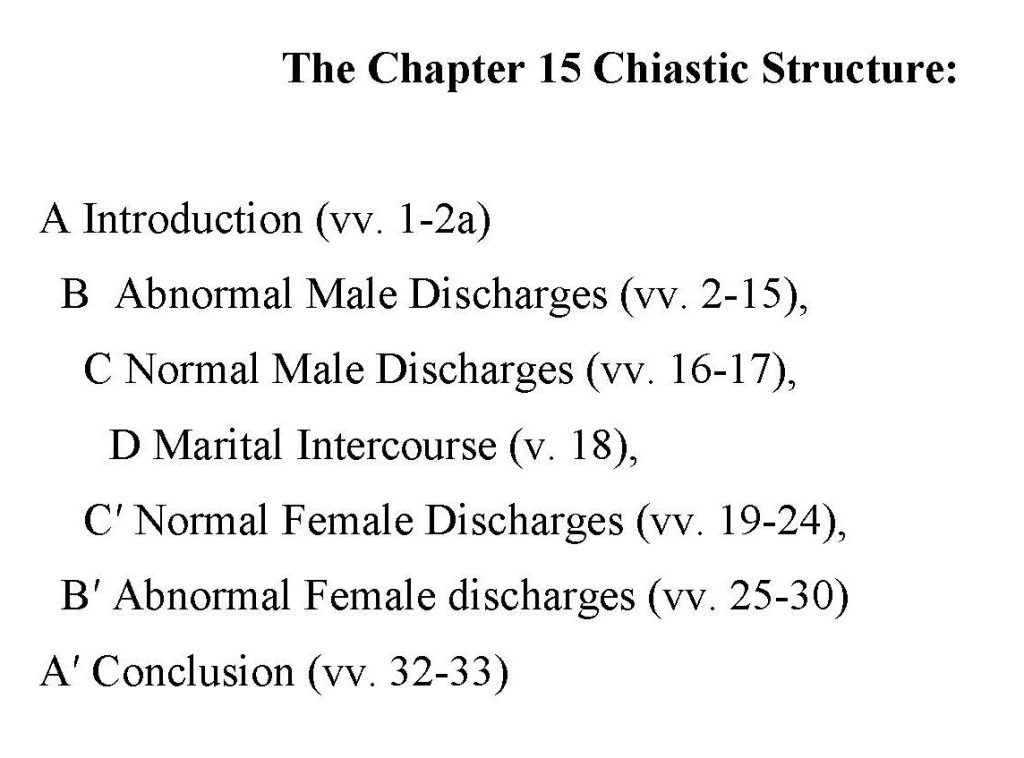
Two things jump out at us. First, one would think that this chapter would best fit with Chapter 12 where childbirth and women’s menstruation is addressed. Milgrom suggests these chapters are structured around the “duration and complexity of the purification process, in descending order,” starting with forty or eighty days of purification for childbirth (Chapter 12), to the least for one-day seminal emission here in this chapter (p. 905). In other words, the ritual itself is emphasized over the topic. Second, marital intercourse (D) is emphatically placed at the center of the chiasm binding both the male and female cases together.
The first condition is that of abnormal male discharges (ebrew Hebrew zāb). Again, as with the various skin diseases, it is not clear what it is. What it is not is gonorrhea, which was unknown before the 15th Century, but most probably blennorrhea utrethrae, an inordinate flow of mucus (Milgrom, p. 907). What is of interest here is how highly contagious this was, for it infected his bed and anything he sat upon, as well as anyone who touched him. If someone did touch the infected bed, chair, or body, that person had to wash himself and his clothes, and was unclean until evening. Once healed, he had to wait seven days, wash his clothes, cleanse his body with running water, and on the eighth day offer up two sacrificial birds, one for a burnt offering, and the other for a purification offering.
If there is an emission of semen, he must bathe his whole body, wash the garments that have semen on them, and be unclean until evening. If the emission happens in intercourse with a woman, both shall bathe themselves in water, and both rendered unclean until the evening.
Again, as we have noted above, our text takes us back to feminine discharges already covered in Chapter 12. Here, however, we see the detail of water purification which parallels that of the male purification, except the impurity extends to seven days. During this time a man must not lie with her, or he too is unclean for seven days. If the discharge is chronic, she is deemed unclean until she is healed. As with a man she is highly contagious, and once healed, seven days are necessary for purification, and on the eighth day go to the priest with two sacrificial birds for a burnt offering and a purification offering.
It is essential to understand there is no moral sin to atone for with regard to these sexual diseases. Everything has to do, for the male, with the discharge of semen (šikbat zera‵, outpouring of seed). For the woman, it has to do with ovulation of seed and the bloody discharge. The sexual act is not morally wrong. Sexuality in every facet is meant to be enjoyed because God created both male and female in the image of God. However, sexual emissions result in impurities which cannot come into contact with God’s holy sanctuary in their midst.
Why? Because sexual discharges were understood to be life leaving the body in the semen and the blood and therefore associated with death. This is true even in sexual intercourse which brings life, yet death in its superfluity which must be cleansed. Indeed, the ecstasy and climax with release most naturally has been associated with death, which the French call La Petite Mort. It is not morally wrong, and certainly a most beautiful expression of love and union if done within the boundaries of married love established at creation. But being part of the mortal cycle of life and death in fallen humanity, it is not without defect. Sex is holy, but it is not to be worshipped or idolized as in pagan fertility rites. This is behind the injunction for the Hebrews to stay away from women for three days before approaching God at the Mount (Exodus 19:15).
Just as the food law regulated Israel in their meat diet, so these emission laws regulated Hebrew sexuality. Married couples had to keep in mind not to have sex on Sabbath and holy days; if so, they would have to forgo public worship, potentially resulting in a huge social embarrassment. Male self-stimulation leading to orgasm, which is not here addressed in a moral way, would render that man contagiously impure, not fit to be in society or God’s sacred space for that whole day. He has death about him.
These sexual taboos, just like the rite of circumcision discussed in our Genesis 17 post, served to separate the Israelites from pagan sexual ritual at the sanctuary, but also protect family life (e.g. from prostitution, so Wenham, p. 223). Therefore, these laws can be applicable in a spiritual way even though we are not, as a Church, obligated to follow them as law.
In the past, man coming from marital intercourse was required to wash. It cannot be too strongly said that the providence of God revealed through the Lord no longer makes this demand. The Lord eliminates washing after intercourse as unnecessary since he has cleansed believers by one single baptism for every such encounter, just as he takes in many washings prescribed by Moses by one single baptism.
Stromateis, Clement of Alexandria,
Takeaway: Sexual emissions were associated with death, rendering the person contagiously impure with things they touch, requiring them to withdraw into secluded privacy.
Questions:
- How do you feel about these laws which touch on the most sensitive area of human life?
- Can you make the link between sexual emissions and death? Explain!
- Can you see any applications for today? What are they?
Resources Used:
ACCS, vol. III, p. 184
Milgrom, Leviticus 1-18, 902-1008.
Wenham, G. The Book of Leviticus in NICOT.