When the people saw that Moses was delayed in coming down from the mountain, they gathered around Aaron and said to him, “Come, make us a god who will go before us; as for that man Moses who brought us out of the land of Egypt, we do not know what has happened to him.” Exodus 32:1
The golden calf episode and its ensuing fallout is of utmost importance to the Book of Exodus. The very literary structure within which it is placed demonstrates how central it is. Consider this chiasm:
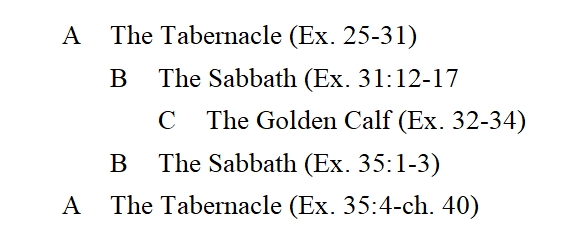
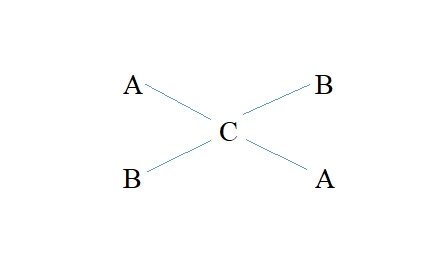
When we arrange the letters as we do below, we see an X, like the Greek Letter X (Chi, from which we get “chiasm”) crossing the A and B sections through the center “C,” making it the centerpiece of the whole last half of the Book from Exodus 25 through 40.
Let us work through what makes this episode so important. As Moses suspected, the people rebelled when he went out of sight for forty days and nights; they quickly became forgetful, impatient, and bored. By their own choice they excluded themselves from close proximity to YHWH at the foot of the Mountain. They were terrified before the Holy; they did not have the spiritual fortitude to hear YHWH speak with Moses. They were not privy to Moses’ vision, the revelation of the Tabernacle. What transpires is thick with irony; they decided to create their own rendition of what YHWH was revealing to Moses over the span of forty days and nights.
It is very telling how the people wanted to remain faithful to YHWH yet at the same time gave way to their deep underlying pagan impulses. They demanded Aaron to make “gods, who shall go before us.” The Hebrew for “gods” is the plural ‵elōhîm, a common term in reference to God when the corresponding verb is singular. Here the corresponding verb “who shall go before us” is plural, which seems to imply a polytheistic plurality of gods. Grammatically, however, this plurality may refer to a “god-like” image (Cassuto), which fits the context of a singular idol, the golden calf (Heb. ‵ēgel). Scholars tend to understand this calf functioning as a substitute for the ark, above which YHWH is enthroned. Whatever way we decipher the people’s intentions, this demand is in direct contrast to Moses, whom the people clearly want to be free of, by their disrespectful “… as for this Moses, the man who brought us out of Egypt, we do not know what has become of him.” Their desire was for some tangible representation of the divine presence “more real and direct than Moses could be” (Moberly).
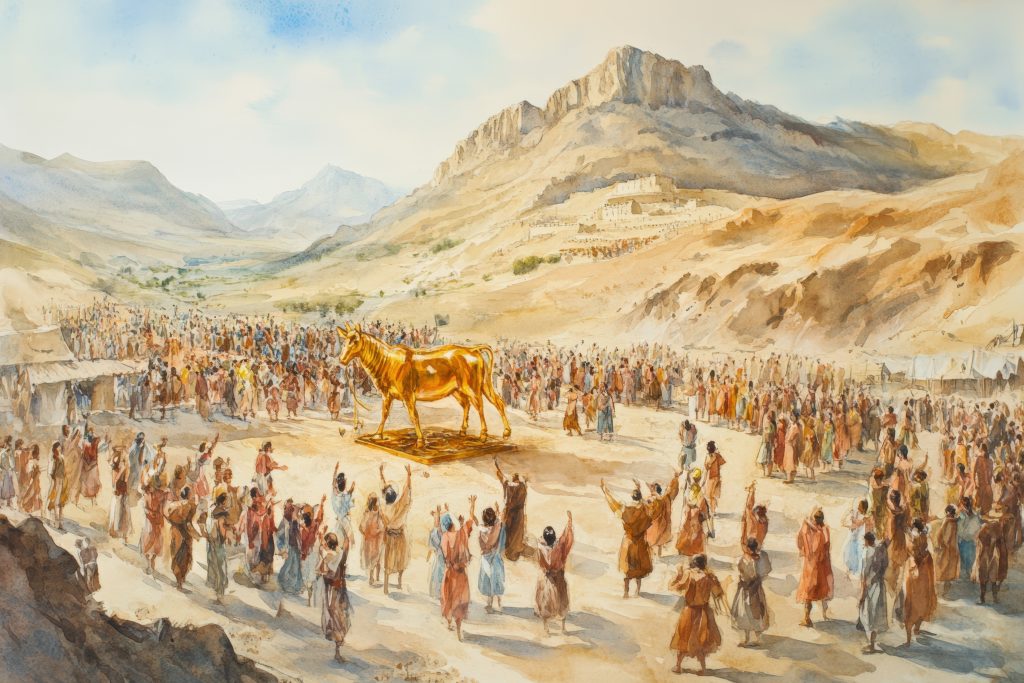
What is shocking is how Aaron immediately complied without a word. He demanded everyone to contribute their gold jewelry, melted down the metal, and crafted a golden calf. The collection of gold must here be seen in contrast to Moses’ request for materials for the building of the Tabernacle, which were given freely. This places the golden calf in direct competition with not only the Tabernacle, but with Moses himself. The irony in the comparison demonstrates the absurdity of the golden calf, which comes off as a grotesque parody of the real thing. The question for the people is this; Who mediates between God and the people, this calf or Moses (Moberly)?
Aaron falls completely into line with their thinking by his declaration, “These are your gods, O Israel, who brought you out of the land of Egypt.” However, this is in contrast to the peoples’ own statement where they had just confessed Moses was the one who brought them out of Egypt. The text adds a very telling phrase, “And Aaron saw…” What did Aaron see? The Hebrew verb “to see” (wayyar′) could easily be read “to be afraid” (wayyirā′), which explains his behavior. Aaron builds an altar, and declares a “feast to YHWH” for the next day. The people bring “peace offerings,” and it all ends in a pagan orgy. Aaron, out of fear of the people, finds himself presiding as YHWH’s High Priest over a scene full of irony and confusion. In contrast, Moses is on the Mountain fasting, enduring the mysterium tremendum, the awful presence of the Holy, on behalf of his people.
The calf represented a new illicit form of YHWH, or perhaps a substitute for the ark above which YHWH was enthroned, directly breaking the first commandment. The Children of Israel, like most of humanity, were very religious, but they wanted religion, even God, in their own way. But Moses was in their way, about to come down off the Mountain with the tablets of the law in hand.
The careful reader, on a subliminal level, may very well connect personally with our narrative which can be brought to light through allegory. We have said all along that Moses represents the spirit dwelling in our most interior spiritual space, likened to the Most Holy Place in the Tabernacle. It naturally longs for union with The Spirit of God, a union for which it was made. Aaron represents our will through which Moses, our spirit, works. The people represent our flesh and sensory powers. The spirit aspires to ascend the mountain of God desiring union, but the flesh rebels, desiring immediate gratification. The will, because it is weak and fearful, acquiesces to the flesh like Aaron does to the people. The will is confused, knowing what it should do, but fails to do it. It finds itself fighting against the spirit within, producing deep interior chaos.
Takeaway: When Moses delays out of sight on the Mountain, the people press Aaron into making a golden calf which functions as an alternative mediator to Moses, a mediator they can control.
Questions:
- Readers often express surprise over how quickly the Children of Israel turned toward idolatry, breaking the first commandment which they had just heard on the Mount before they backed away out of terror. How would you explain this narrative to someone so surprised?
- How do you personally connect with the allegory of this narrative expressed above?
Resources Used:
Cassuto, U. A Commentary on the Book of Exodus. Jerusalem: Magnes Press, 1967.
Kugel, James. The Bible as it Was. Cambridge: Harvard University Press, 1997.
Moberly, R.W.L. At the Mountain of God: Story and Theology in Exodus 32-34. Sheffield: JSOT Press, 1983.