This is the rite you shall perform in consecrating [Aaron and his sons] as my priests. Exodus 29:1
Up to this point in ancient Israel, we surmise that the firstborn, the primogenitor, functioned as the priest of the family unit in its original semi-nomadic setting (so Hahn). We have no reason to doubt this would continue even as Israel transitioned into a nation with YHWH dwelling in their midst in the Tabernacle. YHWH chose Aaron, Moses’ brother, and his sons, to carry on as High Priests to do the work (Heb. ‘ābōdā, Greek latria > liturgy) and keep (Heb. ṧāmar guard) the newly constructed sanctuary. Both of these Hebrew words are used throughout the Pentateuch for priestly duties, and we find them both together in Genesis 2:15, where Adam was given the responsibility to work and guard paradise. Pre-fall Adam and Aaron are therefore linked together through their calling and responsibilities.
To fulfill this role, the High Priest must become what he is not by nature. He must be transformed through a seven-day process, again linking him to creation. The Hebrew term for “ordain/consecrate” is literally “filling the hand” (28:41, 29:9, 29, 33, 35). What this means scholars are not sure, but in the context it surely has to do with the investiture of authority, power, and holiness to stand between the people and the Holy YHWH. Indeed, upon Aaron’s turban was placed the plate of gold inscribed “Holiness to YHWH” (28:36) described here as a holy crown/diadem (Heb. nēzer haqqōdeṧ), suggesting royalty (29:6, cf. II Sam. 1:10).
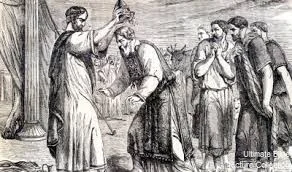
The ceremony consists of various sacrifices, such as a bull for a sin offering, two unblemished rams for burnt offerings and a “wave offering.” The second of the two rams is referred to as the “ram of consecration,” the blood of which is applied to the right ears of Aaron and his sons, and the great toes of their right feet, most probably connecting the office to hearing YHWH, and walking righteously before YHWH. Also, the blood is sprinkled upon Aaron’s garments and those of his sons, making them holy. This ram was to be eaten with bread as a peace offering by Aaron and his sons at the door of the “tent of meeting,” most probably a temporary tent used for holy purposes before the tabernacle was completed. A holy oil of the finest aromatic spices was then applied to Aaron and his sons, and to the whole tabernacle and every article within when the tabernacle was finally built. A daily sin offering was sacrificed each day of the ordination week. As for these various sacrifices, we will discuss them in detail when we get to the Book of Leviticus.
The actual work of the High Priest was first and foremost offering the daily morning and evening sacrifices. A lamb was offered at both. The morning lamb offered with a libation of a mixture of fine flour, oil, and wine. The evening lamb was offered with a cereal with its libation. Consider these beautiful words associated with these offerings:
Throughout your generations this regular burnt offering shall be made before the LORD at the entrance of the tent of meeting, where I will meet you and speak to you. There, at the altar, I will meet the Israelites; hence, it will be made sacred by my glory. Thus I will consecrate the tent of meeting and the altar, just as I also consecrate Aaron and his sons to be my priests. I will dwell in the midst of the Israelites and will be their God. They shall know that I, the LORD, am their God who brought them out of the land of Egypt, so that I, the LORD, their God, might dwell among them.
Ex. 29:42-46
Immediately following Aaron’s ordination, we find mention of the Altar of Incense, the last article belonging to the Holy Place with the Table of the Presence, and the Menorah (30:1). As we noted earlier in our introductory post on the Tabernacle in this section, the Altar of Incense is mentioned here with Aaron’s ordination rather than earlier with the Menorah and Table because it is more directly related to priestly function (Cassuto). Be this as it may, the Altar of Incense is made in the exact same style as the Ark within the Most Holy Place and the Table of Presence: acacia wood plated with pure gold, a cubit in both length and breadth, but two cubits high, with horns on the four corners, and two rings on each side and poles to slide through to carry it. It has the decorative molding to match the Ark and the Table. It is placed in the middle of the Holy Place before the pârōket, the veil which separates the Holy Place from the Most Holy. Incense is to be burned in conjunction with the trimming of the lamps of the Menorah in the morning, and its lighting in the evening. The incense itself was composed of a special, therefore “holy” formula, and any other incense was unholy and therefore forbidden.
No specific purpose for incense is given here. However, it belongs to the vision given to Moses of the heavenly sanctuary. Indeed, smoke, darkness, and storm clouds are often associated with Old Testament theophanies, as we saw with Abraham in Genesis 15 and here on Mount Sinai. Incense, of course, would burn through the thin gold plate of which the altar was made, and so we surmise some sort of bowl was placed on top for its burning (Cassuto). This corresponds to the Book of Revelation where we are shown bowls in heaven burning incense, defined there clearly as the prayers of the saints (Rev. 5:8, 8:3). Incense in the early church was not commonly used because of its deadly association with burning incense to the Emperor. When Rome was converted, incense naturally made its way back into the Church (Dom G. Dix). Again, the Mass is a picture of heaven on earth.
Takeaway: The High Priest Aaron is transformed and made one with the sanctuary he serves in through his vestments, ordination and ministry.
Questions: The ordination and ministry of the High Priest provides for us crucial background to understand Jesus, our Great High Priest.
- What parallels do you see between the High Priest and his sanctuary and Jesus Christ and the Mass?
- How do the vestments, ordination, and ministry of the Church’s priesthood draw on this discussion?
Resources Used:
Cassuto, U. A Commentary on the Book of Exodus.
Driver, S.R. The Book of Exodus, in Cambridge Bible for Schools and Colleges, 1929.
Dix, Dom Gregory. The Shape of the Liturgy. Esp. p. where he talks of incense in the early church, pp. 426ff.
Durham, J. Exodus.