For the glorious adornment of your brother Aaron you shall have sacred vestments made. Therefore, tell the various artisans whom I have endowed with skill to make vestments for Aaron to consecrate him as my priest. These are the vestments they shall make: a breastpiece, an ephod, a robe, a brocade tunic, a turban, and a sash. In making these sacred vestments which your brother Aaron and his sons are to wear in serving as my priests, they shall use gold, violet, purple, and scarlet yarn and fine linen. Exodus 28:2-4
For upon his long robe the whole world was depicted, and the glories of the fathers were engraved on the four rows of stones, and your majesty on the diadem upon his head. Wisdom 18:24
We have worked our way through the structure of the Tabernacle and its furnishings and now our attention is drawn to the priestly garments. Rather than discuss these garments in detail, we will focus on the overall meaning and function of these sacred vestments.
Like the Tabernacle itself, which links us to paradise, to Eden before the fall, so Aaron’s vestments are connected. We know that before the fall Adam and Eve were “naked and not ashamed.” Since the fall, nakedness is the central idea of what it means to be fallen, vulnerable, exposed to the elements, concupiscence and ultimately death. Post-fall nakedness must therefore not be exposed in God’s sacred space like in the heathen fertility cults (20:26, 28:42). Instead, clothing is now a symbol of eternal life in the presence of God.
Aaron’s vestments, by and large, match the Tabernacle perfectly. This is of utmost importance. As High Priest, he represents the whole of God’s people and mediates between them and YHWH. The High Priest walks about in heaven within the Tabernacle, perfectly matching the eternal in all its splendor. The first of the colors mentioned in the above text is gold; gold predominates in the tunic, ephod, and “breastpiece,” no doubt gold spun into the fabric, matching the golden walls and furniture. The rest of the colors of violet, purple, and scarlet match the veils above on the ceiling, the veil separating the Most Holy place from the Holy Place, and the entrance. A blue robe with artistically made pomegranates alternating with golden bells along the hem overlaid these vestments; it is emphasized that the sound of the bells was heard as the High Priest ministered.
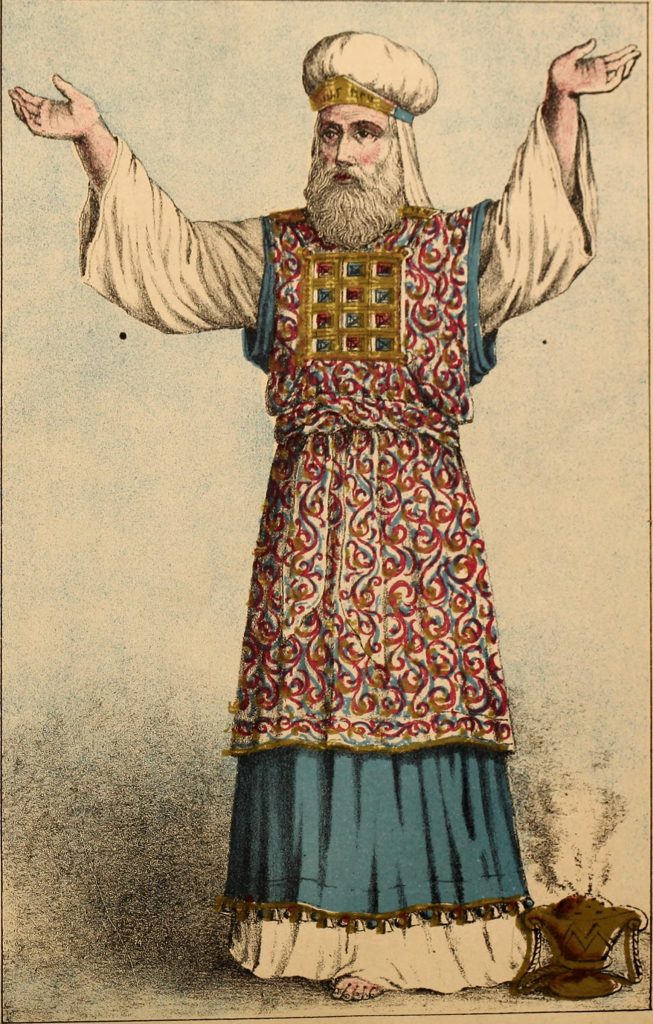
Central to Aaron’s vestments is the “breastpiece” (Heb. ḥōṧen) of judgement (Heb. miṧpāt), to which is attached the 12 gemstones, each inscribed with the name of a tribe, and contains the ′ûrîm & Tummîm, translated “lights and perfections.” This breastpiece is made with the same material as Aaron’s ephod and the veils of the Tabernacle, and was doubled. What this doubling means depends on our understanding of the ′ûrîm & Tummîm. It has become popular over the last couple of centuries among both Christian and Jewish scholars to understand the ′ûrîm & Tummîm as lots cast to determine YHWH’s will. After all, this phenomenon was well known throughout the Ancient Near East from ancient times. If so, then the doubling of the breastpiece would serve the practical purpose of creating a pouch to hold the lots, whether they be in the form of dice-like stones or sticks of varying sizes (so Cassuto).
However, casting lots can only provide yes or no answers, and apart from the fact that it is associated with magic among the pagans, the scriptural evidence suggests that the ′ûrîm & Tummîm, essentially linked to both the “breastpiece of judgement” and placed over the heart of Aaron, was oracular and revelatory, providing information more than “yes or no,” on special occasions when YHWH was directing Israel in critical national situations, such as war (Cornelius Van Dam, p. 210). Rather, the ′ûrîm & Tummîm should be understood as a “hendiadys,” two words linked together as to make one rich meaning, translated as “perfect light” (Van Dam, p. 230). Early Talmudic and Christian commentators envisioned this “perfect light” as a special gemstone attached to the breastpiece among the twelve stones in some way. When the High Priest inquired of YHWH about critical national matters, YHWH would respond, this revelation would be authenticated by the supernatural glow of this “perfect light.” Van Dam suggests the reason modern commentators have ignored this earlier understanding is “the rise of rationalism in the seventeenth century and the anti-supernatural bias of our secular age…” (p. 232).
This interpretation suggests that the doubling of the material for the breastpiece was necessary to bear the weight of the twelve gemstones and their settings, along with the gem of perfect light, sewn on the breastpiece. This breastpiece was in turn bonded to the ephod by gold rings and bands over the heart of the High Priest. The ephod itself was strapped to the shoulders of the High Priest by two Onex stones, one for each shoulder, inscribed with the name of the twelve tribes, six on each stone. The twelve gemstones were attached to the breastpiece in four rows, each inscribed with the name of a tribe. With this symbolism of the precious stones on the breast of the High Priest, one cannot help but be profoundly moved by the value YHWH places on His people as the High Priest continually stands before Him.
We must here make mention of the turban. We do not know what color this turban was, but what is essential was the gold plate attached to it with blue, or deep violet, laced ribbons. Upon it was inscribed “Holiness to YHWH” (Heb. qōdeṧ layhwāh). By wearing this before YHWH, the High Priest is said to bear all the transgression of his people in their failings to serve YHWH perfectly, which is inevitable for mortal, frail people, YHWH acknowledging their best intentions (Cassuto). The “holy” is both beautiful, yet always dangerous.
The Church embraced the beauty of priestly garments in the form of the alb and chasuble. Initially, the presiding presbyter (i.e. “elder,” from which we get our word “priest”), wore tunics like everyone else in the Greco Roman world, but no doubt his very best for Mass. As time went on and styles changed, the priest continued wearing the old fashioned tunic which morphed into the chasuble. The chasuble informs the people that the priest is serving at the altar in persona Christi who is our High Priest, the fulfillment of the High Priesthood in the Old Testament (so Dom. G. Dix).
Takeaway: The High Priest, as mediator between God and the people, must preside in beautiful garments that matched the Tabernacle symbolizing heaven on earth. He bears the people on his breastpiece as he serves before YHWH, and receives revelation through the “perfect light.”
Questions:
- Using your imagination, envision Aaron serving before YHWH in the Tabernacle as described here. What do you see, and how does this affect you?
- Does this post inspire you with regard to your worship in your church and/or your own sacred space? If so, how? If not, why?
Sources Used:
Cassuto, U. A Commentary on the Book of Exodus.
Dix, Dom Gregory. The Shape of the Liturgy, London: A&C Black, 1945, p. 404.
Van Dam, Cornelius. The Urim and Thummin; A Means of Revelation in Ancient Israel. Winona Lake: Eisenbrauns, 1997.