They shall make an ark of acacia wood … Exodus 25:10
The first thing described is the most holy of all, the ark and the “covering” (Heb. Kappȏret) upon which the two cherubim were stationed. The ark itself was a rather small box 2.5 cubits long, 1.5 wide, and 1.5 high. We should not confuse this box (Heb. ′arȏn) with Noah’s ark, which is a different word in the Hebrew. It was purely functional in that it housed the two tablets of the law, which were far smaller than most pictorial renditions we see in art and the movies. Such a practice was similar to Ancient Near East (ANE) custom of placing a covenantal contract made between two kings in the “footstool” of the idol of the deity who sat as a witness. We see in Scripture the ark was indeed called the “footstool of YHWH” (Ps. 99:5, 132:7-8, I Chron. 28:2), even though the earth is also called His footstool (Is. 66:1, Matt. 5:35), and sometimes so are YHWH’s enemies (Ps. 110:1, Matt. 22:44). Here the ark as footstool takes on cosmic meaning, for it also serves as the support, or base, for the Kappȏret and the cherubim, as we shall see.
Although functional, the ark was beautiful. Its wooden frame was plated with gold, and encircled with a “molding of gold,” most probably a floral design. Four rings of gold were attached to it, two on each side, through which two poles plated with gold passed through to carry the ark. The poles were not to be removed, indicating that YHWH was not a local deity, but moved and traveled with His nomadic people.
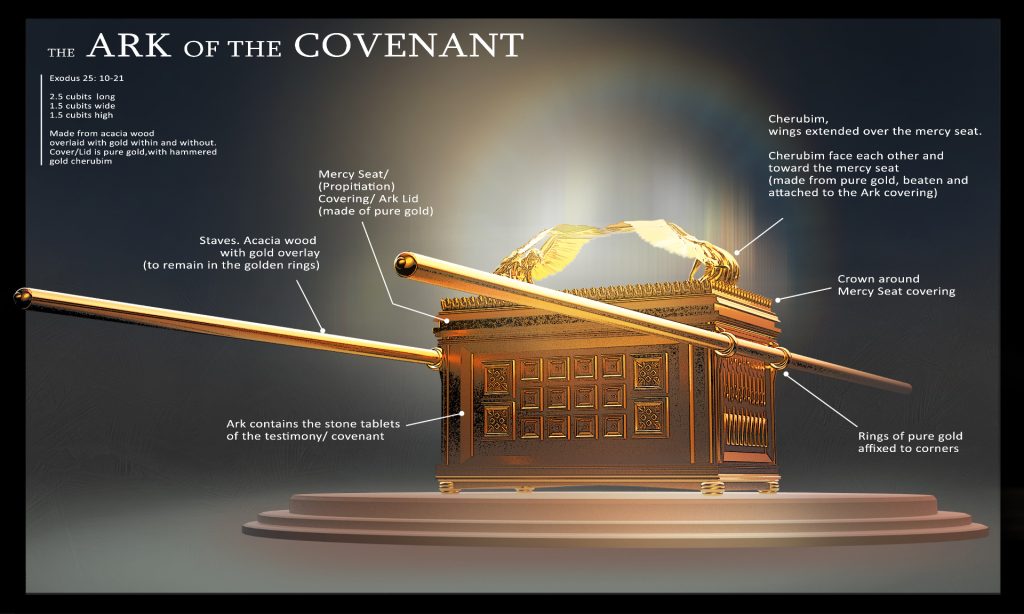
The Kappȏret was the heart of the sanctuary. It was a lid made of solid gold fitted exactly over the top of the ark. The Kappȏret was of one piece with the two winged cherubim stationed upon it, made of solid gold, and so the two must be understood together. The cherubim were creatures understood to be the embodiment of the wind, riding the clouds, and this takes us back to the ancient cosmological notion of the divine chariot. We see this most dramatically in Ezekiel’s vision where we see the winged creatures with 4 faces facing the 4 directions with a “firmament” above their heads. This word “firmament (Heb. rāqîa‵) is the same word in Genesis 1:6 describing the dome God made to separate the waters above and below. This word, interestingly enough, denotes something beaten round and smooth, like what is done to metal, as we have with the Kappȏret. What we have here with the Kappȏret is a divine chariot, a throne upon which YHWH is seated, who is and must be invisible, riding above the wings of the cherubim (cf. Ps. 86:4), breaking into the world of mankind.
As for the etymology of the word Kappȏret, the word is derived from the Hebrew root kpr, to “cover,” which can be taken literally here as a covering for the ark, but also used for the covering of sin, or atonement, as we see in its association of the Day of Atonement, Yom Kippur, where the high Priest enters this most sacred place once a year. English translations, inspired by Luther’s German Bible, often render it “the mercy seat.” As for the cherubim, they most likely had human faces, most likely of youthful form, according to Talmudic tradition. They stood facing each other with wings stretched forward touching each other, and faces turned down so as not to look upon God enthroned above them.
The cherubim filled the ceiling above woven in the veils, symbolizing the heavens above and the spiritual realm, as well as the veil separating the Holy Place from the Most Holy Place, within which was the ark with its Kappȏret and cherubim. The cherubim functioned as guardians of the Holy, directly linking this place with the Garden in Eden and the cherub guarding the entrance with drawn sword. But this also takes us back before the fall where Adam and Eve communed with God without sin. This Tabernacle was a return to lost origins, to the glory lost at the fall.
The Church naturally allegorized the ark and the Kappȏret with the cherubim. St. Gregory the Great associates the ark itself with the Church:
What is symbolized by the ark but holy church? The orders are that it is to be provided with four rings of gold in four corners-obviously because, being extended to the four parts of the world, it is declared to be equipped with the four books of the holy Gospels. And staves of setim [acacia] wood are made and inserted into these rings for carrying, because strong and persevering teachers, like incorruptible timbers, are to be sought out, who, always adhering to the instructions of the sacred volumes, proclaim the unity of holy church, and, as it were, carry the ark with staves to the untutored minds of unbelievers. Furthermore, they are ordered to be overlaid with Gold, that when the sound of their preaching goes forth to others, they may themselves shine in splendor of their ways of life.
Pastoral Care 2.11
The Venerable Bede, following Gregory, sees the ark representing the Church, but addresses the contents. Note that our Exodus text here only mentions the tablets of the law, but we know from Ex. 16:33ff. and Num. 17:10, that it also contained the jar of manna as well as Aaron’s rod that budded:
It [the Church as ark] contains in itself the tablets of the covenant by continual meditation on the law of God; it also contains the golden urn with the manna as a guarantee of the Lord’s incarnation, and Aaron’s rod that budded as a sharing of the kingship and priesthood of the Lord.
On the Tabernacle, p. 20
And with regard to the cherubim, Bede teaches:
Then they [the cherubim] are also ordered to look towards one another and to face the propitiatory [the Kappȏret] doubtless because they agree with one another in glorifying the Divine Vision. In addition, the two testaments can be figured through the two cherubim; one of them proclaims the incarnation of the Lord as future, the other as having been accomplished… They turn their faces to the propitiatory because they vigorously commend the Lord’s mercy, which is the world’s only hope…
On the Tabernacle, p.18
Takeaway: The ark was YHWH’s footstool containing the tablets of the law, the Kappȏret the chariot throne of YHWH, and the cherubim upon the Kappȏret symbolized “the flight” of YHWH breaking into spaces and time, above which YHWH was believed to be enthroned.
Questions: 1) How and in what ways does the symbolism of this ancient piece of furniture help you understand God and Scripture better? 2) In what ways do you see Christ in all this imagery?
Resources:
Bede: On the Tabernacle, ed. Arthur Holden, Liverpool University Press, 1994.
ACCS, vol. III, p. 123
Cassuto, pp. 328ff.