Israel, bonded by covenant with YHWH, made kin by a solemn oath; living arrangements must now be made. Although there are similarities between the sanctuaries the Canaanites made and the Hebrew Tabernacle, the one central idea driving the following building instructions is this: Moses must construct it according to the pattern YHWH has shown him on the mountain (25:9, 26:30, 27:8, and Numbers 8:4). This fact alone lifts the importance of this structure above the mere historical moment to significance for all time. It is symbolic of something eternal; it has the aura of heaven about it, and therefore worth our meditation.
Two things immediately stand out. First, anyone can contribute to this venerable structure. True, later in the narrative we see everyone must participate in the operation of the Tabernacle through a temple tax (I30:11ff.); the actual building of it is something done freely, not forced. It was seen as a privilege, an opportunity not to be missed, to be part of the construction of the sacred space YHWH was to dwell in.
Second, the materials for this sanctuary were of the highest quality and most costly: precious metals, stones, fabrics, animal pelts, acacia wood, spices and oils. These materials are paradise motifs that link us to the Garden in Eden described in Genesis 3. Beauty and splendor, extravagance of costly things, are essentially linked to God’s sanctuary and the holiness of sacred space. God’s dwelling is meant to be uncommon, extraordinary, glorious. As we shall see in Leviticus, the opposite to the Hebrew concept of the holy is the common. God must not come into contact with the common, that is, the normal state of things after the fall.
Having established this, a word must be said here about the structure of this whole section of Exodus 25 through 31. Most of us know the basic format of the Tabernacle with the two rooms, the most interior being the “Holy of Holies,” or “The Most Holy,” and the outer room, the “Holy” Place, which are set in a court yard surrounded by a fence-like structure. The text starts with the most holy and interior object, the ark of the covenant, in the Most Holy Place, and works out from there to the furnishings of the outer room, the table of the Bread of the Presence and the lampstand. (The Altar of Incense in this same space is described later, linked as it is to the order of liturgical service, not directly to God’s abode – Cassuto).
The text then takes us to the construction of the walls of the tabernacle. The beautiful veils woven of blue, purple, and scarlet materials with cherubim designs are described first, with golden loops to hold them together. The walls over which they were hung were made of wooden boards plated with gold that rose, when attached together and anchored in sockets of silver, ten cupids high. Over all this the exterior covering of goat’s hair was placed to protect it from the weather, and on top of this, specially prepared ram’s skins dyed red for the roof. The interior veil that separated the Holy Place from the Most Holy Place, again, with cherubim woven upon it, is described, supported by four pillars of wood plated with gold. Then the screen for the entrance from the outside with its five pillars for support is prescribed.
From there we are taken to the court outside. Here we find the altar in the front of the tent. The text then takes us to the exterior walls of the court that surrounded the whole. With the general structure of the whole in place, liturgical features are addressed, namely: oil for the lamp, the priestly garments, Ephod, directions for the ordination of Aaron and his sons, daily offering, the altar of incense, the bronze laver between the altar and the tent, and ending with specifications of anointing oil and incense.
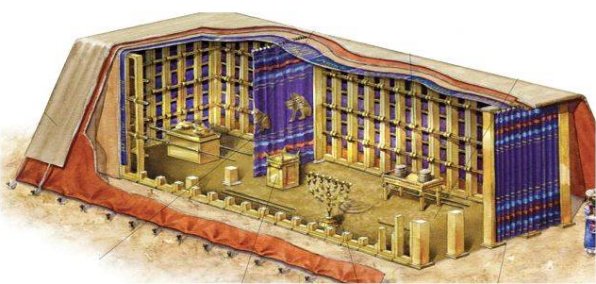
It is critical here to observe that the whole project, though directed by God through the heavenly vision, was created by divinely inspired artisans, Bezalel and Oholiab. It was a thing of absolute perfection, as we see in its exact decimal dimensions. When one entered through the exterior screen, one immediately beheld golden walls, a golden lampstand to the left, a golden table with the Bread of the Presence to the right, and the golden altar of incense directly before him. Fifteen cubits above (approximately 15 feet) one would see the ceiling of woven veils of blue, purple and scarlet with cherubim. The gold clasps that bound the veils together sparkled in the light of the Menorah like stars in the night sky. Directly in front, just beyond the altar of incense with its smoke rising to the celestial ceiling, was the special veil that separated the Holy Place from the Most Holy Place, where God sat enthroned upon the wings of the Cherubim stationed on the Ark of the Covenant.
We must take this tabernacle very seriously to understand God, His universe, and ourselves. We will therefore take our time working through all these elements described above. Our guide will be the Venerable Bede and his seminal work, On the Tabernacle, an 8th century work, among other commentaries, Jewish and Christian. St. Bede respects the historical context of this structure, but he is also a master of the proper use of allegory to bring it to life in our hearts.
Takeaway: The tabernacle was built by heavenly design; as such it is timeless and of spiritual value for all Christians throughout all ages.
Questions: 1. How and in what ways has ecclesiastical architecture affected you spiritually? 2. Do you find yourself curious about the tabernacle and how it may inform your spiritual life?
Resources:
Bede: On the Tabernacle, trans. with notes and introduction by Arthur Holder, Liverpool University Press, 1994.
Cassuto, U. A commentary on the Book of Exodus.
Strong, James. The Tabernacle of Israel in the Desert. Grand Rapids: Baker Book House, 1952.