You shall not make for yourself an idol or a likeness of anything in the heavens above or on the earth below or in the waters beneath the earth; you shall not bow down before them or serve them. Exodus 20:4
For Catholics, the first commandment is in two parts; the general prohibition to have no other gods before Him, and the more specific command not to make images to worship. This commandment concerning images is rooted in creation and the created order. In Genesis 1, God created nature in ascending order, from inanimate objects such as the sun, moon and stars on the 4th day, birds and fish on the 5th day, land animals culminating with the creation of humanity on the 6th day. The order is important, for it teaches us that humanity, made in the image of God, is superior to, and responsible for, all the rest of creation. After the fall, there is what we might call a pagan impulse to worship creation rather than the Creator. Humanity has a twisted urge to worship the hosts of the heavens and the multifarious creatures of the earth, and this is done through images made specifically to be a focal point of magical power. Idolatry is demonic, for it reverses the order of creation.
Central to the idea of pagan idolatry, against which this second commandment is specifically addressing, is the idea of magic. We feel vulnerable in this fallen world, and as a result, we try to manipulate the gods through the worship of images that depict them, so as to get our way. Magic is manipulation, and has nothing to do at all with relationship. As we shall see more clearly later on, covenant is a “kinship bond established by an oath” (so Hahn). Covenant is the framework by which God and His people can have relationship. Covenant and idolatry are opposing ideas; one is centered on love and relationship, the other is centered on fear and magic.
In this second commandment, God is calling Israel out of this idolatrous atmosphere into which humanity as a whole had fallen into. The point is not that Israel was not to make images at all, but that they were not to bow down to them and serve them like the pagans did. For instance, Moses himself made an image of a bronze serpent, which dangerously seemed like a pagan practice of the time, and ordered the people to gaze and meditate on it to be protected and healed (Numbers 21:4-9). Though it might look like magic from the outside, this episode had everything to do with covenant and relationship. Also, the Tabernacle itself had the images of cherubim artfully woven into its tapestry (Ex. 26:1), not to mention the cherubim that set upon the most holy place of all, the arc of the covenant (Ex. 25:18). What these cherubim looked like we do not know, but some scholars believe that they had the body of a lion, and head of a man, something like the Egyptian Sphinx that guarded holy places. These cherubim were made and placed here not to bow down to or to serve, but to draw the hearts and minds of the people to spiritual realities and ultimately to God.
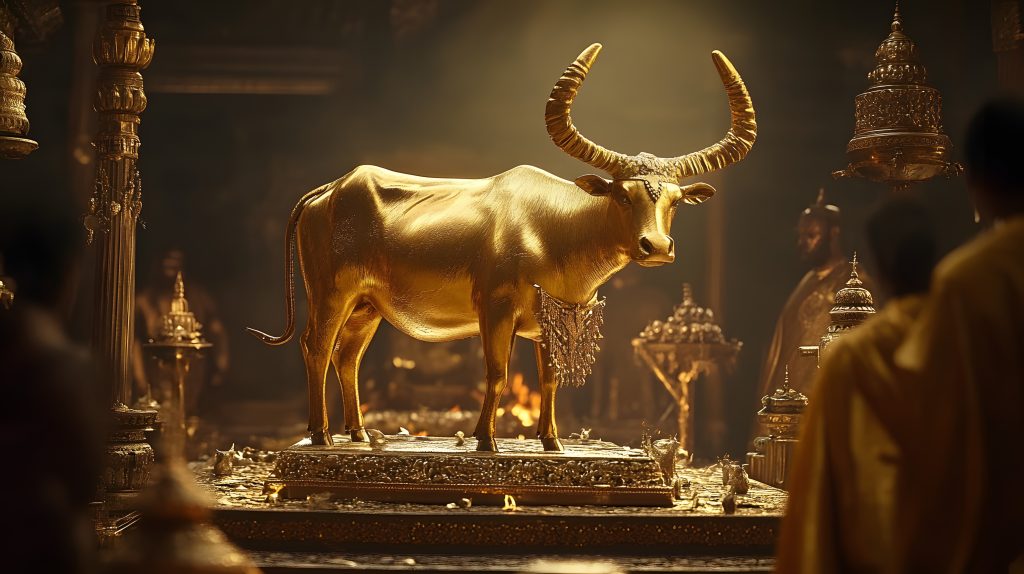
In the Old Testament, the prohibition against making idols is both to protect Israel from pagan magic and worship practices, but also to protect the idea that God is infinitely above and beyond anything that we can ever imagine. The problem with the golden calf episode (Ex. 32) was not only that the whole atmosphere was pagan and magical, but also that they made it as a depiction of YHWH who is beyond anything in nature (Ex. 32:8). It would be inappropriate in the Old Testament to make any depiction of God at all. However, in the New Testament, YHWH the Lord, the God of Israel, became incarnate in the Son, and was made man. We know that Jesus looked like a man, and the Church from earliest times depicted Him in pictures to draw our love and devotion to Jesus. The pictures and statues themselves were meant to be venerated in that they draw us to Jesus, but not worshipped or served in the sense that pagans did with their idols. Again, true worship of the Lord is all about relationship and covenant, not manipulation and magic. Shall we burn all of our children’s books with pictures of Jesus? We are not, like the Muslims, iconoclasts. As the Catechism teaches:
2131 Basing itself on the mystery of the incarnate Word, the seventh ecumenical council at Nicaea (787) justified against the iconoclasts the veneration of icons – of Christ, but also of the Mother of God, the angels, and all the saints. By becoming incarnate, the Son of God introduced a new “economy” of images.
2132 The Christian veneration of images is not contrary to the first commandment which proscribes idols. Indeed, “the honor rendered to an image passes to its prototype,” and “whoever venerates an image venerates the person portrayed in it” [St. Basil]. The honor paid to sacred images is a “respectful veneration,” not the adoration due to God alone:
Religious worship is not directed to images in themselves, considered as mere things, but under their distinctive aspect as images leading us on to God incarnate. The movement toward the image does not terminate in it as image, but tends toward that whose image it is. [St. Thomas Aquinas]
Back in my days teaching in a Baptist seminary, I loved to teach this commandment to my students. Many of them felt very comfortable with a plain cross without a corpus, and are satisfied with the argument that their Lord a risen Lord and not a crucified Lord. However, St. Paul Himself tells us that he preaches Christ crucified (I Cor. 1:23). This is indeed a mental image that is as vivid to the mind as a crucifix is to the sight. I suspect that the Protestant aversion to the crucifix springs from a gnostic tendency to spiritualize rather than confront the raw reality of the crucified Lord in the flesh.
Takeaway: We must not make for ourselves idols to worship, but since Christ became incarnate, He opened up a whole new mode of venerating Him and the saints through images.
Questions: 1) What do you think is behind the Protestant repugnance of images? 2) How would you defend the use of images in your worship of God and the veneration of saints? 3) How important is sacred art in your life and relationship with God?
Resources Used:
CCC