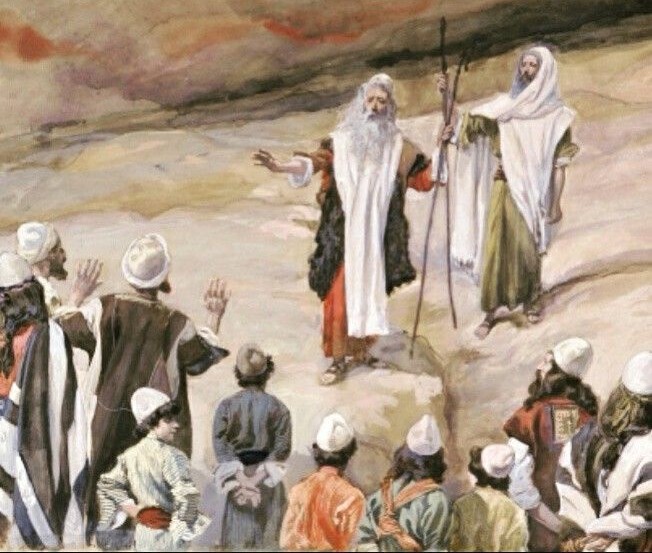
Moses listened to his father-in-law [Jethro] and did all that he had said. He picked out able men from all Israel and put them in charge of the people as commanders of thousands, of hundreds, of fifties, and of tens. They rendered decisions for the people in all routine cases. The more difficult cases they referred to Moses, but all the lesser cases they settled themselves. Exodus 18:24-26
The desert is a strange and complex place, full of surprises. One would think that all of its inhabitants would be “desert demons,” as Amalek most likely seemed to the Israelites, taking on the harsh character of their bleak environment. This is not so. Our text (Chapter 18) juxtaposes Jethro the Midianite with Amalek of the last chapter, not to associate them, but to contrast. It is through this contrast that the Book of Exodus transitions out of its first part, Israel’s redemption out of Egypt (1-17), to the great second part, of Israel before Sinai (19-24).
Jethro, Moses’ Father-in-law, is a complex character. He is said here in Exodus to be a priest of Midian, a tribe of desert people who like Amalek, roamed the wilderness. As a priest he stood as a mediator between the tribal gods and his people, a man of obvious importance. It is of interest to us that later historical material associates Jethro with the Kenites (Judges 1:16, 4:11), a tribe named after Cain their notorious ancestor, condemned to be wilderness wanderers in this world. We can never know what is behind this seeming confusion of tribes, but it is clear that Jethro is a pagan priest of the wilderness, and that, contrary to the old legends of the Jews, never converted to YHWH. Nevertheless, he was intimate with Moses as both a helpful counselor and family relation.
Jethro is not at all like Amalek. He provides a wife and a home for Moses at the beginning of the first section before the great conflict with Pharaoh in an idyllic familial scene (2:15-22). Now we find them eating bread together in another peaceful scene (18:12) which forms “bookends” around the fast action of the Exodus, slowing the narrative to transition into the great covenant episode (Childs). Amalek “came and fought Israel” (17:8) while Jethro “came” and sought Moses’ welfare (šālôm, 18:5, 7). Moses commands Joshua to “choose” men for war against Amalek (17:9), but Jethro commands Moses to “choose” able men for judging Israel (18:21).
Moses’ hands grew “heavy” holding his hands up (17:12) and Jethro observed that Moses’ task of judging all the people was too “heavy” (18;18, see Cassuto for other parallels). Jethro rejoices when Moses tells him all that YHWH did in Egypt (18:9), “blesses YHWH” (18:10), and acknowledges YHWH to be greater than all gods (18:11). He even worships with Moses in sacrificing to God (18:12).
But Jethro never converts. Though he sacrifices to “God,” the word used is the generic ʹElôhîm, not YHWH of the covenant, and though he recognizes YHWH as supreme over all deities, this does not mean that this pagan priest embraced the faith for himself. Indeed, the narrative ends with him parting ways with Moses and Israel, never joining the covenant community (18:27). His lot was the desert from which he came, not the Promised Land. Jethro was not at all like Amalek, but he was not a convert to YHWH either. We are not compelled to believe that Moses divorced Zipporah, but reunited with her and his two sons after separating for his task in Egypt. Jethro remained his father-in-law in parting, bonded relationally.
Jethro symbolizes, in the best way possible, the wisdom of this world and how close the covenant community draws from this wisdom and is even related to this wisdom. So Augustine:
God spoke to Moses, did he not? Yet Moses very prudently and humbly yielded to the advice of his father-in-law, foreigner though he was, with regard to governing and directing such a mighty nation. For he realized that from whatever intellect right counsel proceeded, it should be attributed not to him who conceived it but to the One who is the Truth, the immutable God.
On Christian Doctrine
At this crucial moment in Israel’s life, he was able to see what Moses, who talked with God, was not able to see. He introduces an organizational principle in Israel, that of decentralization and empowering others. Humble and wise Christians know how to gather nectar from all sorts of flowers. Yes, in the desert there are all sorts of rare and wonderful flowers; it is a strange and complex place, full of surprises. Catholics will observe, when looking at my “resources” at the bottom of these posts, that there are many references from Jewish and Christian (Protestant) sources.
Takeaway: All wisdom is God’s wisdom, and it is wise for Christians to get knowledge wherever it can be found, like Jethro the pagan priest.
Questions: Many Christians fear the acquisition of knowledge in general, let alone from non-Christian scholars and/or resources. 1) What is behind this fear stated above? 2) Give examples in Church history and from your own life where you have learned from non-Christians.
Resources Used:
Augustine, On Christian Doctrine in Prologue 7, in ACCS, vol. III, p. 94
Cassuto, U. A Commentary on the Book of Exodus, 204ff.
Childs, B. The Book of Exodus, p. 327
Ginsburg, L. The Legends of the Jews, vol. III, Jewish Publication Society, 1911, pp. 65ff.