But [Moses] said, “Oh my Lord, send, I pray, some other person.” Then the anger of the Lord kindled against Moses …” Exodus 4:13f.
As we reflect on the unfolding dialogue, it begins to dawn on us how casual the negotiation flows between mortal man and divine transcendence. As we have seen in the last post, Moses asks some good questions in “who am I,” and “who are you?” Moses’ questions are short, and YHWH’s answers are open, complete and expansive. As the negotiations move on into Chapter Four, Moses continues to ask valid questions, but we sense an increasing anxiety, even desperation, in his tone. We use the term “negotiation” because it is clear Moses is trying to negotiate himself out of what seems to be an impossible situation. Again, Moses represents the deepest part of our humanity, the spirit, where the divine Spirit touches spirit, the most holy place, which God takes very seriously, respecting our person-hood to the point where intimacy goes beyond formalities. The dialogue is “casual,” a “back and forth” conversation, but frighteningly serious.
Moses has a very practical sense, arising no doubt from his experience with the Hebrew who showed no respect for him after he killed the Egyptian (2:14). He knew the Hebrews would be a tough lot to convince that God sent him to them (4:1). Therefore, God shows him two signs for him to perform before the Hebrews. First, he is to cast his staff on the ground so that it becomes a snake. He then takes it by the tail, and it turns back into his staff (4:2-4). This is far more that a miracle. We are confident that this snake was a cobra, for the rearing cobra, called the Uraeus, adorned the royal headdress of the Pharaoh, supposedly to protect him by spiting at his enemies. What is more, it is clear that those who handle such poisonous snakes never take them by the tail, but by the back of their heads, lest they swing around and strike. The point of this sign is that Moses will be in complete control of Pharaoh, ultimately “crushing the head of the serpent” (Gen. 3:15), and Pharaoh will be able to do nothing about it. On a spiritual level, God intends for us also to be in control of the cobra that lurks in the hidden caverns of us all, bravely taking it by its tail, and turning it into a harmless stick.
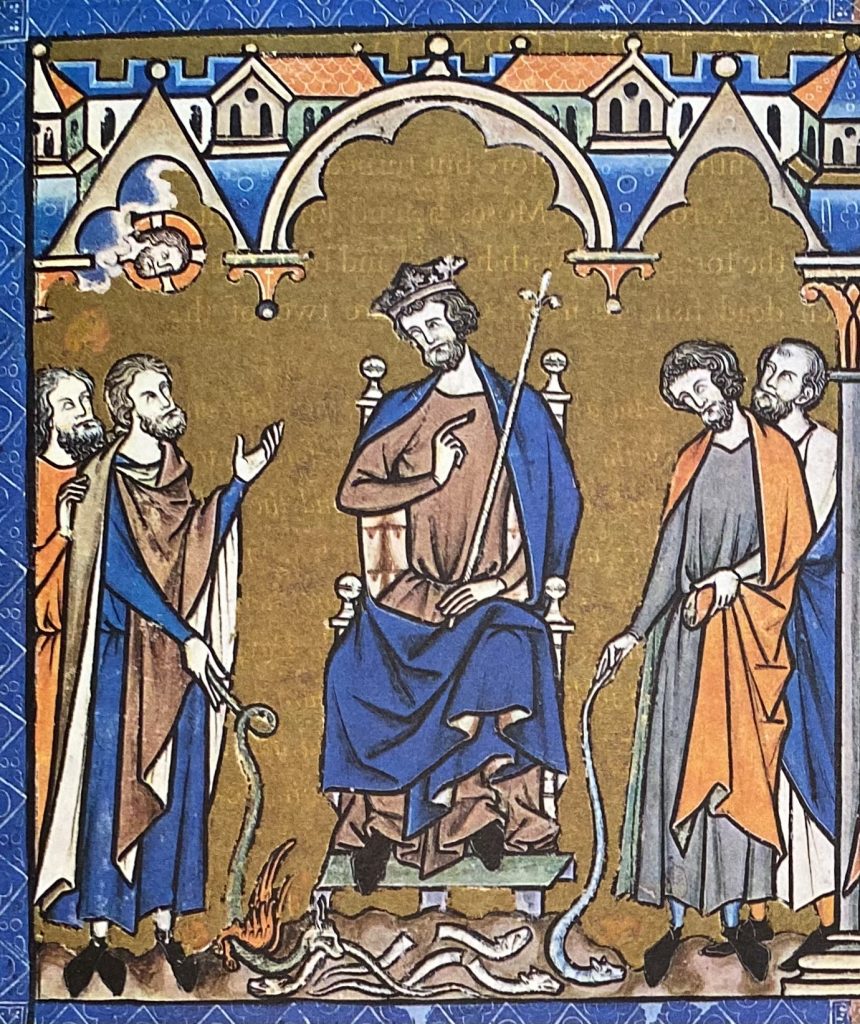
The second sign is for Moses to place his hand into his bosom, and when he pulls it out, it becomes leprous. This too is more than a mere miracle. Egypt was known for its diseases (Ex. 15: 26), especially leprosy (not leprosy as we know it [elephantiasis], but another skin disease; see post Looking like Death: Leviticus 13 below). In the Hebrew world view, moral corruption is always manifested in the physical realm by disease or natural disaster, a symbiosis which we will soon see with the coming plagues. That Moses could turn leprosy on and off with complete control shows God’s power over the terrors of Egyptian society over which Pharaoh had no power. If this did not convince the Hebrews, he was to turn Nile water into blood (4:9).
As incredible as this is, Moses seems unimpressed. He drums up an old liability he hopes will work to get him off the hook, his lack of eloquence (4:10). God, in turn, dismisses this obstacle as inconsequential, countering with a most radical statement of divine sovereignty, “Who has made man’s mouth? Who makes him mute, or deaf, or seeing or blind? Is it not I, the Lord?” Behind this boast is the wonderful fact that our weaknesses are not accidents of nature, but thoughtfully given so as to mold us into the particular person God wishes to design for His purposes. Moses is in no state of mind to appreciate such fine theological reflection and finally blurts out his real feelings which he had suppressed from the beginning of the dialogue, “Oh, my Lord, send, I pray, some other person” (4:13).
At this point YHWH’s anger flares up and ends the negotiation by installing Aaron, Moses’ brother, to be his spokesman (4:14-17). This arrangement is no accident, even though it seems to be an “off the cuff” divine response to Moses’ reticence to embrace his destiny. Actually, the narrative is developing a theology of the prophetic institution in Hebrew culture, as St. Augustine observes:
One should notice that when Moses is sent to the people, God does not say to him, “Behold, I give you as a god to the people, and your brother will be your prophet, “but he says, “[Your brother] will speak to the people for you.” For Scripture had said, “He will be your mouth, and you will be for him as God.” It did not say, “You are a god to him.” But to Pharaoh Moses is said to be given as a god, and according to analogy, Aaron is a prophet of Moses, but to Pharaoh. Here it is suggested to us that prophets of God say what they hear from him. A prophet of God is nothing but one who speaks the words of God to men – those who either cannot hear God or do not deserve to.
Questions on Exodus 17: 15
We should add here that an initial reluctance to the task is a standard prophetic motif (e.g. Amos 7, Jeremiah 1). This is because, as St. Augustine says, a prophet is “nothing” but a mouthpiece of God, yet receives the brunt of the anger and malice of the people. In spite of this, Moses, in finally answering the call, becomes “godlike” in Egypt and to the world (so Kugel), something like Joseph, who re-incarnated Osiris to the Egyptians.
As we continue in the narrative, we will see that Aaron, though overshadowed by the towering presence of his brother, is indispensable to Moses. If Moses is the spirit of the person, Aaron his brother is the will. It is through Aaron that Moses accomplishes everything. Indeed, it is through Aaron that Moses will actually take hold of the cobra’s tail.
Takeaway: Moses is deemed ready for the task of delivering Israel only when he shows no interest for the great task, and thorough understands that he in and of himself, is capable of doing nothing.
Question: Many argue themselves completely out of answering the call of God. Where are you on this score?
Sources used:
ACCS, p. 29
Kugel, J. The Bible as it Was, pp. 312ff.