“… He Remembers We Are Dust.” Ps. 103:14

It is good to take to heart the strange fact that the twelve gates of paradise are named after Jacob’s twelve sons. There are only a very few Josephs among us. As for the rest of us, not much will be all that noteworthy, at least from outward human observation. There are many in God’s family who simply do not grow very much in this life. Most of us labor, and will continue to labor, under the heavy hand of our darkness. For some reason known only to God, some of us will struggle horribly throughout our lives with the kind of vile attitudes and dark memories that Reuben, Simeon, and Levi knew; we will be glad, perhaps surprised, when one day we make it to the end. We do well to meditate deeply on divine pity and mercy.
What is of supreme importance is that we are headed in the right direction. Israel and his sons had the Land of Promise in their hearts; Canaan was home, not Egypt. Perhaps the most significant thing Israel did for his family was to demand that he be buried not in Egypt but in Canaan with his fathers. When the great man finally died, not only did his children make the trip back to the family plot at Machpelah, near Mamre, in the land of Canaan, but many of Pharaoh’s high officials did as well (Gen. 50:1-14). The Canaanites were deeply impressed, especially at the fact that the Egyptians themselves were mourning so intensely over this Hebrew. This mummy brought proud Egypt out of itself to the Promised Land, and the Canaanites within gathered around. During a brief moment in this ancient time, Israel, Egypt, and the Canaanites, a small segment of the world, experienced a little bit of heaven around Jacob’s mummy as it was placed next to his grandfather Abraham’s bones. Israel never forgot this; their destiny, and the destiny of the nations, lies in their land.
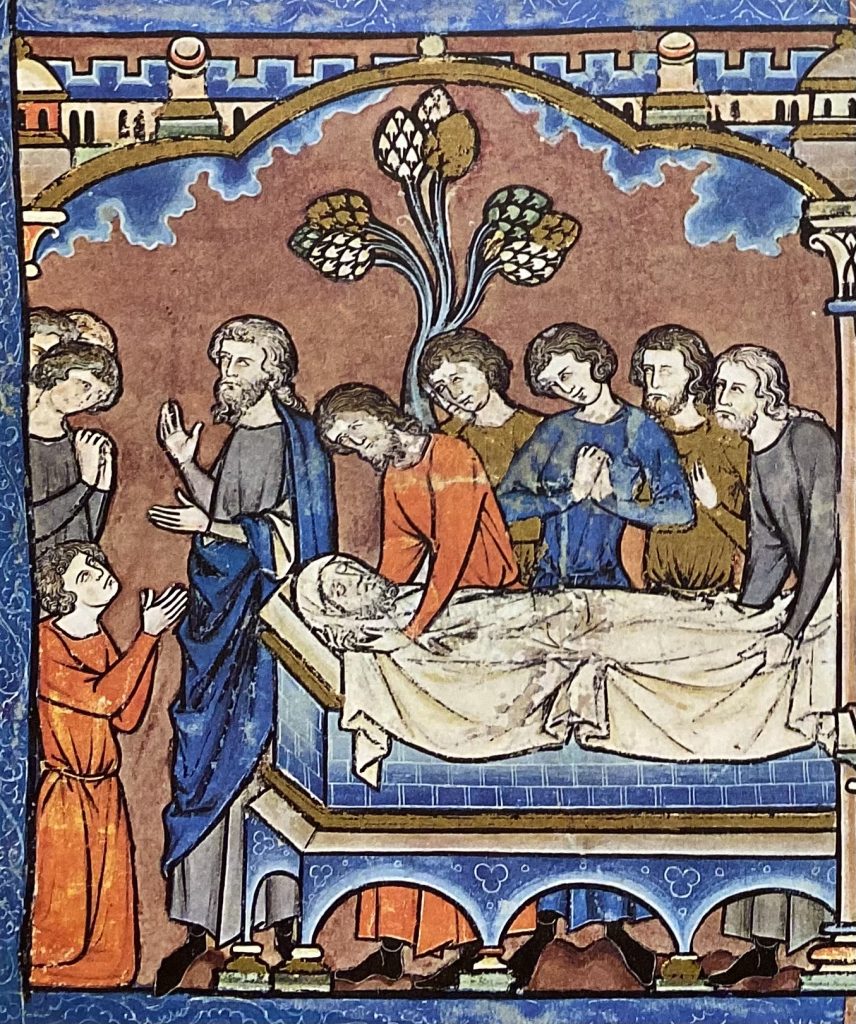
This demand for burial has eschatological implications. The Egyptians were obsessed with the afterlife, and the method and manor of embalming had everything to do with maintaining the union of body and soul after death. Priests were the physicians who did the procedure according to their magical texts. In the case of the Hebrew Jacob, the practical issue of the mourning and transferring the body to Canaan demanded embalming to preserve the body (von Rad, Westermann). For Jacob and his family, Israel’s future and any hope of the afterlife, however they understood it these early times, did not lie in Egypt with all its magic, but in Canaan, the promised land, the land that represented to them Eden. As for death, all they knew is that it was important for their bodies to lie at rest on this sacred ground, where they went to the underworld, called Sheol, there to return to their Creator for judgement. It was to these souls that Jesus, upon His death, visited the underworld to preach His Gospel, and bring salvation (I Peter 4:6, CCC 633, 634,). For the Egyptians everything had to do with magic and the scales upon which deeds were weighed. For the Hebrews, everything had to do with their relationship with their covenantal God and their faithfulness to this relationship. Though the afterlife was very vague to them, still here there might be some seeds of the hope of an afterlife with the God of their Fathers, as Ephrem the Syrian has Joseph saying,
God will indeed remember you and will bring you up to the land which he swore to Abraham . Bring my bones up there, so that even if I do not inherit the land with you, I may be raised with you from that land. Commentary of Genesis.
Jacob’s death rendered Joseph’s brothers vulnerable to his vengeance (Gen. 50:15-21). They were so terrified that they could not approach him in person, but sent a message to him, imploring his forgiveness as requested by Jacob before he died. Joseph responds in tears, anguished that this dark fear lingered so deeply in their hearts even after all the years where he proved his love for them living in Egypt. Here again is a deep parallel to Jesus; Jesus came to forgive not to judge or render vengeance. Joseph understood those old evil motives that drove them to sin against him just as Jesus understood the evil that drives us to sin, and ultimately crucify Him. In both cases, the motive and plans of God override the motives and plans of men.
As for Joseph, we find that in spite of all his Egyptian ways, he was a Hebrew at heart. As we said above, he had his father and himself mummified according to custom, but he requested that the Israelites bring his bones along with them when God came to bring them out of Egypt (Gen. 50:24-26). A man of his rank would most surely have had opportunity to acquire an expensive tomb, perhaps near his Pharaoh whom he served so faithfully in life, according to all the procedures in Egyptian religious practice necessary to secure for himself eternal life. As impressive Egypt was in history and ancient Dynasties of its Pharaohs, towering Pyramids, columned towers of Karnack’s palaces and Temples, ages of learning and lore, not to mention his highly pedigreed wife Asenath, Joseph was not impressed. His heart belonged to the God of his fathers, who encountered him in his youthful dreams, and showed Himself faithful to His promises. His God was real and not a myth.
Takeaway: We have here the conclusion to the narrative which centers on the partial fulfillment of the divine promises made to Abraham; blessing, land in the form of the family cemetery plot, greatness, seed, and nations. God is the ultimate hero of the story, not the family, who are, for the most part, a lackluster bunch, like all of us.
Questions: 1) Everything in Egypt, which is symbolic of the world and all its glitz and glamour, recedes completely in the background in comparison to the patriarchs’ unshakeable orientation to the land of promise. What is your orientation in your life? 2) Is God the ultimate hero of your story? If so, explain. If not, explain this as well.
Resources Used:
Catechism of Catholic Church
Rad, von, Gerhard. Genesis
Westermann, Clause. Genesis 37-50