Now Israel loved Joseph more than any other of his children, because he was the son of his old age; and he made him a long robe with sleeves. Genesis 37:3

With chapter 37 the narrative shifts to what is called the “Joseph Cycle” of stories, the longest sustained narrative in Genesis. Its literary genius and spiritual depth is unrivaled, not only providing the on-going history of the Patriarchal family, but offering an engaging theological treatise in narrative form. The introductory statement, “This is the history of Jacob” is of interest to us. The Hebrew is ′ēlleh tōledōt literally translated “These are the generations of…” The root of the word tōledōt means to give birth, and therefore translated “generations of” in the older Bibles, and “history of” in the newer versions. This phrase occurs at various transition points in Genesis, but interesting enough, it first occurs in Genesis 2:4 in reference to the creation of the heavens and the earth, which God “generated.” The very idea of human generation is seen as a continuation of the creative act of God in the beginning.
This part of “generating” begins with Joseph, a lad of 17 years of age, the firstborn of Joseph’s favorite wife Rachel, but overall the 5th born behind Leah’s first four boys, Reuben, Simeon, Levi, and Judah. Herein is the problem that weaves its way throughout the whole narrative – who will emerge as the “first-born?” The fact that Jacob made a “long robe with sleeves” (Heb. ketōnet passim, meaning obscure) for Joseph, perhaps a luxury garment of some sort, demonstrates Jacob’s favoritism, but maybe with priestly implications which belong by right to the firstborn.
Be this as it may, Joseph was a dreamer. Nowadays such a statement would not draw that much attention for “dreamers” are not taken seriously. Not so in olden times. Those who had dreams were understood to have contact with the supernatural realm and thus insight into the future (Cf. Genesis 15:12, Job 4:12-16, 33:14-18). Perhaps another reason Jacob had that special priestly coat made for Joseph, apart from his favoritism, was that he recognized his supernatural powers. Surely his brothers felt this when Joseph told them his dreams and decided to rid themselves of him so that the dreams would never be fulfilled. This was risky business for they knowingly were attempting to alter the plans of God (von Rad).
Joseph’s dreams were more than just prophecy, however. They were encounters, touches with Transcendence. When someone encounters God, whatever the medium, that person is never the same again. The soul is elevated to great heights and is endowed with a wonderful sense of destiny. Moreover, encounters inherently carry with them a content of promise, as we have seen with his great-grandfather Abraham. The soul knows in its depths that God will accomplish something very specific and humanly impossible. Such was the case with Joseph; he knew in his soul of souls that his brothers, and even his parents, would bow down to him some day. What form this promise would take and for what purpose, he had no clue. He just knew it was going to happen.
There is no doubt that the narrative would lead us to believe that Joseph, due to his youth and inexperience, was “spoiled” by his father’s favoritism. We see this dynamic when we find that his brothers hated him, and when Joseph “rats” on his brothers to their father, and when he naively and rashly tells them his dreams of dominance over them. But more than this, we know that when God encounters people, especially the young, a sense of spiritual pride settles deep in the soul, going unnoticed by that person, but felt by the others around them. Spiritual pride is therefore a vice that is harder to deal with than the more obvious sins of the flesh as is the case with Joseph’s brother Judah, as we shall soon see.
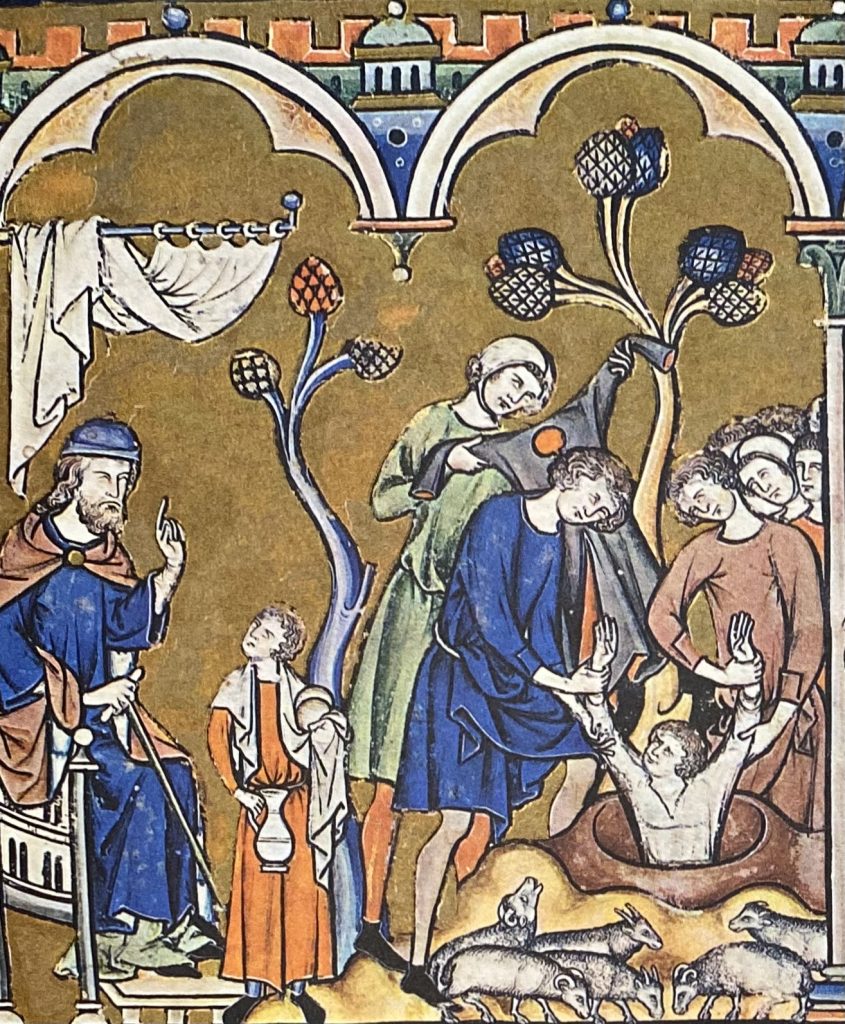
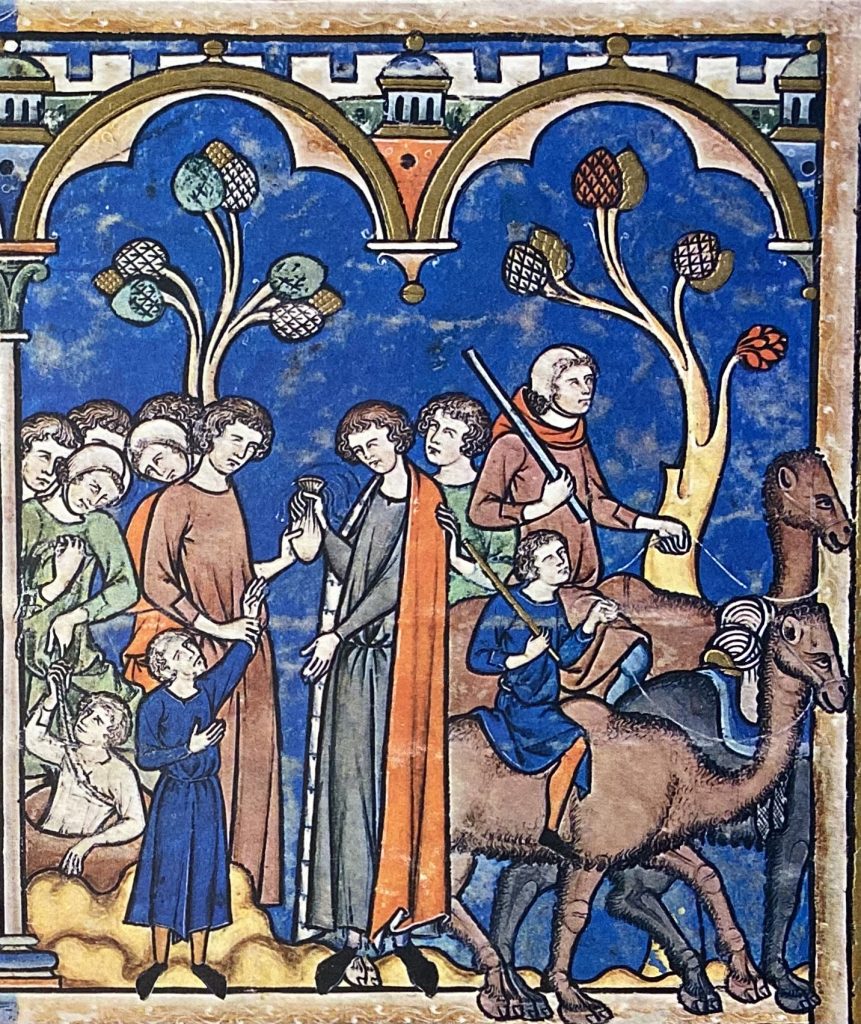
It got to the point that the brothers felt they could not live with him anymore and even plot fratricide. Given the family dynamics, we can assume that Simeon and Levi, who were known to be violent (Gen. 34:25, 49:5-7), and had the status of being second and third born, came up with the idea when they saw their unsuspecting brother approaching. Reuben the firstborn, and therefore responsible for his brothers, is seen as ineffectual because he could not save him. In the end, Judah’s idea to sell him to the Ishmaelite’s prevails. Here we see even now the beginnings of the emergence of Judah among the brothers.
Finally, St. Ambrose opens for us how Joseph in his dreams are a type of Christ and the resurrection.
Indeed, God’s grace shone on Joseph even in his boyhood. For he had a dream that when he was binding sheaves with his brothers – so it appeared to him in the vision – this sheaf rose up and stood straight, while the other sheaves of his brothers turned and bowed down to his sheaf. Now in this the resurrection of the Lord Jesus that was to come was revealed. When they saw him at Jerusalem, the eleven disciples and all the saints bowed down; when they rise, they will bow down bearing the fruits of their good works, just as it is written “Coming, they shall come with joyfulness, bearing their sheaves… For that vision indicated the King who was to come, and before him all human flesh would bow down with bended knee.”
Takeaway: In the midst of family dysfunction, God sets in motion a plan that will eventually save the family and the world.
Questions: 1) In what ways have you seen God working in the dysfunction of your family? 2) Can you detect spiritual pride in yourself or those close to you in your family? If so, how does it show itself and what are its effects in the family dynamics?
Sources Used:
St. Ambrose, On Joseph. ACCS, vol. 2, pp. 233f.
von Rad. Genesis OTL (Philadelphia: Westminster Press, 1972), p. 353.