And I will make my covenant between me and you … Genesis 17: 2
The backbone of Holy Scripture and the unifying principle that binds Genesis to Revelation is the idea of covenant. We introduced this idea of covenant showing how the Noachian covenant organically grew out of the Edenic Covenant. Now we will show how the Abrahamic organically grew out of the Edenic and the Noachian. Scott Hahn defines a covenant as a “kinship bond established by an oath.” He derives this simple definition from F.M. Cross’ important book, Kinship and Covenant.
As for a definition of covenant, [F.M.] Cross offers one of the best: “Oath and covenant is … a widespread legal means by which duties and privileges of kinship may be extended to another individual or group, including aliens.”
Scott Hahn
The Abrahamic covenant is presented in a very sophisticated and complex series of tightly related stories. The following analysis is the work of my good friend Byron Wheaton. It centers around two motifs, land and seed, and the structure reflects this. The covenant is divided into two great sections: the first beginning with 11:27 and ending in Chapter 15 largely dealing with land, and the second comprising chapters 16-22 largely dealing with seed. When we look closely at these sections we can see that each acts as a literary “panel” whose individual parts mirror each other. Wheaton organizes the structure in the following way:
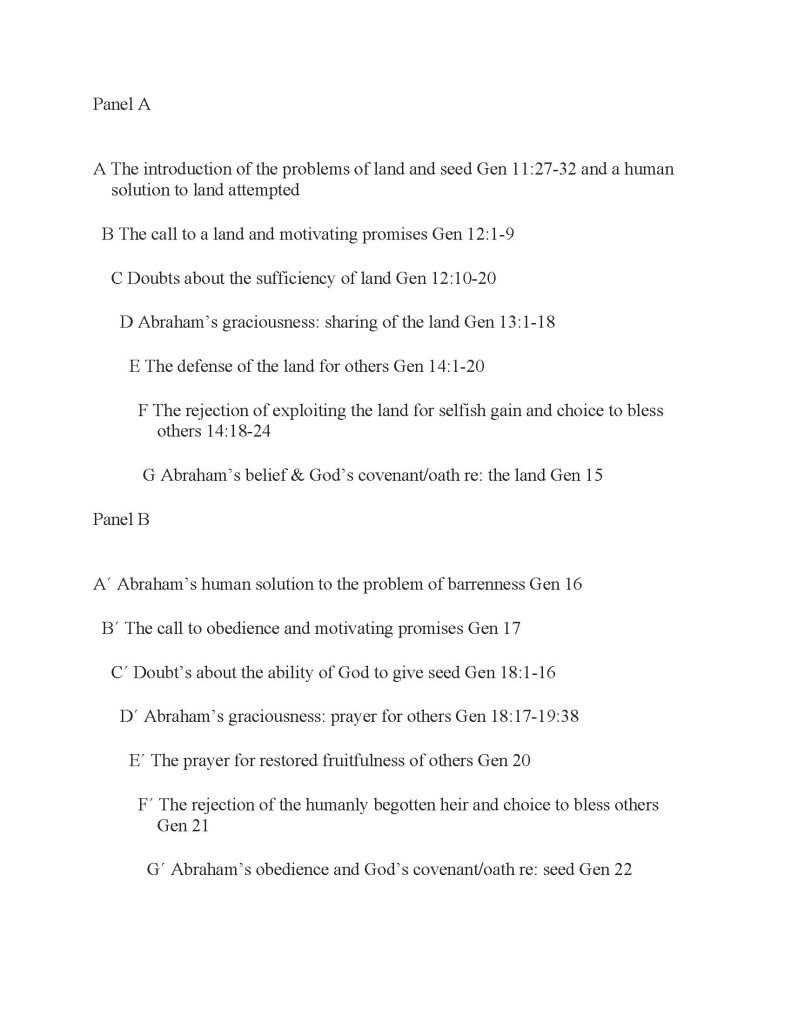
Rather than a chiastic structure, we have here a graduating step-like structure. This structure binds all the sections/stories together, and helps us see how each section fits into the whole with each panel culminating in covenant. As we work our way through the covenant, we will follow this outline and refer to it from time to time. Here it is important to note that chapters 12 and 22 are closely parallel as are chapters 15 and 17, forming the four pillars of the covenant. However, there are deep parallels between all four of these chapters, displaying the literary art and theological profundity that this structure conveys to the careful reader.
The important takeaway here is that while individuals and tribes commonly entered into covenant together, forming a kinship like bond, it is only unique to Israel that YHWH enters into a covenant with His people, forming a divine/human kinship bond. Such a thing never happened between the pagan gods and the peoples who serve them, for the gods have little to no interest in mortals.
Resources Used:
Hann, Scott. Kinship by Covenant. New Haven: Yale University Press, 2009, above quotes on pp. 28, 333. This book is fundamental to all the rest of this Blog.
Wheaton, Byron. Focus and Structure in the Abrahamic Narratives in Trinj 27NS (2006) 143-162.